

Introduction
Today, in this article let's play around with one of the interesting and most useful concepts in SharePoint 2010.
Question: What is Navigation Heading?
In simple terms "Creates a navigation heading for the top-level site, where it can be linked with an URL such that anybody who wishes to click on it will be navigated to the specific page".
Step 1: Open SharePoint 2010 Central Administration and navigate to a specific site.
Step 2: Open up Visual Studio 2012 and try to select "SharePoint Visual Web Part" project, as in:
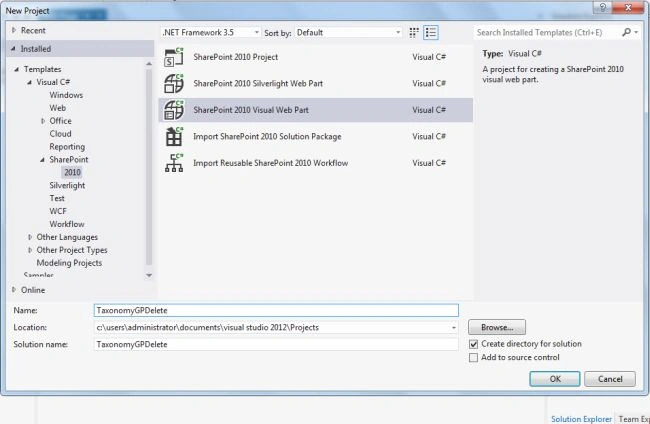
Step 3: Select "Deploy as a farm solution" as in the following and click on next the "Finish" button, as in the following:

Step 4: The complete code of visualwebpart1usercontrol.ascx looks like this:
<%@ Assembly Name="$SharePoint.Project.AssemblyFullName$" %>
<%@ Assembly Name="Microsoft.Web.CommandUI, Version=14.0.0.0, Culture=neutral, PublicKeyToken=71e9bce111e9429c" %>
<%@ Register TagPrefix="SharePoint" Namespace="Microsoft.SharePoint.WebControls"
Assembly="Microsoft.SharePoint, Version=14.0.0.0, Culture=neutral, PublicKeyToken=71e9bce111e9429c" %>
<%@ Register TagPrefix="Utilities" Namespace="Microsoft.SharePoint.Utilities" Assembly="Microsoft.SharePoint, Version=14.0.0.0, Culture=neutral, PublicKeyToken=71e9bce111e9429c" %>
<%@ Register TagPrefix="asp" Namespace="System.Web.UI" Assembly="System.Web.Extensions, Version=3.5.0.0, Culture=neutral, PublicKeyToken=31bf3856ad364e35" %>
<%@ Import Namespace="Microsoft.SharePoint" %>
<%@ Register TagPrefix="WebPartPages" Namespace="Microsoft.SharePoint.WebPartPages"
Assembly="Microsoft.SharePoint, Version=14.0.0.0, Culture=neutral, PublicKeyToken=71e9bce111e9429c" %>
<%@ Control Language="C#" AutoEventWireup="true" CodeBehind="VisualWebPart1.ascx.cs"
Inherits="SPNavigationApp.VisualWebPart1.VisualWebPart1" %>
<center>
<div>
<table style="text-align: center">
<tr>
<td colspan="2">
<asp:label id="Label1" runat="server" text="Navigation Heading Text Creation - SharePoint 2010 Programatically"
font-bold="true" font-size="Large" font-names="Verdana" forecolor="Maroon"></asp:label>
</td>
</tr>
<tr>
<td>
<asp:label id="Label2" runat="server" text="Please Enter Heading Name" font-size="Large"
font-names="Verdana" font-italic="true"></asp:label>
</td>
<td>
<asp:textbox id="TextBox1" runat="server"></asp:textbox>
</td>
</tr>
<tr>
<td>
<asp:label id="Label3" runat="server" text="Please Enter Heading URL" font-size="Large"
font-names="Verdana" font-italic="true"></asp:label>
</td>
<td>
<asp:textbox id="TextBox2" runat="server"></asp:textbox>
</td>
</tr>
<tr>
<td colspan="2">
<asp:button id="Button1" runat="server" text="Create Heading" font-names="Verdana"
width="174px" backcolor="Orange" font-bold="True" onclick="Button1_Click" />
</td>
</tr>
<tr>
<td colspan="2">
<asp:label id="Label5" runat="server" font-bold="true" font-names="Verdana"></asp:label>
</td>
</tr>
</table>
</div>
</center>
Step 5: The complete code of visualwebpart1usercontrol.ascx.cs looks like this:
using Microsoft.SharePoint;
using Microsoft.SharePoint.Navigation;
using System;
using System.ComponentModel;
using System.Web.UI.WebControls.WebParts;namespace SPNavigationApp.VisualWebPart1
{
[ToolboxItemAttribute(false)]
public partial class VisualWebPart1 : WebPart
{
// Uncomment the following SecurityPermission attribute only when doing Performance Profiling using
// the Instrumentation method, and then remove the SecurityPermission attribute when the code is ready
// for production. Because the SecurityPermission attribute bypasses the security check for callers of
// your constructor, it's not recommended for production purposes.
// [System.Security.Permissions.SecurityPermission(System.Security.Permissions.SecurityAction.Assert, UnmanagedCode = true)]
public VisualWebPart1(){}protected override void OnInit(EventArgs e)
{
base.OnInit(e);InitializeControl();
}
protected void Page_Load(object sender, EventArgs e)
{
TextBox1.Focus();
}
protected void Button1_Click(object sender, EventArgs e)
{
if (string.IsNullOrEmpty(TextBox1.Text) || string.IsNullOrEmpty(TextBox2.Text))
{
Label5.Text = "Please Enter Some Values";
Label5.ForeColor = System.Drawing.Color.Red;
}
else{try{SPSite site = new SPSite("http://win-5c3g1lanj3k:46908/");
SPWeb web = SPContext.Current.Web;
SPNavigationNodeCollection navigationNode = web.Navigation.TopNavigationBar;
SPNavigationNode mainHeading = new SPNavigationNode(TextBox1.Text, TextBox2.Text, true);
navigationNode.AddAsLast(mainHeading);
Label5.Text = TextBox1.Text + " Heading is Successfully Created !";
Label5.ForeColor = System.Drawing.Color.Green;
TextBox1.Text = string.Empty;
TextBox2.Text = string.Empty;
}
catch (SPException exception)
{
Label5.Text = exception.Message;
}
}
}
}
}
Step 6: Deploy the solution file and add the new webpart to a SharePoint site.
Step 7: The output of the application looks like this:

Step 8: Data entering output of the application looks like this:

Step 9: Navigation heading created output of the application looks like this:

I hope this article is useful for you.
Join the conversation! Your thoughts help the community grow.