Blue Theme Orange Theme Green Theme Red Theme
 
Home | Forums | Videos | Photos | Downloads | Blogs | E-Books | Interviews | Jobs | Beginners | Training
 | Consulting  
Submit an Article Submit a Blog 
 Login Close
User Id:
Password:
 
Forgot Password
Forgot Username
Why Register
 Jump to
Skip Navigation Links
TechnologyExpand Technology
WebsiteExpand Website
 Resources  
Close
 Our Network  
Close
Search :       Advanced Search »
Home » WPF » Windows Popup Tutorial

Windows Popup Tutorial

To show a popup when the mouse is hovered over the DataGrid cell with the information of the particular row’s columns. And, to hide the popup when the mouse leaves the DataGrid’s cell.

Technologies: .NET 2.0, Windows Forms, WPF,Visual C# .NET
Total downloads : 115
Total page views :  5249
Rating :
 5/5
This article has been rated :  1 times
   Print Read/Post comments Post a comment  Rate  
   Email to a friend  Bookmark  Similar Articles  Author's other articles  
Download Files:
DataGridPopup.zip
 
Become a Sponsor


Related EbooksTop Videos


Objective: To show a popup when the mouse is hovered over the DataGrid cell with the information of the particular row's columns. And, to hide the popup when the mouse leaves the DataGrid's cell.

Output GUI:

popup1.1.gif

Many try to implement it by creating a new Form for the popup window and try to show/ hide the form.

Or, they may try creating a UserControl for the popup window.
Put the user UserControl in the Datagrid/ Form and try to display/hide it.

And, there could be many possible options.

But implementing it via all these may also lead to have other exceptional flows or others things that you may need to take care of.

Here, is a way that may not be so popular with everyone but is certainly the way which is meant for these kinds of implementation.

Here, being used is -> .NET Framework Class Library - Popup Class

Namespace:  System.Windows.Controls.Primitives
Assembly:  PresentationFramework (in PresentationFramework.dll)

Here, is a small, basic and self explanatory solution for that.

Application Structure:->

popup2.gif

Additional References needed:

PresentationFramework.dll
PresentationCore.dll
WindowsBase.dll


Additional Namespace(s) required:

using System.Windows.Controls.Primitives;
using System.Windows.Controls;

Files:

  1. Form File(Form1)
  2. Class File (DataSourceDatagrid.cs)

File: Form1.cs[Design]
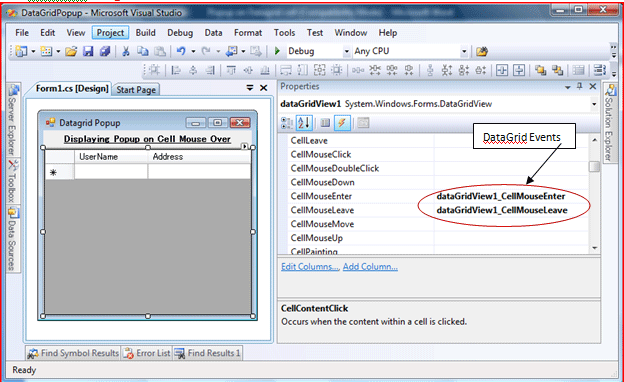
popup3.gif

File: Form1.cs ->

using System;
using System.Collections;
using System.Collections.Generic;
using System.ComponentModel;
using System.Data;
using System.Drawing;
using System.Linq;
using System.Text;
using System.Windows.Forms;

using System.Windows.Controls.Primitives;
using System.Windows.Controls;

namespace DataGridPopup
{
    public partial class Form1 : Form
    {

//Members for Popup declared here so that only one instance is managed for the popup //at a time.
        Popup codePopup = new Popup();
        TextBlock popupText = new TextBlock();

        public Form1()
        {
            InitializeComponent();
        }

        private void Form1_Load(object sender, EventArgs e)
        {
            ArrayList arrSrc = new ArrayList();

             try
            {
//Binding Datagrid with data:
                arrSrc.Add(new DataSourceDatagrid("SAN", "Pune"));
                arrSrc.Add(new DataSourceDatagrid("Dipak", "Mumbai"));
                arrSrc.Add(new DataSourceDatagrid("Kiran", "Delhi"));
                arrSrc.Add(new DataSourceDatagrid("SAN1", "Pune1"));
                arrSrc.Add(new DataSourceDatagrid("Dipak1", "Mumbai1"));
                arrSrc.Add(new DataSourceDatagrid("Kiran1", "Delhi1"));
                arrSrc.Add(new DataSourceDatagrid("SAN2", "Pune2"));
                arrSrc.Add(new DataSourceDatagrid("Dipak2", "Mumbai2"));
                arrSrc.Add(new DataSourceDatagrid("Kiran2", "Delhi2"));

                dataGridView1.DataSource = arrSrc;
            }
            catch (Exception ex)
            {
                ex = new Exception("Error occurred while binding the datasource to datagrid.  
                                     "
+ ex.Message);

                throw ex;
            }
        }


        private void dataGridView1_CellMouseEnter(object sender, DataGridViewCellEventArgs e)
        {
            try
            {

//Additional Check: to see if there is a valid row-column cell for the datagrid on each mouse over event:
                if (e.RowIndex >= 0 && e.RowIndex < dataGridView1.RowCount
                    && e.ColumnIndex >= 0 && e.ColumnIndex < dataGridView1.ColumnCount)
                {
                    codePopup.Visibility = System.Windows.Visibility.Hidden;
                    codePopup.IsOpen = false;
                    popupText.Text = "Information: "
                                    + System.Environment.NewLine
                                    + "Name: " + dataGridView1[0, e.RowIndex].Value.ToString()
                                    + System.Environment.NewLine
                                    + "Address: " + dataGridView1[1, e.RowIndex].Value.ToString();
                    popupText.Background = System.Windows.Media.Brushes.LightBlue;
                    popupText.Foreground = System.Windows.Media.Brushes.Blue;
                    codePopup.Child = popupText;

                    codePopup.Placement = System.Windows.Controls.Primitives.PlacementMode.MousePoint;
                    codePopup.Height = 50;
                    codePopup.Width = 100;
                    codePopup.IsOpen = true;
                }
            }
            catch (Exception ex)
            {
                ex = new Exception("Error occurred while displaying the popup for datagrid cell. " +
ex.Message);
                throw ex;
            }
        }

        private void dataGridView1_CellMouseLeave(object sender, DataGridViewCellEventArgs e)
        {
            try
            {
                codePopup.IsOpen = false;
            }
            catch (Exception ex)
            {
                ex = new Exception("Error occurred while hiding the popup for datagrid cell. " +
ex.Message);

                throw ex;
            }
        }
    }
}

File: DataSourceDatagrid.cs ->

using System;
using System.Collections.Generic;
using System.Linq;
using System.Text;

namespace DataGridPopup
{
   
public class DataSourceDatagrid
    {
       
private string userName = string.Empty;
       
private string address = string.Empty;

        public string UserName
        {
           
get
            {
               
return this.userName;
            }
            
set
            {
               
this.userName = value;
            }
        }
       
public string Address
        {
           
get
            {
               
return this.address;
            }
           
set
            {
                
this.address = value;
            }
        }

        public DataSourceDatagrid(string usrName, string addr)
        {
            userName = usrName;
            address = addr;
        }
    }
}


>> And, there are so many possiblities with the Popup Class that can be played with for better and attractive GUI etc.


Login to add your contents and source code to this article
 [Top] Rate this article
 About the author
 
Abhijeet Lakra
Looking for C# Consulting?
C# Consulting is founded in 2002 by the founders of C# Corner. Unlike a traditional consulting company, our consultants are well-known experts in .NET and many of them are MVPs, authors, and trainers. We specialize in Microsoft .NET development and utilize Agile Development and Extreme Programming practices to provide fast pace quick turnaround results. Our software development model is a mix of Agile Development, traditional SDLC, and Waterfall models.
Click here to learn more about C# Consulting.
 
Introducing MaxV - one click. infinite control. Hyper-V Hosting from MaximumASP.
Finally – a virtual platform that delivers next-generation Windows Server 2008 Hyper-V virtualization technology from a managed hosting partner you can truly depend on. Visit www.maximumasp.com/max for a FREE 30 day trial. Hurry offer ends soon. Climb aboard the MaxV platform and take advantage of High Availability, Intelligent Monitoring, Recurrent Backups, and Scalability – with no hassle or hidden fees. As a managed hosting partner focused solely on Microsoft technologies since 2000, MaximumASP is uniquely qualified to provide the superior support that our business is built on. Unparalleled expertise with Microsoft technologies lead to working directly with Microsoft as first to offer IIS 7 and SQL 2008 betas in a hosted environment; partnering in the Go Live Program for Hyper-V; and product co-launches built on WS 2008 with Hyper-V technology.
Dynamic PDF
ceTE software specializes in components for dynamic PDF generation and manipulation. The DynamicPDF™ product line allows you to dynamically generate PDF documents, merge PDF documents and new content to existing PDF documents from within your applications.
Go.NET
Build custom interactive diagrams, network, workflow editors, flowcharts, or software design tools. Includes many predefined kinds of nodes, links, and basic shapes. Supports layers, scrolling, zooming, selection, drag-and-drop, clipboard, in-place editing, tooltips, grids, printing, overview window, palette. 100% implemented in C# as a managed .NET Control. Document/View/Tool architecture with many properties&events. Optional automatic layout.
Dundas Software
Dundas Chart for .NET is the most advanced .NET charting package available today.  With an extremely complete feature set, elegant architecture and easy implementation, Dundas Chart can quickly add advanced Charting functionality to enhance and transform ASP.NET and Windows Forms applications.  Whether you are implementing charting into internal projects, or building applications for clients, Dundas Chart offers advanced technology and advanced results to get the most out of data.
Clickatell's SMS Gateway
Clickatell's Developer Solutions allow you to SMS enable any website or application via a range of API's. Learn More about our API connections.
Free access to .NET Memory Management video
Everything you need to know about Garbage Collection, Temporary Objects, Fragmentation, Finalization and common causes of memory leaks in .NET. Watch the video here.
Microsoft Visual Studio 2010
Microsoft Visual Studio 2010 offers more to developers than any other Visual Studio release. Work more productively and collaboratively-with greater control over your work at every step. The Beta 2 can give you a head start on achieving efficiency.
 
   Print Read/Post comments Post a comment  Rate  
   Email to a friend  Bookmark  Similar Articles  Author's other articles  
Download Files:
DataGridPopup.zip
 
 Post a Feedback, Comment, or Question about this article
Subject:  
Comment:  
Become a Sponsor
 Comments

 Hosted by MaximumASP  |  Found a broken link?  |  Contact Us  |  Terms & conditions  |  Privacy Policy  |  Site Map  |  Suggest an Idea  |  Media Kit
Current Version: 5.2009.6.2
 © 1999 - 2009  Mindcracker LLC. All Rights Reserved