
Today I am going to explain how you can display different window styles in WPF using F#. If you want to show a different window style firstly you will create a MenuItem Object to change the window style than you will add the items (Window Styles) to the menu. Then you will add this style menu to a Dock Panel and lastly add a TextBlock to the Dock panel to show the Text in the Window. where you can set the Title, FontSize and Alignment properties for the Text.
A MenuItem
object will be created by below code.
//
This will Create the MenuItem objects to change WindowStyle
let
stylItm = new MenuItem(Header="_WindowStyle");
The below
given code will add the Items to the Menu.
//
This will Add window styles menu items
[("_Window
Without Border", WindowStyle.None);
("_Window with Single Border",WindowStyle.SingleBorderWindow);
("_Window with 3D Border",WindowStyle.ThreeDBorderWindow);
("_Window with Tool",WindowStyle.ToolWindow)]
|> Seq.iter (fun (str,style)
->
let cmpnt =
new MenuItem(Header=str,
Tag=style,
IsChecked= (style=wndw.WindowStyle))
if cmpnt.IsChecked
then itemChecked <- cmpnt
cmpnt.Click.Add( fun _
->
itemChecked.IsChecked <- false
cmpnt.IsChecked <- true
wndw.WindowStyle <-(cmpnt.Tag :?> WindowStyle)
itemChecked <- cmpnt)
stylItm.Items.Add(cmpnt) |> ignore)
Then you
will add this style Menu to the Dock Panel with the below code.
//
This will Add Style menu to dock panel
let
nwmnu = new Menu()
nwmnu.Items.Add(stylItm)|>ignore
dck.Children.Add(nwmnu)|>ignore
DockPanel.SetDock(nwmnu, Dock.Top)
Lastly a
TextBlock will be added to the Dock Panel with the below code.
//This will Add TextBlock to DockPanel
dck.Children.Add
(new TextBlock(Text=wndw.Title,
FontSize=25.0,
TextAlignment = TextAlignment.Center)
) |> ignore
Steps For Window style
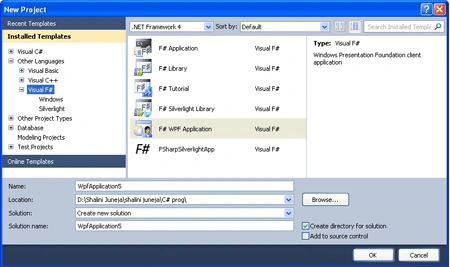
Step 1: Firstly Open a new project in F# using Visual Studio 2010. Select F# WPF application template and give name to it like below image.
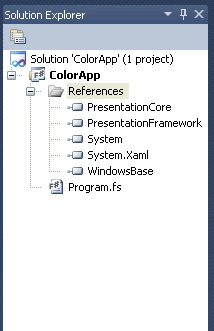
Step 2: Now add the below define references to the project by right clicking on the project in Solution Explorer.
PresentationCore
PresentationFramework
System
System.Xaml
WindowsBase
Step 3: When you have added all these references, your Solution Explorer will look like the below image.
Step 4:
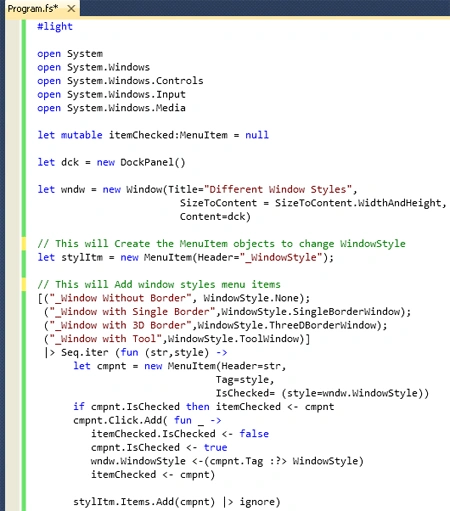
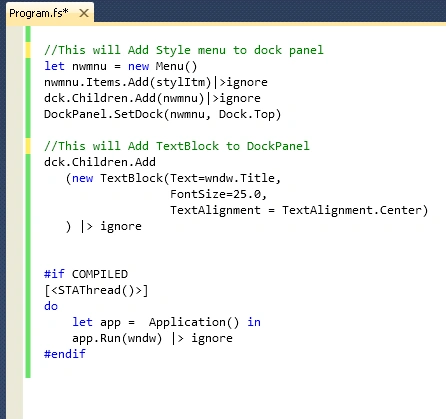
Now click on Program.fs in Solution Explorer and write the below code in the Program.fs window. Your window will look like below.
#light
open System
open
System.Windows
open
System.Windows.Controls
open
System.Windows.Input
open
System.Windows.Media
let
mutable itemChecked:MenuItem =
null
let
dck = new DockPanel()
let
wndw = new Window(Title="Different
Window Styles",
SizeToContent = SizeToContent.WidthAndHeight,
Content=dck)
//
This will Create the MenuItem objects to change WindowStyle
let
stylItm = new MenuItem(Header="_WindowStyle");
//
This will Add window styles menu items
[("_Window
Without Border", WindowStyle.None);
("_Window with Single Border",WindowStyle.SingleBorderWindow);
("_Window with 3D Border",WindowStyle.ThreeDBorderWindow);
("_Window with Tool",WindowStyle.ToolWindow)]
|> Seq.iter (fun (str,style)
->
let cmpnt =
new MenuItem(Header=str,
Tag=style,
IsChecked= (style=wndw.WindowStyle))
if cmpnt.IsChecked
then itemChecked <- cmpnt
cmpnt.Click.Add( fun _
->
itemChecked.IsChecked <- false
cmpnt.IsChecked <- true
wndw.WindowStyle <-(cmpnt.Tag :?> WindowStyle)
itemChecked <- cmpnt)
stylItm.Items.Add(cmpnt) |> ignore)
//
This will Add Style menu to dock panel
let
nwmnu = new Menu()
nwmnu.Items.Add(stylItm)|>ignore
dck.Children.Add(nwmnu)|>ignore
DockPanel.SetDock(nwmnu, Dock.Top)
//This will Add TextBlock to DockPanel
dck.Children.Add
(new TextBlock(Text=wndw.Title,
FontSize=25.0,
TextAlignment = TextAlignment.Center)
) |> ignore
#if
COMPILED
[<STAThread()>]
do
let app = Application()
in
app.Run(wndw) |> ignore
#endif
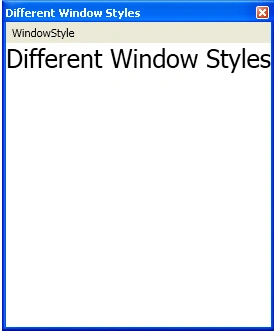
Step 5: Now press F5 to execute the Code.
Output
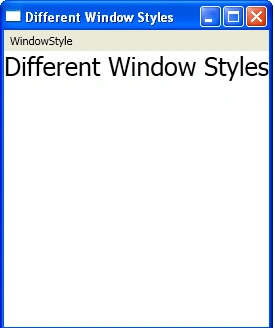
Firstly you will get the default Style of Windows which is a window with single Border.
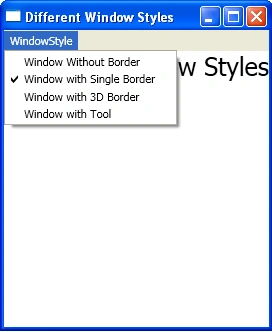
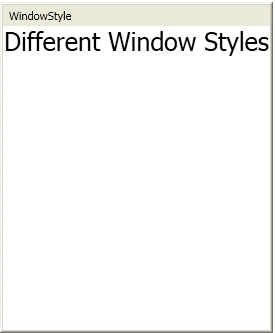
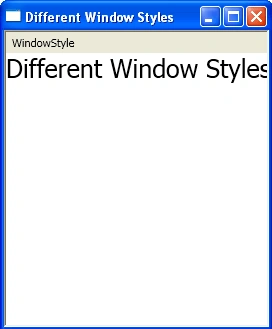
Then you will get the window without Border,3D Border and other styles as well.
Summary
In this article I have discussed how you can display different window styles in WPF using F#.
Join the conversation! Your thoughts help the community grow.