Blue Theme Orange Theme Green Theme Red Theme
 
Ads by Lake Quincy Media
Home | Forums | Videos | Photos | Downloads | Blogs | Interviews | Jobs | Beginners | Training
 | Consulting  
Submit an Article Submit a Blog 
 Login Close
User Id:
Password:
 
Forgot Password
Forgot Username
Why Register
 Jump to
Skip Navigation Links
TechnologyExpand Technology
WebsiteExpand Website
 Resources  
Close
 Our Network  
Close
Search :       Advanced Search »
Home » ASP.NET & Web Forms » LinqDataSource Control in ASP.NET 3.5

LinqDataSource Control in ASP.NET 3.5

This article shows that how to use LindDataSource Control in ASP.NET 3.5.

Author Rank:
Total page views :  4723
Total downloads :  174
   Print Read/Post comments Post a comment  Similar Articles  
   Email to a friend  Bookmark  Author's other articles  
Download Files:
LinqDataSource.zip | LinqDataSource.zip
 
Become a Sponsor


INTRODUCTION

In this article I will show you how to Select, Insert, Update, Delete data using LinqDataSource control. Language-Integrated Query (LINQ) is a query syntax that defines a set of query operators that enable traversal, filter, and projection operations to be expressed in a declarative way in any .NET-based programming language. The data object can be an in-memory data collection or an object that represents data from a database. You can retrieve or modify the data without having to write SQL commands for each operation.

The LinqDataSource control enables you to use LINQ in an ASP.NET Web page by setting properties in markup text. The LinqDataSource control uses LINQ to SQL to automatically generate the data commands.

<
asp:LinqDataSource
ID="LinqDataSource1" runat="server"
            ContextTypeName="DataClassesDataContext"
            Select="new (VendorId, VendorFName, VendorLName, VendorCity,
 VendorState, VendorCountry, PostedDate, VendorDescription)"

            TableName="Vendors"
>

        </asp:LinqDataSource>

First of all make a new website using ASP.NET and connect your database using Server Explorer.
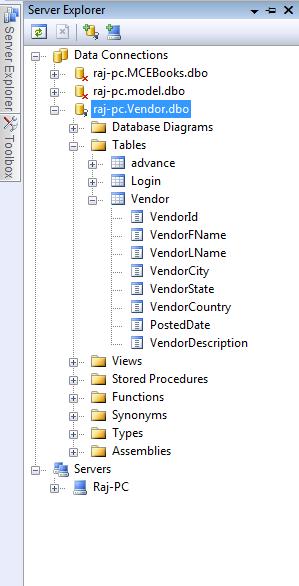
Image1.jpg

Figure1.

Now drag and drop LinqDataSource and GridView control from toolbox.
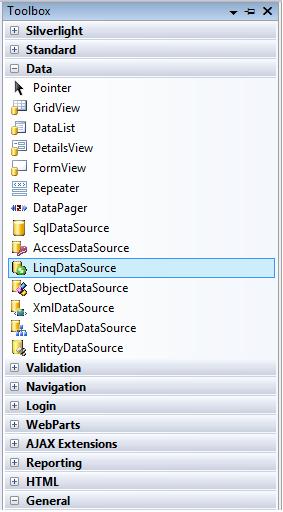
Image2.jpg

Figure2.

Now add a LINQ to SQL class in solution explorer.
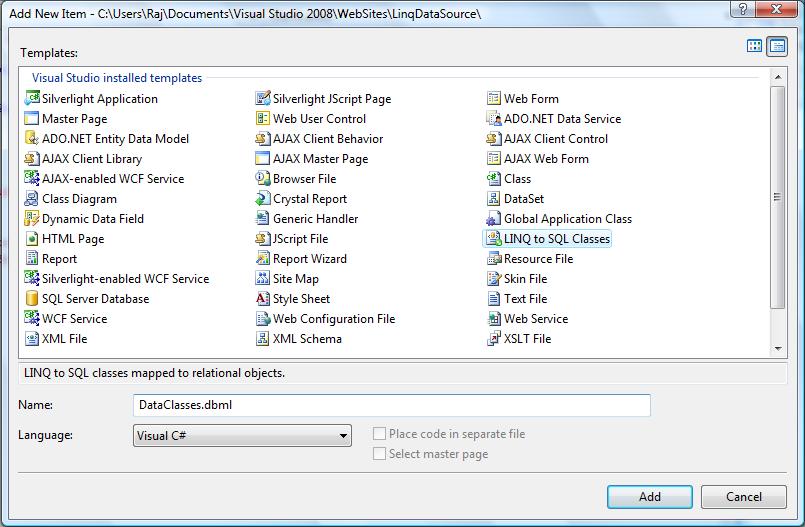
Image3.jpg

Figure3.

By default it saves in App_Data folder. You can save wherever you want.
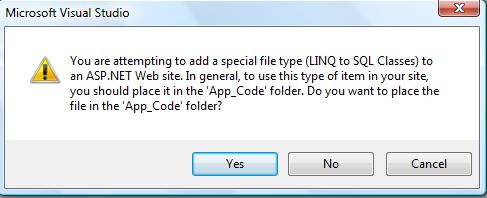
Image4.jpg

Figure4.

Now drag and drop you table from Server Explorer to DataClass.
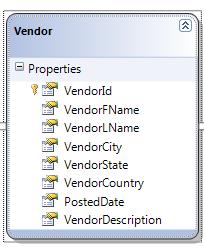
Image5.jpg

Figure5.

Now time to configure LinqDataSource.

Image6.jpg

Figure6.

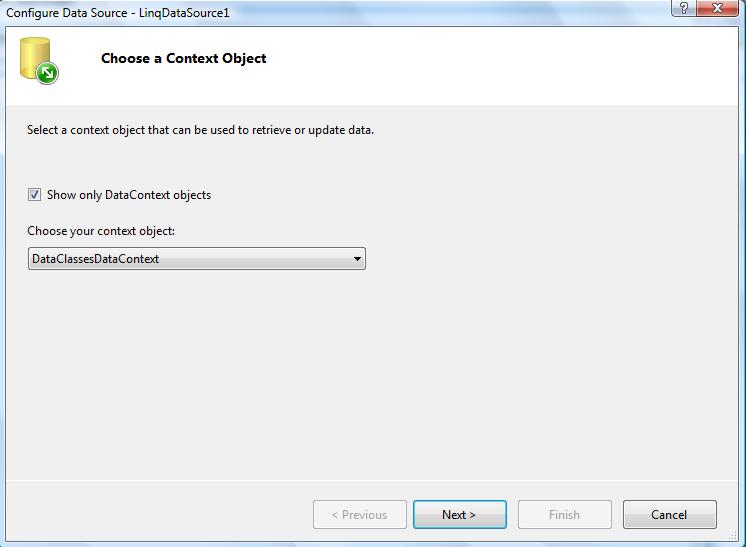
Choose a context object.

Image7.jpg

Figure7.

Select tables, columns whatever you want show.
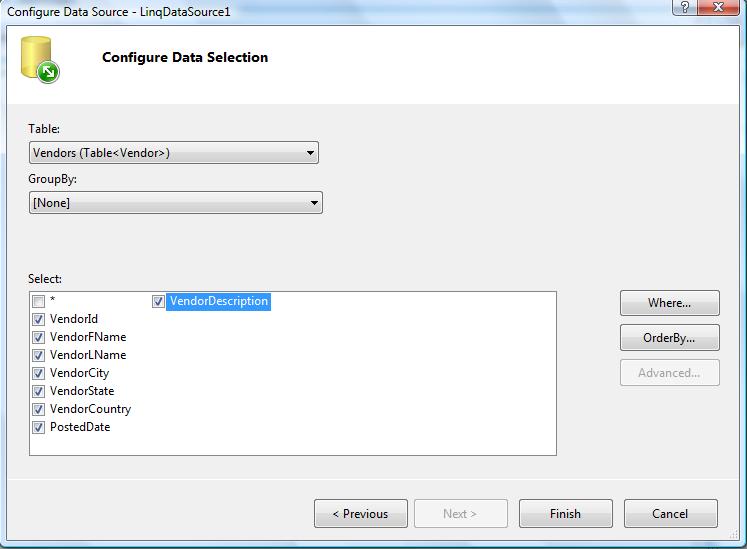
Image8.jpg

Figure8.

Put GridView DataSourceID = LinqDataSourceID
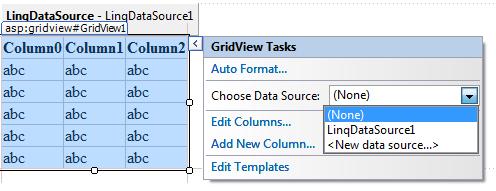
Image9.jpg

Figure9.

Here is my page code for showing data in grid view.
Select Data

<h2>Select Data Using LinqDataSource</h2>
        <asp:LinqDataSource ID="LinqDataSource1" runat="server"
            ContextTypeName="DataClassesDataContext"
            Select="new (VendorId, VendorFName, VendorLName, VendorCity, VendorState, VendorCountry, PostedDate, VendorDescription)"
            TableName="Vendors"
            EnableDelete="true"
            EnableInsert="true"
            EnableUpdate="true">  
        </asp:LinqDataSource>       

        <asp:GridView ID="GridView1" runat="server" AllowPaging="True"
            AutoGenerateColumns="False" BackColor="LightGoldenrodYellow" BorderColor="Tan"
            BorderWidth="1px" CellPadding="2" DataSourceID="LinqDataSource1"
            ForeColor="Black" GridLines="None" AutoGenerateSelectButton="True"
            DataKeyNames="VendorId">
            <Columns>
                <asp:BoundField DataField="VendorId" HeaderText="VendorId" ReadOnly="True"
                    SortExpression="VendorId" />
                <asp:BoundField DataField="VendorFName" HeaderText="VendorFName"
                    ReadOnly="True" SortExpression="VendorFName" />
                <asp:BoundField DataField="VendorLName" HeaderText="VendorLName"
                    ReadOnly="True" SortExpression="VendorLName" />
                <asp:BoundField DataField="VendorCity" HeaderText="VendorCity" ReadOnly="True"
                    SortExpression="VendorCity" />
                <asp:BoundField DataField="VendorState" HeaderText="VendorState"
                    ReadOnly="True" SortExpression="VendorState" />
                <asp:BoundField DataField="VendorCountry" HeaderText="VendorCountry"
                    ReadOnly="True" SortExpression="VendorCountry" />
                <asp:BoundField DataField="PostedDate" HeaderText="PostedDate" ReadOnly="True"
                    SortExpression="PostedDate" />
                <asp:BoundField DataField="VendorDescription" HeaderText="VendorDescription"
                    ReadOnly="True" SortExpression="VendorDescription" />
            </Columns>
            <FooterStyle BackColor="Tan" />
            <PagerStyle BackColor="PaleGoldenrod" ForeColor="DarkSlateBlue"
                HorizontalAlign="Center" />
            <SelectedRowStyle BackColor="DarkSlateBlue" ForeColor="GhostWhite" /
            <HeaderStyle BackColor="Tan" Font-Bold="True" />
            <AlternatingRowStyle BackColor="PaleGoldenrod" />
        </asp:GridView>

Output
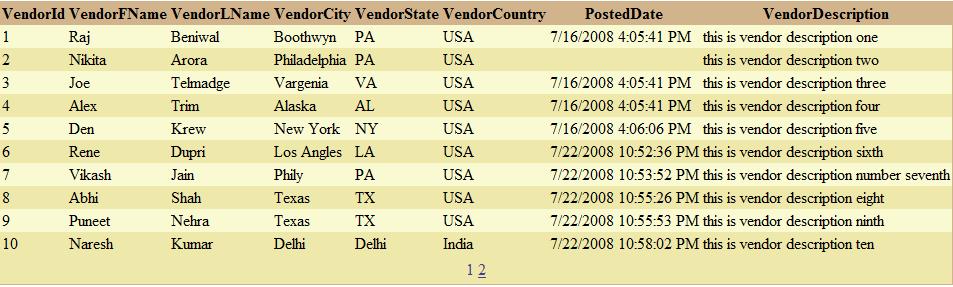

Image10.jpg

Figure10.

Insert, Update, Delete.

With the LinqDataSource control, you can create Web pages that enable users to update, insert, and delete data. You do not have to specify SQL commands, because the LinqDataSource control uses dynamically created commands for those operations. To let users modify data, you can enable update, insert, or delete operations on the LinqDataSource control. You can then connect the control to a data-bound control that lets users update data, such as the DetailsView or GridView control. If you want to customize the values to be updated, you can add parameters or create an event handler and change values dynamically.

<asp:LinqDataSource ID="LinqDataSource2"
        runat="server"
        ContextTypeName="DataClassesDataContext"
        TableName="Vendors"
        EnableDelete="true"
        EnableInsert="true"
        EnableUpdate="true">
    </asp:LinqDataSource>
<asp:DetailsView AutoGenerateRows="false" DataSourceID="LinqDataSource2" DataKeyNames="VendorId"
        ID="DetailsView1" runat="server" CellPadding="4"
        ForeColor="#333333" GridLines="None" Height="50px" Width="125px"
        AllowPaging="True" AutoGenerateDeleteButton="True"
        AutoGenerateEditButton="True" AutoGenerateInsertButton="True">
        <FooterStyle BackColor="#5D7B9D" Font-Bold="True" ForeColor="White" />
        <CommandRowStyle BackColor="#E2DED6" Font-Bold="True" />
        <RowStyle BackColor="#F7F6F3" ForeColor="#333333" />
        <FieldHeaderStyle BackColor="#E9ECF1" Font-Bold="True" />
        <PagerStyle BackColor="#284775" ForeColor="White" HorizontalAlign="Center" />
        <Fields>
            <asp:BoundField DataField="VendorId" HeaderText="VendorId"
                InsertVisible="False" ReadOnly="True" SortExpression="VendorId" />\
            <asp:BoundField DataField="VendorFName" HeaderText="VendorFName"
                SortExpression="VendorFName" />
            <asp:BoundField DataField="VendorLName" HeaderText="VendorLName"
                SortExpression="VendorLName" />
            <asp:BoundField DataField="VendorCity" HeaderText="VendorCity"
                SortExpression="VendorCity" />
            <asp:BoundField DataField="VendorState" HeaderText="VendorState"
                SortExpression="VendorState" />
            <asp:BoundField DataField="VendorCountry" HeaderText="VendorCountry"
                SortExpression="VendorCountry" />
            <asp:BoundField DataField="PostedDate" HeaderText="PostedDate"
                SortExpression="PostedDate" />
            <asp:BoundField DataField="VendorDescription" HeaderText="VendorDescription"
                SortExpression="VendorDescription" />
        </Fields>
        <HeaderStyle BackColor="#5D7B9D" Font-Bold="True" ForeColor="White" />
        <EditRowStyle BackColor="#999999" />
        <AlternatingRowStyle BackColor="White" ForeColor="#284775" />
    </asp:DetailsView>

Output:
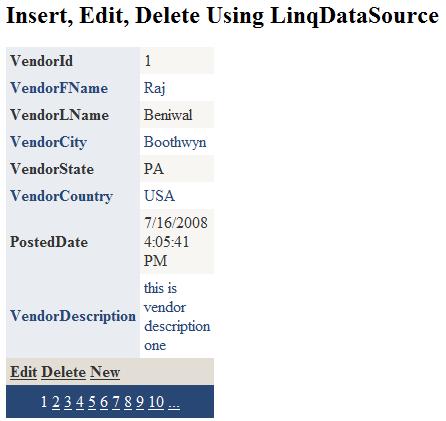
Image11.jpg
Figure11.

When you click on Edit link button.
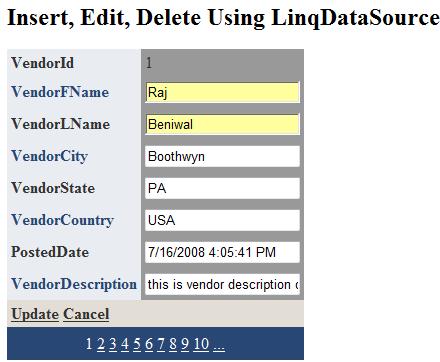
Image12.jpg

Figure12.

When you click on Insert link, looks like this
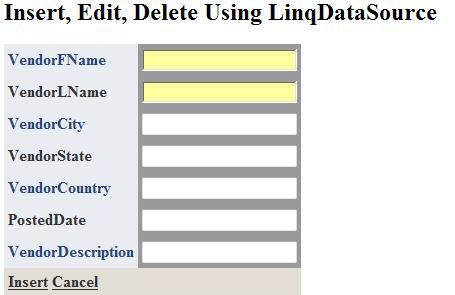
Image13.jpg
Figure13.

This is it for now


Login to add your contents and source code to this article
 About the author
 
Raj Kumar
Rajkumar is working as a senior software engineer has over 5 years experience working on ASP.NET, VB.NET, C#, AJAX and other latest technologies. He holds Master's degree in Computer Science. currently enjoying working on WPF, WCF, Silverlight, MVC, XAML.I can be reached on at raj2511984 at yahoo.com
Looking for C# Consulting?
C# Consulting is founded in 2002 by the founders of C# Corner. Unlike a traditional consulting company, our consultants are well-known experts in .NET and many of them are MVPs, authors, and trainers. We specialize in Microsoft .NET development and utilize Agile Development and Extreme Programming practices to provide fast pace quick turnaround results. Our software development model is a mix of Agile Development, traditional SDLC, and Waterfall models.
Click here to learn more about C# Consulting.
 
Introducing MaxV - one click. infinite control. Hyper-V Hosting from MaximumASP.
Finally – a virtual platform that delivers next-generation Windows Server 2008 Hyper-V virtualization technology from a managed hosting partner you can truly depend on. Visit www.maximumasp.com/max for a FREE 30 day trial. Hurry offer ends soon. Climb aboard the MaxV platform and take advantage of High Availability, Intelligent Monitoring, Recurrent Backups, and Scalability – with no hassle or hidden fees. As a managed hosting partner focused solely on Microsoft technologies since 2000, MaximumASP is uniquely qualified to provide the superior support that our business is built on. Unparalleled expertise with Microsoft technologies lead to working directly with Microsoft as first to offer IIS 7 and SQL 2008 betas in a hosted environment; partnering in the Go Live Program for Hyper-V; and product co-launches built on WS 2008 with Hyper-V technology.
Dynamic PDF
ceTE software specializes in components for dynamic PDF generation and manipulation. The DynamicPDF™ product line allows you to dynamically generate PDF documents, merge PDF documents and new content to existing PDF documents from within your applications.
Go.NET
Build custom interactive diagrams, network, workflow editors, flowcharts, or software design tools. Includes many predefined kinds of nodes, links, and basic shapes. Supports layers, scrolling, zooming, selection, drag-and-drop, clipboard, in-place editing, tooltips, grids, printing, overview window, palette. 100% implemented in C# as a managed .NET Control. Document/View/Tool architecture with many properties&events. Optional automatic layout.
Dundas Software
Dundas Chart for .NET is the most advanced .NET charting package available today.  With an extremely complete feature set, elegant architecture and easy implementation, Dundas Chart can quickly add advanced Charting functionality to enhance and transform ASP.NET and Windows Forms applications.  Whether you are implementing charting into internal projects, or building applications for clients, Dundas Chart offers advanced technology and advanced results to get the most out of data.
Clickatell's SMS Gateway
Clickatell's Developer Solutions allow you to SMS enable any website or application via a range of API's. Learn More about our API connections.
Free access to .NET Memory Management video
Everything you need to know about Garbage Collection, Temporary Objects, Fragmentation, Finalization and common causes of memory leaks in .NET. Watch the video here.
Microsoft Visual Studio 2010 Professional
Microsoft Visual Studio 2010 Professional will launch on April 12, but you can beat the rush and secure your copy today by pre-ordering at the affordable estimated retail price of $549 (US). Pre-order now.
Nevron Chart for .NET 2010.1 Now Available
The leading .NET charting control now features PDF, Flash and Silverlight export, visualization of large datasets and more. Deliver true charting functionality to your BI, Scorecard, Presentation or Scientific apps. Download evaluation now.
Developer-Ready ASP.NET 2.0 Web Hosting with 3 MONTHS FREE
Now supporting .NET 3.0 Framework with Windows Workflow Foundation, Windows Communication Foundation (WCF), Windows Presentation Foundation (WPF), windows CardSpace (WCS)! Providing more flexibility for Developers with Web Services Support and a User/Permission Manger. Also supporting MS SQL 2005/2000 with Real-Time Backups, FREE Automated Attach .MDF Tool, FREE SQL Restore and Shrink SQL DB Tools, and SQL
 
   Print Read/Post comments Post a comment  Similar Articles  
   Email to a friend  Bookmark  Author's other articles  
Download Files:
LinqDataSource.zip | LinqDataSource.zip
 
 Post a Feedback, Comment, or Question about this article
Subject:  
Comment:  
Click Here for 6 Months Free! Powerful ASP.NET Hosting at your Fingertips!
Become a Sponsor
 Comments

 Hosted by MaximumASP  |  Found a broken link?  |  Contact Us  |  Terms & conditions  |  Privacy Policy  |  Site Map  |  Suggest an Idea  |  Media Kit
Current Version: 5.2009.6.2
 © 2010  contents copyright of their authors. Rest everything copyright Mindcracker. All rights reserved.