
Introduction to .NET Architecture
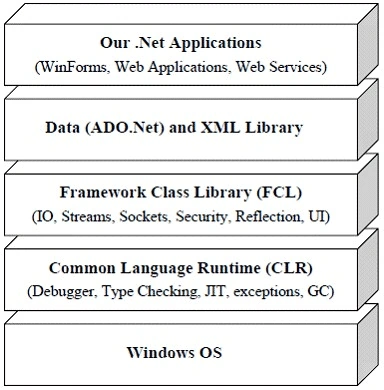
- Common Language Runtime (CLR): The heart of the .Net Framework. It is also called the .Net runtime. It resides above the operating system and handles all .Net applications. It handles garbage collection, Code Access Security (CAS), etc.
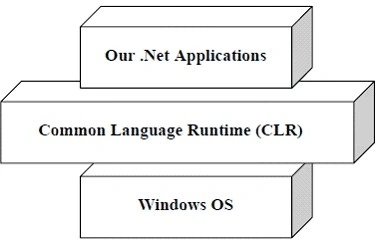
- Microsoft Intermediate Language (MSIL) Code: When we compile our .Net code then it is not directly converted to native/binary code; it is first converted into intermediate code known as MSIL code which is then interpreted by the CLR. MSIL is independent of hardware and the operating system. Cross-language relationships are possible since MSIL is the same for all .Net languages. MSIL is further converted into native code.

- Just in Time Compilers (JIT): It compiles IL code into native executable code (exe or dlls). Once the code is converted to IL then it can be called again by JIT instead of recompiling that code.
- Framework class library: The .Net Framework provides a huge class library called FCL for common tasks. It contains thousands of classes to access Windows APIs and common functions like string manipulations, Data structures, stream, IO, thread, security, etc.
- Common Language Specification (CLS): What makes a language to be .Net compliant? The answer is CLS. Microsoft has defined some specifications that each .Net language has to follow. For e.g.: no pointer, no multiple inheritances, etc.
- Common Type System (CTS): CTS defines some basic data types that IL can understand. Each. Net-compliant language should map its data types to these standard data types. This makes it possible for two. Net-compliant languages to communicate by ing/receiving parameters to and from each other. For example, CTS defines Int32 for C# int and VB integer data types.
- The .Net Framework: Is a combination of CLR, FCL, ADO.Net and XML classes, Web/Window applications, and Web services.
Sagar Pandurang KapPosted Dec 15, 2017, 6:21 AM
Very well explained..Keep posting..
Dinesh BeniwalPosted Apr 26, 2011, 12:58 AM
Welcome to the C# Corner Community.