Blue Theme Orange Theme Green Theme Red Theme
 
Team Foundation Server Hosting
Home | Forums | Videos | Advertise | Certifications | Downloads | Blogs | Interviews | Jobs | Beginners | Training
 | Consulting  
Submit an Article Submit a Blog 
 Jump to
Skip Navigation Links
TechnologyExpand Technology
WebsiteExpand Website
6 Months Free & No Setup Fees ASP.NET Hosting!
Search :       Advanced Search »
Home » Learn .NET » ASP.NET MVC Web Application using LINQ to SQL Classes

ASP.NET MVC Web Application using LINQ to SQL Classes

This article will demonstrate how to use ASP.NET MVC Web Application using LINQ to SQL Classes.

Author Rank :
Page Views : 12965
Downloads : 352
Rating :
 Rate it
Level : Beginner
   Print Read/Post comments Post a comment  Similar Articles  
   Email to a friend  Bookmark  Author's other articles  
Download Files:
MVCUsingLINQToSQL.zip
 
 
Team Foundation Server Hosting
Become a Sponsor
 Tag Cloud
 Latest Jobs
More ... 
 Latest Interview Questions
More ... 


In my previous article ASP.NET MVC Web Application using ADO.NET Entity Data Model we discussed about MVC basic introduction and how to use with ADO.NET Entity Data Model so in this article we'll see how to use with LINQ to SQL Classes.


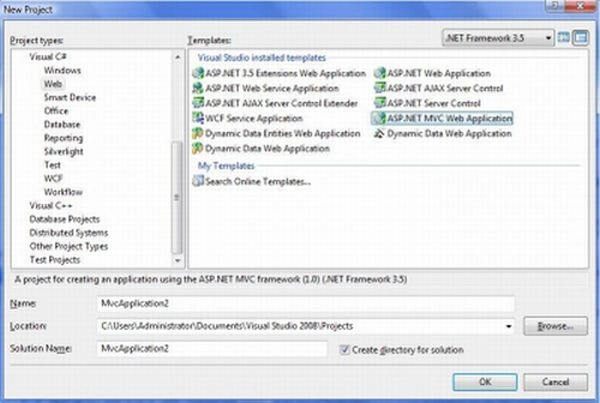
Get Started - After installing MVC framework SDK you will see a new template in installed visual studio templates 'ASP.NET MVC Web Application'.

Create a new project using ASP.NET MVC Web Application :

Figure1.

1.jpg

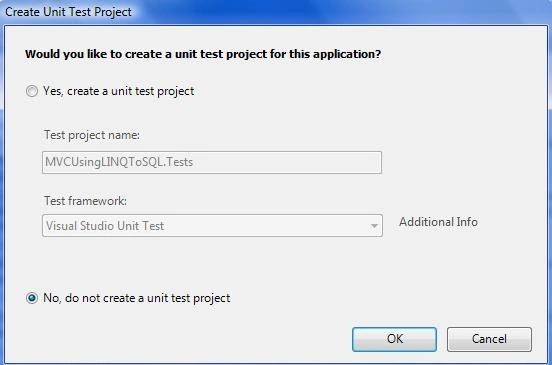
Next step if you want create unit test project or not? When you create a new ASP.NET MVC application, the Create Unit Test Project dialog appears (see Figure 2). This dialog enables you to create a separate project in your solution for testing your ASP.NET MVC application. Select the option No, do not create a unit test project and click the OK button.

Figure2.

2.jpg

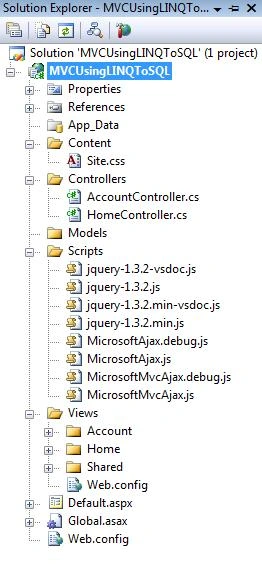
After the new ASP.NET MVC application is created, you will see several folders and files in the solution explorer. There are five folders by default Content, Controllers, Models, Scripts, and Views.

Figure3.

3.jpg
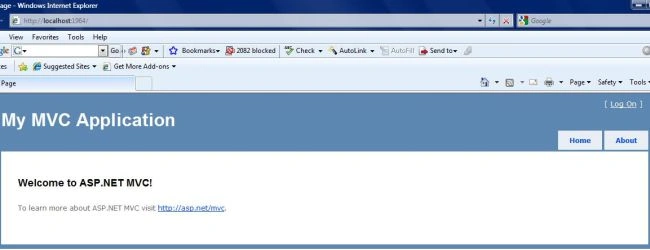
After execution output will look like this.

Figure4.

4.jpg

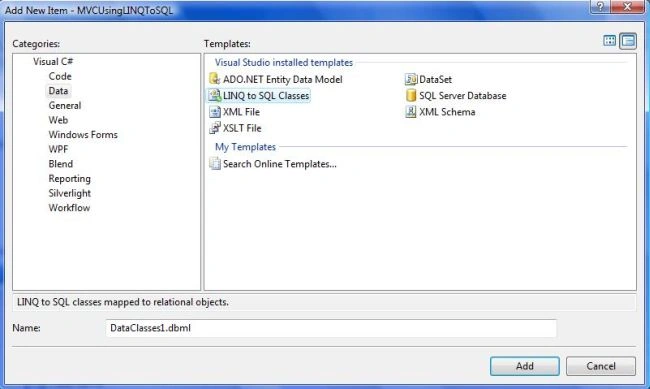
Now time to add a new item 'LINQ to SQL Classes' template.

Figure5.

5.jpg

In this MVC application I am using NORTHWND database you can copy that from App_Data folder.

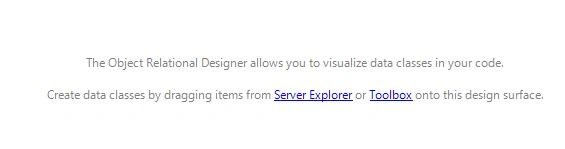
This data class will look like this.

Figure6.

6.jpg
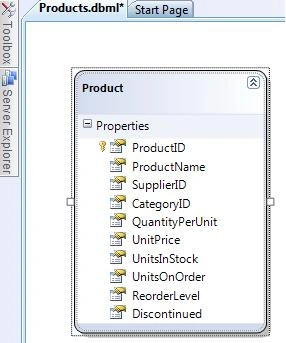
Now drag and drop your database table from Server Explorer.

Figure7.

7.jpg

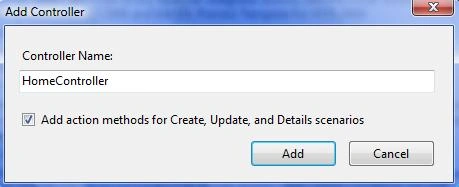
Now add a new Controller in Controllers folder and check that Add action for Create, Update and Details scenario and click Add.

Figure8.

8.jpg

HomeController.cs will show some methods like this.

using System;

using System.Collections.Generic;

using System.Linq;

using System.Web;

using System.Web.Mvc;

using System.Web.Mvc.Ajax;


namespace MVCUsingLINQToSQL.Controllers

{

    public class HomeController : Controller

    {

        //

        // GET: /Home/


        public ActionResult Index()

        {

            return View();

        }


        //

        // GET: /Home/Details/5


        public ActionResult Details(int id)

        {

            return View();

        }


        //

        // GET: /Home/Create


        public ActionResult Create()

        {

            return View();

        }


        //

        // POST: /Home/Create


        [AcceptVerbs(HttpVerbs.Post)]

        public ActionResult Create(FormCollection collection)

        {

            try

            {

                // TODO: Add insert logic here


                return RedirectToAction("Index");

            }

            catch

            {

                return View();

            }

        }


        //

        // GET: /Home/Edit/5


        public ActionResult Edit(int id)

        {

            return View();

        }


        //

        // POST: /Home/Edit/5


        [AcceptVerbs(HttpVerbs.Post)]

        public ActionResult Edit(int id, FormCollection collection)

        {

            try

            {

                // TODO: Add update logic here


                return RedirectToAction("Index");

            }

            catch

            {

                return View();

            }

        }

    }

}


First of all add a namespace on controller class.

using MVCUsingLINQToSQL.Models;

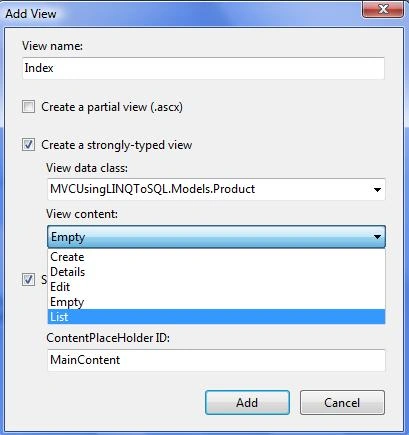
Now right click on Index method and click Add View and select View data class name view content.

Figure9.

9.jpg

Add some code to show data in list on Index method.

public ActionResult Index()

        {

            var dataContext = new ProductsDataContext();

            var products = (from m in dataContext.Products

                       select m).ToList();

            return View(products);

        }

And run your application you will see all records.

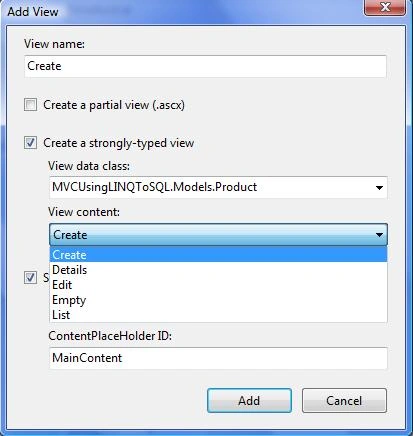
Now right click on Create method and click on Add View.

Figure10.

10.jpg

From Create.aspx you have to remove ProductID paragraph because this is auto generated column.

Now add this code in controller class for Create method.

//

        // GET: /Home/Create


        public ActionResult Create()

        {

            return View();

        }


        //

        // POST: /Home/Create


        [AcceptVerbs(HttpVerbs.Post)]

        public ActionResult Create(Product product)

        {          

            if (ModelState.IsValid)

            {

                try

                {

                    // TODO: Add insert logic here

                    var dataContext = new ProductsDataContext();

                    dataContext.Products.InsertOnSubmit(product);

                    dataContext.SubmitChanges();

                    return RedirectToAction("Index");

                }

                catch

                {

                    return View(product);

                }

            }

            return View(product);


        }


Here is your Edit method code:

//

        // GET: /Home/Edit/5

        public ActionResult Edit(int id)

        {

            var dataContext = new ProductsDataContext();

            var products = dataContext.Products.SingleOrDefault(x => x.ProductID == id);

            return View(products);           

        }


        //

        // POST: /Home/Edit/5

        [AcceptVerbs(HttpVerbs.Post)]

        public ActionResult Edit(int id, FormCollection collection)

        {

            var dataContext = new ProductsDataContext();

            var products = dataContext.Products.SingleOrDefault(x => x.ProductID == id);

            try

            {

                // TODO: Add update logic here

                UpdateModel(products);

                dataContext.SubmitChanges();

                return RedirectToAction("Index");

            }

            catch

            {

                return View(products);

            }

        }

Delete Method Code:

public ActionResult Delete(int id)

        {

            // Get movie to delete

            var dataContext = new ProductsDataContext();

            var productToDelete = dataContext.Products.First(m => m.ProductID == id);


            // Delete

            dataContext.Products.DeleteOnSubmit(productToDelete);

            dataContext.SubmitChanges();


            // Show Index view

            return RedirectToAction("Index");

        }

We are done with LINQ to SQL Class here.

Comment Request!
Thank you for reading this post. Please post your feedback, question, or comments about this post Here.
Login to add your contents and source code to this article
 Article Extensions
Contents added by Raj Kumar on Oct 14, 2009

Sorry folks i forgot to tell you about Details method. Right Click on Controller class Details method and Add View and select View Content Details that will add a new Details.aspx page in Home directory.

21.JPG  
Here is your Details.aspx page content.

Details.aspx

<%@ Page Title="" Language="C#" MasterPageFile="~/Views/Shared/Site.Master" Inherits="System.Web.Mvc.ViewPage<MVCUsingLINQToSQL.Models.Product>" %>
<asp:Content ID="Content1" ContentPlaceHolderID="TitleContent" runat="server">
Details
</asp:Content>
<
asp:Content ID="Content2" ContentPlaceHolderID="MainContent" runat="server">
<h2>Details</h2>
<fieldset>
<legend>Fields</legend>
<p>
ProductID:
<%
= Html.Encode(Model.ProductID) %>
</p>
<p>
ProductName:
<%
= Html.Encode(Model.ProductName) %>
</p>
<p>
SupplierID:
<%
= Html.Encode(Model.SupplierID) %>
</p>
<p>
CategoryID:
<%
= Html.Encode(Model.CategoryID) %>
</p>
<p>
QuantityPerUnit:
<%
= Html.Encode(Model.QuantityPerUnit) %>
</p>
<p>
UnitPrice:
<%
= Html.Encode(String.Format("{0:F}", Model.UnitPrice)) %>
</p>
<p>
UnitsInStock:
<%
= Html.Encode(Model.UnitsInStock) %>
</p>
<p>
UnitsOnOrder:
<%
= Html.Encode(Model.UnitsOnOrder) %>
</p>
<p>
ReorderLevel:
<%
= Html.Encode(Model.ReorderLevel) %>
</p>
<p>
Discontinued:
<%
= Html.Encode(Model.Discontinued) %>
</p>
</fieldset>
<p>
<%=Html.ActionLink("Edit", "Edit", new { id=Model.ProductID }) %> |
<%
=Html.ActionLink("Back to List", "Index") %></p>
</
asp:Content>

Now put this code in controller class Detail Method.

//

// GET: /Home/Details/5

public ActionResult Details(int id)
{
var dataContext = new ProductsDataContext();
var products = dataContext.Products.SingleOrDefault(x => x.ProductID == id);
return View(products);
}
Now run your application and click on Details link.
22.JPG

 [Top] Rate this article
 
 About the author
 
Raj Kumar

Raj Kumar is a Microsoft MVP and Senior Software Engineer with lots of hands on experience using ASP.NET 2.0/3.5, AJAX, MVC, C#, Visual Basic .NET, SQL Server 2005/2008, Oracle, WPF, WCF, XAML and Silverlight. He has over 6 years of IT experience working most on Microsoft technologies. He holds Master's degree in Computer Science. When he is not writing code, he likes to write articles and play cricket.

Reach him at raj2511984@gmail.com 


Looking for C# Consulting?
C# Consulting is founded in 2002 by the founders of C# Corner. Unlike a traditional consulting company, our consultants are well-known experts in .NET and many of them are MVPs, authors, and trainers. We specialize in Microsoft .NET development and utilize Agile Development and Extreme Programming practices to provide fast pace quick turnaround results. Our software development model is a mix of Agile Development, traditional SDLC, and Waterfall models.
Click here to learn more about C# Consulting.
 
Introducing MaxV - one click. infinite control. Hyper-V Hosting from MaximumASP.
Finally – a virtual platform that delivers next-generation Windows Server 2008 Hyper-V virtualization technology from a managed hosting partner you can truly depend on. Visit www.maximumasp.com/max for a FREE 30 day trial. Hurry offer ends soon. Climb aboard the MaxV platform and take advantage of High Availability, Intelligent Monitoring, Recurrent Backups, and Scalability – with no hassle or hidden fees. As a managed hosting partner focused solely on Microsoft technologies since 2000, MaximumASP is uniquely qualified to provide the superior support that our business is built on. Unparalleled expertise with Microsoft technologies lead to working directly with Microsoft as first to offer IIS 7 and SQL 2008 betas in a hosted environment; partnering in the Go Live Program for Hyper-V; and product co-launches built on WS 2008 with Hyper-V technology.
Dynamic PDF
ceTE software specializes in components for dynamic PDF generation and manipulation. The DynamicPDF™ product line allows you to dynamically generate PDF documents, merge PDF documents and new content to existing PDF documents from within your applications.
Discover the Top 5 .NET Memory Management Fundamentals
To write the best .NET code, you need to know exactly how the .NET framework really manages memory. Ricky Leeks presents the Top 5 fundamental facts of .NET memory management. Learn more.
Nevron Chart for .NET 2010.1 Now Available
The leading .NET charting control now features PDF, Flash and Silverlight export, visualization of large datasets and more. Deliver true charting functionality to your BI, Scorecard, Presentation or Scientific apps. Download evaluation now.
ASP.NET 4 Hosting
Get 2 Months Free of ASP.NET Hosting for Only $4.95/month! Receive FREE MS SQL and MySQL Databases Including ASP.NET 4/3.5, MVC 3.0, Silverlight 4, Windows 2008/IIS 7.0 Plus FREE IIS 7 Modules. Host UNLIMITED ASP.NET Web Sites – Click Here!
 
 Post a Feedback, Comment, or Question about this article
Subject:
Comment:
Nevron Chart
Become a Sponsor
 Comments
Very nice by Kishan On September 11, 2010
Very nice article for the beginners. Good and clean codes. Great work.
Reply | Email | Modify 
Discover the top 5 tips for understanding .NET Interop
 © 2012  contents copyright of their authors. Rest everything copyright Mindcracker. All rights reserved.