
Blue Theme Orange Theme Green Theme Red Theme
 
6 Months Free & No Setup Fees ASP.NET Hosting!
Home | Forums | Videos | Advertise | Certifications | Downloads | Blogs | Interviews | Jobs | Beginners | Training
 | Consulting  
Submit an Article Submit a Blog 
 Jump to
Skip Navigation Links
TechnologyExpand Technology
WebsiteExpand Website
6 Months Free & No Setup Fees ASP.NET Hosting!
Search :       Advanced Search »
Home » Programming Best Practices » Add and handle application settings in the configuration file: Part II

Add and handle application settings in the configuration file: Part II

This article tells you how to add connection string using the configuration file itself.

Author Rank :
Page Views : 10938
Downloads : 0
Rating :
 Rate it
Level : Intermediate
   Print Read/Post comments Post a comment  Similar Articles  
   Email to a friend  Bookmark  Author's other articles  
 
6 Months Free & No Setup Fees ASP.NET Hosting!
Become a Sponsor
 Tag Cloud
 Latest Jobs
More ... 
 Latest Interview Questions
More ... 

Introduction

We demonstrate in the PartI how to add connection strings using the IDE tools, add connection string using the configuration file it self and add a connection string programmatically using the Configuration and the ConfigurationManager classes. Finally, we have seen how to retrieve the connection parameters from the configuration file.

In this article, we will see how to add application settings using the IDE tools, add application settings using the configuration file it self and add application settings programmatically using the Configuration and the ConfigurationManager classes. Finally, we will see how to retrieve the application settings from the configuration file.

The application settings are used to restore application settings, such as file paths, XML Web service URL, application properties values and others. This object is composed by the following elements:
 

Element Description
"add" Adds an application settings to the collection
"clear" Removes all references to inherited application settings, allowing only the application settings that are added by the current add element.
"remove" Removes a reference to inherited application settings from the elements collection.

Add application settings

Add application settings using the IDE

  • Open the project menu and click on the project properties:
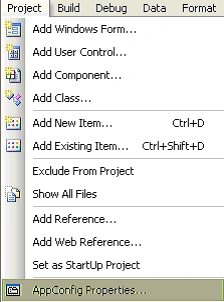


Figure 1

The followed window will be opened:
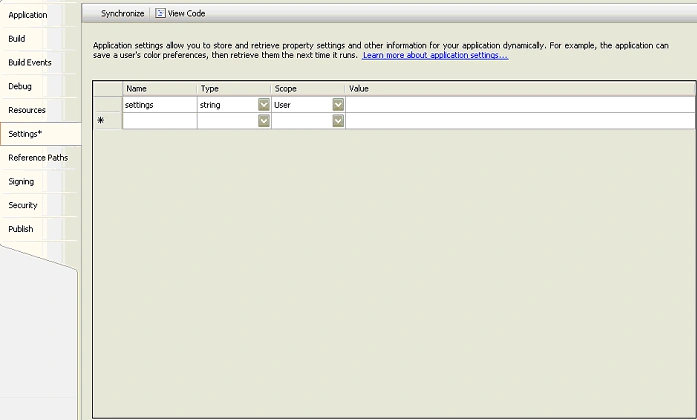


Figure 2

  • Add an application settings name, and set the type by choosing it from the combo box, set the scope witch can be either user or application scope.
  • Save the application settings by right clicking the first tab and choosing save file
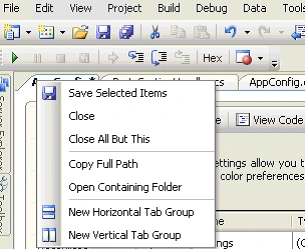


Figure 3

Add application settings directly in the configuration file:

The configuration file is located at the same directory as the application one with ".exe.config" as extension and as icon.

  • 1. Open it and add directly application settings, the "intellisense" will help you to do that.
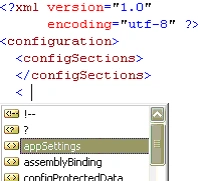


After adding a couple of application settings the configuration file looks like bellow:

<?xml version="1.0" encoding="utf-8" ?><?xml:namespace prefix = o ns = "urn:schemas-microsoft-com:office:office" />

<configuration>

  <configSections>

  </configSections>

  <appSettings>

    <add key="setting1" value="value1"/>

    <add key="setting2" value="value2"/>

    <add key="setting3" value="value3"/>

  </appSettings>

</configuration>

Add the application settings programmatically

  • Add this method to your code:

    private static void AddNewSetting()

    {

        /* This code provides access to configuration files using OpenMappedExeConfiguration

        , method. You can use the OpenExeConfiguration method instead. For further informatons

        , consult the MSDN, it gives you more inforamtions about config files access methods*/

        ExeConfigurationFileMap oConfigFile = new ExeConfigurationFileMap();

        oConfigFile.ExeConfigFilename = Application.StartupPath + \\AppConfig.exe.config;

        Configuration oConfiguration = ConfigurationManager.OpenMappedExeConfiguration(oConfigFile, ConfigurationUserLevel.None);

        //Add the setting key and value

        oConfiguration.AppSettings.Settings.Add("setting1", "value1");


        //Save the configuration settings

        oConfiguration.Save(ConfigurationSaveMode.Full);

        MessageBox.Show("The setting is saved");


        //Restart the application

        Application.Restart();

    }
  • Call the method at the run time, open the configuration file and observe the changes.

    <?xml version="1.0" encoding="utf-8" ?>

    <configuration>

      <configSections>

      </configSections>

      <appSettings file="">

        <clear />

        <add key="setting1" value="value1" />

      </appSettings>

       </configuration>

Retrieve application settings values for use purposes:

  • Add this method to your code

    private static void RetriveAppSettingInfo()

    {

        /* This code provides access to configuration files using OpenMappedExeConfiguration

        , method. You can use the OpenExeConfiguration method instead. For further informatons

        , consult the MSDN, it gives you more inforamtions about config files access methods*/

        ExeConfigurationFileMap oConfigFile = new ExeConfigurationFileMap();

        oConfigFile.ExeConfigFilename = Application.StartupPath + \\AppConfig.exe.config;

       Configuration oConfiguration = ConfigurationManager.OpenMappedExeConfiguration(oConfigFile, ConfigurationUserLevel.None);


        //Retrieving the setting1 value from the config file

        try

        {

            string settingValue = oConfiguration.AppSettings.Settings["setting1"].Value;

            MessageBox.Show(settingValue);

        }

        catch (NullReferenceException caught) { MessageBox.Show(caught.Message); }

    }

Call it at the run time

Comment Request!
Thank you for reading this post. Please post your feedback, question, or comments about this post Here.
Login to add your contents and source code to this article
 [Top] Rate this article
 
 About the author
 
Bechir Bejaoui

The author holds a master degree in NTIC specialized  in software developement delivered by the high school of communication SUPCOM, he also holds a bachelor degree in finance delivered by  the  economic sciences and  management  university of Tunis "FSEGT".

He also holds:

MCPD enteprise solutions developement 3.5 certification and MCTS distibuted application developement 2.0

 He's a freelance developer since 2006. Actually woking on the WPF, .Net framewok 3.5, silverlight and the other .Net new features, in addition, he is painter and sculptor.

Looking for C# Consulting?
C# Consulting is founded in 2002 by the founders of C# Corner. Unlike a traditional consulting company, our consultants are well-known experts in .NET and many of them are MVPs, authors, and trainers. We specialize in Microsoft .NET development and utilize Agile Development and Extreme Programming practices to provide fast pace quick turnaround results. Our software development model is a mix of Agile Development, traditional SDLC, and Waterfall models.
Click here to learn more about C# Consulting.
 
Introducing MaxV - one click. infinite control. Hyper-V Hosting from MaximumASP.
Finally – a virtual platform that delivers next-generation Windows Server 2008 Hyper-V virtualization technology from a managed hosting partner you can truly depend on. Visit www.maximumasp.com/max for a FREE 30 day trial. Hurry offer ends soon. Climb aboard the MaxV platform and take advantage of High Availability, Intelligent Monitoring, Recurrent Backups, and Scalability – with no hassle or hidden fees. As a managed hosting partner focused solely on Microsoft technologies since 2000, MaximumASP is uniquely qualified to provide the superior support that our business is built on. Unparalleled expertise with Microsoft technologies lead to working directly with Microsoft as first to offer IIS 7 and SQL 2008 betas in a hosted environment; partnering in the Go Live Program for Hyper-V; and product co-launches built on WS 2008 with Hyper-V technology.
Dynamic PDF
ceTE software specializes in components for dynamic PDF generation and manipulation. The DynamicPDF™ product line allows you to dynamically generate PDF documents, merge PDF documents and new content to existing PDF documents from within your applications.
Discover the Top 5 .NET Memory Management Fundamentals
To write the best .NET code, you need to know exactly how the .NET framework really manages memory. Ricky Leeks presents the Top 5 fundamental facts of .NET memory management. Learn more.
Nevron Chart for .NET 2010.1 Now Available
The leading .NET charting control now features PDF, Flash and Silverlight export, visualization of large datasets and more. Deliver true charting functionality to your BI, Scorecard, Presentation or Scientific apps. Download evaluation now.
ASP.NET 4 Hosting
Get 2 Months Free of ASP.NET Hosting for Only $4.95/month! Receive FREE MS SQL and MySQL Databases Including ASP.NET 4/3.5, MVC 3.0, Silverlight 4, Windows 2008/IIS 7.0 Plus FREE IIS 7 Modules. Host UNLIMITED ASP.NET Web Sites – Click Here!
 
 Post a Feedback, Comment, or Question about this article
Subject:
Comment:
Discover the top 5 tips for understanding .NET Interop
Become a Sponsor
 Comments
DevExpress Free UI Controls
 © 2012  contents copyright of their authors. Rest everything copyright Mindcracker. All rights reserved.