
Blue Theme Orange Theme Green Theme Red Theme
 
Team Foundation Server Hosting
Home | Forums | Videos | Advertise | Certifications | Downloads | Blogs | Interviews | Jobs | Beginners | Training
 | Consulting  
Submit an Article Submit a Blog 
 Jump to
Skip Navigation Links
TechnologyExpand Technology
WebsiteExpand Website
Team Foundation Server Hosting
Search :       Advanced Search »
Home » Visual C# » What really it differs an Interface from a class: Part III

What really it differs an Interface from a class: Part III

As a response to the third question asked in the first article Part I-What really it differs an Interface from a class? I can say that also interfaces play others important roles. They can serve as a powerful tool to explore objects

Author Rank :
Page Views : 3462
Downloads : 0
Rating :
 Rate it
Level : Beginner
   Print Read/Post comments Post a comment  Similar Articles  
   Email to a friend  Bookmark  Author's other articles  
 
Team Foundation Server Hosting
Become a Sponsor
 Tag Cloud
 Latest Jobs
More ... 
 Latest Interview Questions
More ... 

As a response to the third question asked in the first article What really it differs an Interface from a class: Part I, I can say that also interfaces play others important roles. They can serve as a powerful tool to explore objects that have some common characteristics or/and behaviors within an extremely heterogeneous environment. To fully understand the issue, I give this example:

Currently, the biologists estimate at 1.750.000 the number of a live species described by the scientists. Animals are classified as follow:

Specie  Estimate number Samples
Arthropoda 1 200 000 Insect, Spider, crab
Mollusca 100 000 snail, mould, octopus
Nematoda 90 000 Ascaris
Chordata 47 200 mammals, fish, reptiles
Platyhelminthes 15 000 tapeworm
Annellida 15 000 lombric, leech
Cnidaires 9 000 jellyfishes, Polyps
Echinodermata 6 000 sea urchin, starfish
Porifera 4 300 sponge

Imagine that you are responsible to develop an application that helps scientists as a part of a given research department activities to improve some tasks. Even though it is an extremely heterogeneous environment to handle, there are common characteristics shared between some of them. Imagine now that there are some treatments that should be done only if a given animal is vertebrate. So, this characteristic could be shared between species regardless of their genres. The problem is how to deal with this creasy number of animals and species to extract the targeted sub group from the entire one. To do so, you should adopt an interface programming concept, yes interface again!!!

Given that you have this situation:
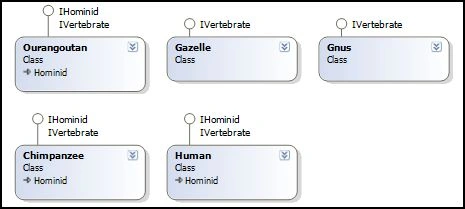

 
Figure 12

Now, suppose that you want to handle special kind of vertebrate animals by injecting them some substances dose as a part of a given experience,  you have to treat only the hominid category for example. You can do this through this mechanism:

First of all, all those species have to implement this interface

interface IVertebrate

    {

        /// <summary>

        /// boolean indicates that this is an vertebrate animal

        /// </summary>

        bool IsVertebrate{get;}     
    }

Now, in order to treat the Hominid case you can use this code:

//Create a Species array to iterate throug them

Species [] Creatures = { new Human(), new Chimpanzee(), new Ourangoutan(), new Gazelle(), new Gnus()/* … and the list could continue so far */ };

/* use the for to iterate through Species objetcts then add only vertebrate

   To the Vertebratelist */

ArrayList Vertebratelist = new ArrayList();

            for (int i = 0; i < Species.Lenght; i++)

            {

                //If it is vertebrate then add it to the list

                if (Creatures[i] is IVertebrate)

                {

                    Vertebratelist.Add(Creatures[i]);

                }


            }


//use the for to iterate through objetcts

            for (int i = 0;i < Vertebratelist.count; i++)

            {

                //If it is hominid then apply

                if (Creatures[i] is IHominid)

                {

                    //Do the injection process

                }
            }

 
If I summarize, first, I create a Species array then I extract all vertebrates from the whole group and put them into the Vertebratelist, in this case I'm sure that the entire invertebrate sub group will be ignored during the process. As a second step, I also filter the Hominid elements using the keyword is. At the other hand, Interfaces could be used as parameters to overload a given method. Interfaces could also be used as returned values in spite of their pure protocol nature. For example we can overload this method and use it to return an IHominid object if it is the case:


private IHominid GetHominid(Object obj)

        {

            if (obj is IHominid)

            {

                /* as is used to cast the object if

                 * its class implements the IHominid

                 interface */

                return obj as IHominid;

            }

            else

            {

                return null ;

            }

        } 

This function returns a hominid object. You can use it in the main bloc as follow:

//Create a IVertebrate array to iterate throug them

Ivertebrate [] Creatures = { new Human(), new Chimpanzee(), new Ourangoutan(), new Gazelle(), new Gnus() };

            ArrayList list = new ArrayList();

            for (int i = 0; i < Creatures.Length; i++)

            {

                if (Creatures[i] is IHominid)

                { list.Add(GetHominid(Creatures[i])); }

            }

            for (int i = 0; i < list.Count; i++)

                MessageBox.Show(list[i].ToString());

As you see there are a lot of differences when comparing classes to interfaces, hope that you catch some principals ideas that enable you distinguish between them.

Good Dotneting!!!

Comment Request!
Thank you for reading this post. Please post your feedback, question, or comments about this post Here.
Login to add your contents and source code to this article
 [Top] Rate this article
 
 About the author
 
Bechir Bejaoui

The author holds a master degree in NTIC specialized  in software developement delivered by the high school of communication SUPCOM, he also holds a bachelor degree in finance delivered by  the  economic sciences and  management  university of Tunis "FSEGT".

He also holds:

MCPD enteprise solutions developement 3.5 certification and MCTS distibuted application developement 2.0

 He's a freelance developer since 2006. Actually woking on the WPF, .Net framewok 3.5, silverlight and the other .Net new features, in addition, he is painter and sculptor.

Looking for C# Consulting?
C# Consulting is founded in 2002 by the founders of C# Corner. Unlike a traditional consulting company, our consultants are well-known experts in .NET and many of them are MVPs, authors, and trainers. We specialize in Microsoft .NET development and utilize Agile Development and Extreme Programming practices to provide fast pace quick turnaround results. Our software development model is a mix of Agile Development, traditional SDLC, and Waterfall models.
Click here to learn more about C# Consulting.
 
Introducing MaxV - one click. infinite control. Hyper-V Hosting from MaximumASP.
Finally – a virtual platform that delivers next-generation Windows Server 2008 Hyper-V virtualization technology from a managed hosting partner you can truly depend on. Visit www.maximumasp.com/max for a FREE 30 day trial. Hurry offer ends soon. Climb aboard the MaxV platform and take advantage of High Availability, Intelligent Monitoring, Recurrent Backups, and Scalability – with no hassle or hidden fees. As a managed hosting partner focused solely on Microsoft technologies since 2000, MaximumASP is uniquely qualified to provide the superior support that our business is built on. Unparalleled expertise with Microsoft technologies lead to working directly with Microsoft as first to offer IIS 7 and SQL 2008 betas in a hosted environment; partnering in the Go Live Program for Hyper-V; and product co-launches built on WS 2008 with Hyper-V technology.
Dynamic PDF
ceTE software specializes in components for dynamic PDF generation and manipulation. The DynamicPDF™ product line allows you to dynamically generate PDF documents, merge PDF documents and new content to existing PDF documents from within your applications.
Discover the Top 5 .NET Memory Management Fundamentals
To write the best .NET code, you need to know exactly how the .NET framework really manages memory. Ricky Leeks presents the Top 5 fundamental facts of .NET memory management. Learn more.
Nevron Chart for .NET 2010.1 Now Available
The leading .NET charting control now features PDF, Flash and Silverlight export, visualization of large datasets and more. Deliver true charting functionality to your BI, Scorecard, Presentation or Scientific apps. Download evaluation now.
ASP.NET 4 Hosting
Get 2 Months Free of ASP.NET Hosting for Only $4.95/month! Receive FREE MS SQL and MySQL Databases Including ASP.NET 4/3.5, MVC 3.0, Silverlight 4, Windows 2008/IIS 7.0 Plus FREE IIS 7 Modules. Host UNLIMITED ASP.NET Web Sites – Click Here!
 
 Post a Feedback, Comment, or Question about this article
Subject:
Comment:
6 Months Free & No Setup Fees ASP.NET Hosting!
Become a Sponsor
 Comments
Team Foundation Server Hosting
 © 2012  contents copyright of their authors. Rest everything copyright Mindcracker. All rights reserved.