

ELMAH stands for Error Logging Modules and Handler, it provide error logging facilities to the application. ELMAH is one of the easiest error logging package. It can be added automatically into a running ASP.NET Web Application.
Once ELMAH is installed and configured properly, we can easily use this without changing the single line of code.
ELMAH has the following three main categories:
- HTTP Module: HTTP module is a class that define event handler for the HTTP Application. The ELMAH includes multiple HTTP modules. In that, the following are the three of them mostly used.
o ErrorLogModule- Logs the unhandled errors in the Log.
o ErrorMailModule- Sends Errors of unhandled exception through mail.
o ErrorFilterModule- Filter to determine what exceptions are logged. - HTTP Handler: It is a class that is responsible for generating markup for particular type of request. The HTTP Handler creates the error details as web page, a RSS Feed or a CSV file.
- Error Log Source: This class allow to log the error into the database.
Create a new MVC Project (for testing the ELMAH).
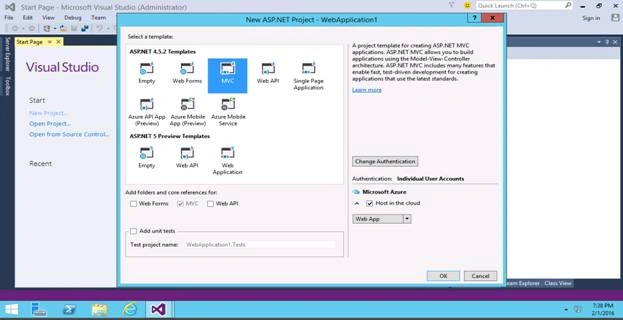
Then go to the Nuget Package Manager and install ELMAH,
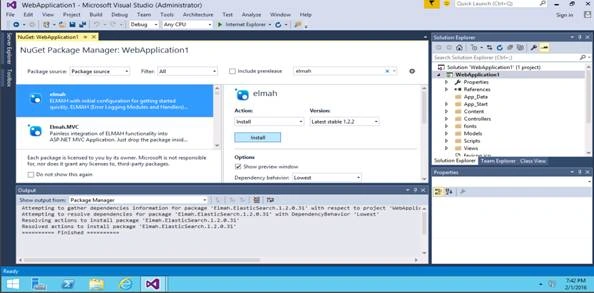
After installing the ELMAH it can alter config file automatically. It makes easy to use the ELMAH. If not configured, enter the following in the config file.
- <configuration>
- <configSections>
- <sectionGroup name="elmah">
- <section name="security" requirePermission="false" type="Elmah.SecuritySectionHandler, Elmah" />
- <section name="errorLog" requirePermission="false" type="Elmah.ErrorLogSectionHandler, Elmah" />
- <section name="errorMail" requirePermission="false" type="Elmah.ErrorMailSectionHandler, Elmah" />
- <section name="errorFilter" requirePermission="false" type="Elmah.ErrorFilterSectionHandler, Elmah" />
- </sectionGroup>
- </configSections>
- <system.web>
- <httpModules>
- <add name="ErrorLog" type="Elmah.ErrorLogModule, Elmah" />
- <add name="ErrorMail" type="Elmah.ErrorMailModule, Elmah" />
- <add name="ErrorFilter" type="Elmah.ErrorFilterModule, Elmah" />
- </httpModules>
- </system.web>
- <system.webServer>
- <modules>
- <add name="ErrorLog" type="Elmah.ErrorLogModule, Elmah" preCondition="managedHandler" />
- <add name="ErrorMail" type="Elmah.ErrorMailModule, Elmah" preCondition="managedHandler" />
- <add name="ErrorFilter" type="Elmah.ErrorFilterModule, Elmah" preCondition="managedHandler" />
- </modules>
- </system.webServer>
- <elmah>
- <security allowRemoteAccess="false" />
- </elmah>
- <location path="elmah.axd" inheritInChildApplications="false">
- <system.web>
- <httpHandlers>
- <add verb="POST,GET,HEAD" path="elmah.axd" type="Elmah.ErrorLogPageFactory, Elmah" />
- </httpHandlers>
- <!--
- <authorization>
- <allow roles="admin" />
- <deny users="*" />
- </authorization>
- -->
- </system.web>
- <system.webServer>
- <handlers>
- <add name="ELMAH" verb="POST,GET,HEAD" path="elmah.axd" type="Elmah.ErrorLogPageFactory, Elmah" preCondition="integratedMode" />
- </handlers>
- </system.webServer>
- </location>
- </configuration>
- If you want to get Exception through mail then add the following line of code.
- <errorMail from="[email protected]" to="[email protected]" Subject="Application Error" async="true" smtpPort="0" useSsl="true"></errorMail>
- Enter the above line of code must be added within the
- <elmah> tag Now we have to config the email account. By using the below excel tags
- <mailSettings>
- <smtpdeliveryMethod="Network">
- <network host="smtp.gmail.com" port="587" userName="Your mail address " password="your password " />
- </smtp>
- </mailSettings>
- </system.net>
While running the code I got the following error,
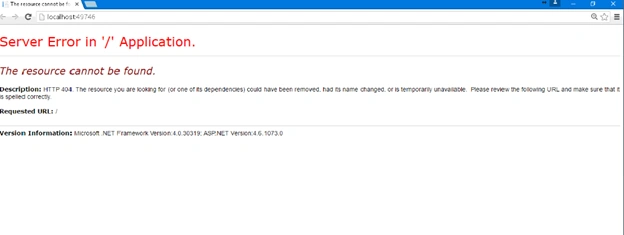
The exception can be seen in many ways,
We can use the url, to know the list of error occurred. Here's the screenshot:
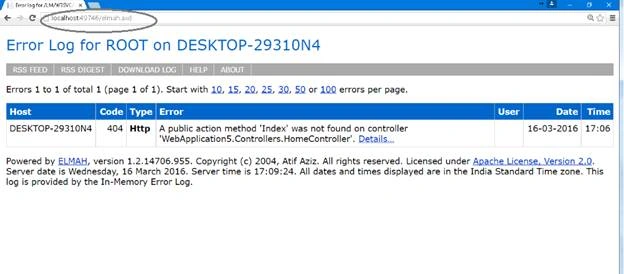
We have to add /elmah.axd at the end of the url.
When the exception is fired it will automatically send a mail to the given mail address like the following message.
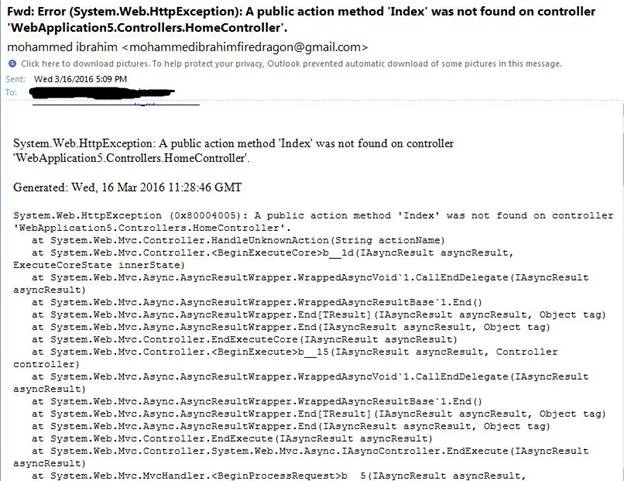
So, we found the exception using ELMAH.
Read more articles on ASP.NET:
Ashwanth SailaPosted Sep 26, 2016, 11:09 PM
Hiii broooo. Does Elmah work on portable class libraries
Muhammad Aqib ShehzadPosted Apr 22, 2016, 5:31 AM
good share
Kashif SohailPosted Mar 21, 2016, 10:48 PM
Very nice and very helpfull
Sibeesh VenuPosted Mar 17, 2016, 11:17 AM
Nice Share
Jaipal ReddyPosted Mar 17, 2016, 12:11 AM
Nice. .
ThrishPosted Mar 16, 2016, 6:44 PM
nice article
Vignesh ManiPosted Mar 16, 2016, 5:57 PM
nice
Debasis SahaPosted Mar 16, 2016, 1:53 PM
Good One..