

Generally a class in inherited using this method:
- var InheritedClass = WinJS.Class.derive(BaseClass,
- function (properties) {
- //properties section
- });
Let's make an example to understand how to use it.
Building the App
Create a class with some members and then create inherited classes from base classes changing properties. Don't use base class to create new instances.
Solution
We shall create a base class named Employee:
This will be our base class.
According to the scenario; we shall never create instances from that. So,what we are going to do is create inherited classes that derive from base class:
Now let's create our instances:
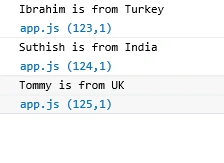
And show them their values in JavaScript Console:
Running the app will display results as shown below:
Now that we made a simple inheritance sample, why don't we try something extra?
Let's create two more inherited classes:
These classes inherited from another inherited class which is now base class for them.
What we are going to do is change their salaries as we see fit. We broke the assigned value there.
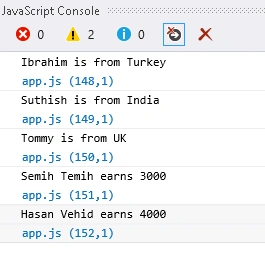
The reason for doing this sample is to show you how you can create inherited classes endlessly.
It's up to your structure.
Building the App
Create a class with some members and then create inherited classes from base classes changing properties. Don't use base class to create new instances.
Solution
We shall create a base class named Employee:
- var Employee = WinJS.Class.define(
- function (name, surname, age, profession, nationality, salary) {
- this.name = name;
- this.surname = surname;
- this.age = age;
- this.profession = profession;
- this.nationality = nationality;
- this.salary = salary;
- });
According to the scenario; we shall never create instances from that. So,what we are going to do is create inherited classes that derive from base class:
- var TurkishEmp = WinJS.Class.derive(Employee,
- function (name) {
- this.name = name;
- this.nationality = "Turkey";
- });
- var IndianEmp = WinJS.Class.derive(Employee,
- function (name) {
- this.name = name;
- this.nationality = "India";
- });
- var EnglishEmp = WinJS.Class.derive(Employee,
- function (name) {
- this.name = name;
- this.nationality = "UK";
- });
- var emp1 = new TurkishEmp("Ibrahim");
- var emp2 = new IndianEmp("Suthish");
- var emp3 = new EnglishEmp("Tommy");
- console.log(emp1.name + " is from " + emp1.nationality);
- console.log(emp2.name + " is from " + emp2.nationality);
- console.log(emp3.name + " is from " + emp3.nationality);
Now that we made a simple inheritance sample, why don't we try something extra?
Let's create two more inherited classes:
- var FreelancerEmp = WinJS.Class.derive(TurkishEmp,
- function (name, surname) {
- this.name = name;
- this.surname = surname;
- this.salary = 2400;
- }
- );
- var OutSourcing = WinJS.Class.derive(EnglishEmp,
- function (name, surname) {
- this.name = name;
- this.surname = surname;
- this.salary = 3000;
- }
- );
What we are going to do is change their salaries as we see fit. We broke the assigned value there.
- var emp4 = new FreelancerEmp("Semih", "Temih");
- var emp5 = new OutSourcing("Hasan", "Vehid");
- emp4.salary = 3000;
- emp5.salary = 4000;
The reason for doing this sample is to show you how you can create inherited classes endlessly.
It's up to your structure.
Read more articles on Universal Windows App:
Gowtham RajamanickamPosted Apr 7, 2016, 4:29 AM
Good Show.
Mohammed IbrahimPosted Apr 5, 2016, 12:21 PM
nice
Ammar ShaukatPosted Apr 4, 2016, 5:31 PM
I tried to read the article . But it seems This is not my area.. :)
Gopi ChandPosted Apr 4, 2016, 11:02 AM
Great one sir :)
Humayun Kabir MamunPosted Apr 4, 2016, 5:03 AM
Nice...
Debasis SahaPosted Apr 4, 2016, 4:03 AM
Good One..
Vignesh ManiPosted Apr 4, 2016, 3:59 AM
Good
Rahul Kumar SaxenaPosted Apr 4, 2016, 3:47 AM
Good Show