

If you missed any of the previous articles, you can read them here:
- How to Create RESTful API using Node.js and MySQL
- Working with read operation in angular 2 Application
In this third part of the tutorial, I am going to cover the topics give below.
- Creating Routing
- Add
- Validation
- Delete
- Update and more
At the end of the article, you will find the link to the source code on GitHub, so feel free to play with the code yourself.
In part 1, I created RESTful API, using node.js and MySQL. In part 2, I discussed the read operation and also how to create custom filter pipe etc.
Now, in this article I am starting from routing.
Creating Routing
Angular2 routing is all about the changing state of your Application and loading different components which depend on the URL that the user enters. Angular 2 first parses the URL entered by the user, identifies the routes and then finally loads the suitable component.
How does routing work?
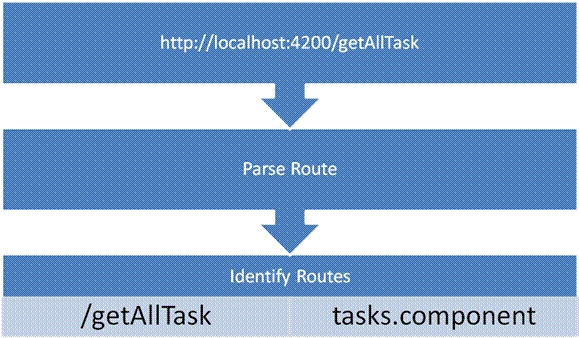
First, I am creating the router array.
- [code language=”typescript”]
- app.routing.ts
- import {
- Routes,RouterModule;
- }
- from '@angular/router';
- import {
- TasksComponent;
- }
- from './tasks/tasks.component';
- import {
- AddtasksComponent;
- }
- from './tasks/addtasks.component';
- const routerRoutes=[ {
- path'',redirectTo'/allTask',pathMatch'full';
- },
- {path'allTask',componentTasksComponent;
- },
- {path'addTask',componentAddtasksComponent;
- }
- ];
- export const routes=RouterModule.forRoot(router);
- [/code]
After creating the routing file, it must be declared in imports array in app.module.ts
- [code language = ”typescript”]
- imports[
- BrowserModule,
- FormsModule,
- HttpModule,
- routes
- ], [/code]
- [code language = ”html”] < router - outlet > < /router-outlet> [/code]
Now, we need routing on each and every page. Thus, for my convenience, I am creating one component as a header.component in which I will create a menu for my project. I am using Bootstrap to design the menu.
Header.component.html
- [code language=”html”]
- <nav class="navbar navbar-inverse">
- <div class="container-fluid">
- <!-- Brand and toggle get grouped for better mobile display -->
- <div class="navbar-header">
- <button type="button" class="navbar-toggle collapsed" data-toggle="collapse" data-target="#bs-example-navbar-collapse-1" aria-expanded="false">
- <span class="sr-only">Toggle navigation</span>
- <span class="icon-bar"></span>
- <span class="icon-bar"></span>
- <span class="icon-bar"></span>
- </button>
- <a class="navbar-brand" routerLink="/allTask">CsharpCorner</a>
- </div>
- <!-- Collect the nav links, forms, and other content for toggling -->
- <div class="collapse navbar-collapse" id="bs-example-navbar-collapse-1">
- <ul class="nav navbar-nav">
- <li class="active">
- <a routerLink="/allTask">Task
- <span class="sr-only">(current)</span>
- </a>
- </li>
- <li>
- <a routerLink="/addTask">AddTask</a>
- </li>
- </ul>
- </div>
- <!-- /.navbar-collapse -->
- </div>
- <!-- /.container-fluid -->
- </nav>
- [/code]
Focus on <a routerLink="/addTask">AddTask</a>. Now, as Angular2 has done all routing locally, so we will be using router link instead of href.
Add New Task
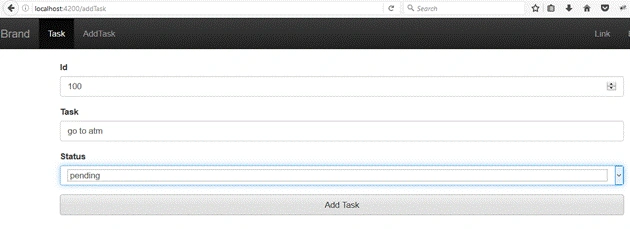
In this demo, I am using two way data binding for the add operation. You can get an idea about data binding from here.
addtasks.component.html
- [code language=”html”]
- <div class="row">
- <app-header></app-header>
- </div>
- <div class="container">
- <form (ngSubmit)="taskSubmit()" #addform="ngForm">
- <div class="form-group">
- <label for="id">Id</label>
- <input type="number" [(ngModel)]="model.Id"
- name="id"
- class="form-control" id="id"
- required #id="ngModel">
- </div>
- <div [hidden]="id.valid || id.pristine"
- class="alert alert-danger">
- Task Id is required
- </div>
- <div class="form-group">
- <label for="name">Task</label>
- <input type="text" [(ngModel)]="model.Title"
- name="title"
- class="form-control" id="name"
- required #title="ngModel">
- </div>
- <div [hidden]="title.valid || title.pristine"
- class="alert alert-danger">
- Task Title is required
- </div>
- <div class="form-group">
- <label for="power">Status</label>
- <select class="form-control" id="status"
- [(ngModel)]="model.Status" name="status"
- required>
- <option *ngFor="let s of status" [value]="s">{{s}}</option>
- </select>
- </div>
- <button type="submit" class="btn btn-default form-control" [disabled]="!addform.form.valid" >Add Task</button>
- </form>
- </div>
- [code]
- [code language=”html”]
- <button type="submit" class="btn btn-default form-control" [disabled]="!addform.form.valid" >Add Task</button>
- [/code]
- [code language=”html”]
- <input type="number" [(ngModel)]="model.Id"
- name="id"
- class="form-control" id="id"
- required #id="ngModel">
- [/code]
I had used dropdown for Status field (done or pending), so I will create an array of string in typescript file and loop through it and bind it to html page.
- [code language=”html”]
- <select class="form-control" id="status"
- [(ngModel)]="model.Status" name="status"
- required>
- <option *ngFor="let s of status" [value]="s">{{s}}</option>
- </select>
- [/code]
- [code language=”typescript”]
- import { Component, OnInit } from '@angular/core';
- import { Router } from '@angular/router';
- import { TaskdataService } from '../shared/taskdata.service';
- @Component({
- selector 'app-addtasks',
- templateUrl './addtasks.component.html',
- styles []
- })
- export class AddtasksComponent implements OnInit {
- statusstring[]=[
- 'done',
- 'pending'
- ];
- model = {Id'',Title'',Status'pending'};
- constructor(private _taskdataTaskdataService,private _routerRouter) { }
- ngOnInit() {
- }
- taskSubmit()
- {
- this._taskdata.addTask(this.model)
- .subscribe(
- (dataany)=>{
- console.log(data);
- this._router.navigate(['/allTask']);
- },
- function(error){
- console.log(error);
- },
- function(){
- console.log('complete');
- }
- );
- }
- }
- [/code]
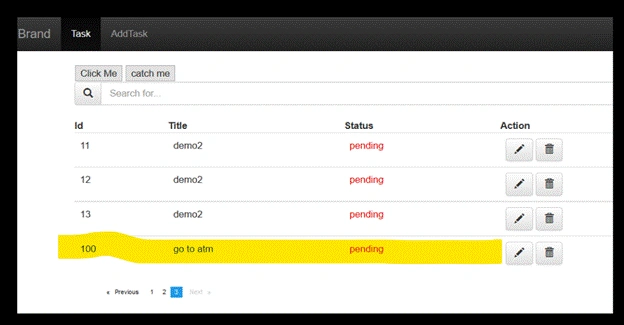
On click of add task button I am calling the taskSubmit() function inn which I am calling addtask method which I created in taskdata.service.
Subscribe method will take three arguments first is on success, second on error, third on complete.
Delete Task
Now for delete task ,I will simply add one button inside the tasks.component.html which I created previous article.
- [code language=”html”]
- <button (click)='deleteStatus(item)' type="button" class="btn btn-default" aria-label="Left Align">
- <span class="glyphicon glyphicon-trash" aria-hidden="true"></span>
- </button>
- [/code]
- [code language=”typescript”]
- deleteStatus(itemTask){
- this._taskdata.deleteTask(item.Id)
- .subscribe(
- (dataany)=>{
- this.allTasks.splice(this.allTasks.indexOf(item),1);
- },
- function(error){
- console.log(error);
- },
- function(){
- console.log(‘complete’);
- }
- );
- }
- [/code]
Update Task
Now on update I simply created the toggle button i.e. it will change the status to done or pending.
- [code language=”html”]
- <button (click)='updateStatus(item)' type="button" class="btn btn-default" aria-label="Left Align">
- <span class="glyphicon glyphicon-pencil" aria-hidden="true"></span>
- </button>
- [/code]
- [code language=”typescript”]
- updateStatus(itemTask){
- this._taskdata.editTask(item)
- .subscribe(
- (dataany)=>{
- if(item.Status=="done")
- {
- item.Status='pending';
- }
- else
- {
- item.Status='done';
- }
- },
- function(error){
- console.log(error);
- },
- function(){
- console.log ('Edited successfully');
- }
- );
- }
- [/code]
We covered a lot in this tutorial. Let’s just summarize it.
- Routing
- Validation
- Add
- Delete
- Update and more
There is a lot more to come in the next tutorial (Multiple delete,file upload,pagging). So, stay tuned for more.
Syamala SyamPosted Jun 1, 2018, 8:42 AM
Nice sir, Thank you
Manivel MPosted Jan 23, 2018, 4:27 AM
../shared/taskdata.service this file Missing.Can you attach demo link please
Mahesh ChandPosted Dec 29, 2016, 9:57 AM
I think reader level of this article should be Intermediate. Thanks!