

Introduction
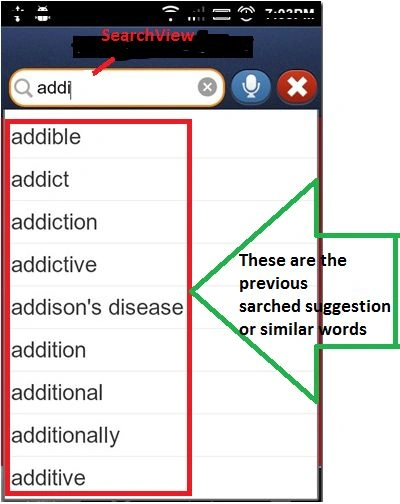
Features of Search Widgets
- Enable voice search
- Provide search suggestions based on recent user queries
- Provide custom search suggestions that match actual results in your application data
- Offer your application's search suggestions in the system-wide Quick Search Box
Creating a Search Interface
- The search dialog is a UI component that's controlled by the Android system. When activated by the user, the search dialog appears at the top of the activity as we have already learned in previous articles.
The Android system controls all events in the search dialog. When the user submits a query, the system delivers the query to the activity that we have defined and coded as in the following so that it can specify to handle searches. The dialog can also provide search suggestions while the user types.
- The search widget is an instance of SearchView so that we can place it anywhere in your layout. By default, the search widget behaves like a standard EditText widget but does nothing more.
- A searchable configurationAn XML file that configures some settings for the search dialog or widget. It includes settings for features such as voice search, search suggestion and hint text for the search box.
- A searchable activity
The Activity that receives the search query, searches your data and displays the search results.
- The search dialog
By default, the search dialog is hidden, however, we can enable it if needed but most commonly it appears at the top of the screen when you call onSearchRequested() (when the user presses your Search button).
- SearchView widget
Using the search widget allows you to put the search box anywhere in your activity. Instead of putting it in your activity layout, you should usually use SearchView as an action view in the Action Bar.
Creating a Searchable Configuration
- <?xml version="1.0" encoding="utf-8"?>
- <searchable xmlns:android="http://schemas.android.com/apk/res/android"
- android:label="@string/app_label"
- android:hint="@string/search_hint" >
- </searchable>
The android: label attribute is the only required attribute. However, it is pointing towards a string resource. Its attributes must be defined in the string.xml file.
The <searchable> element accepts several other attributes. However, you don't need most attributes until one must attach the features on the search suggestions and voice search.
Creating the Searchable Activity
- Declare the activity to accept the ACTION_SEARCH intent, in an <intent-filter> element.
- Specify the searchable configuration to use, in a <meta-data> element.
- <application ... >
- <activity android:name=".SearchableActivity" >
- <intent-filter>
- 1<action android:name="android.intent.action.SEARCH" />
- </intent-filter>
- <meta-data android:name="android.app.searchable"
- android:resource="@xml/searchable"/>
- </activity>
- ...
- </application>
Note: The <intent-filter> does not need a <category> with the DEFAULT value because the system delivers the ACTION_SEARCH intent explicitly to searchable activity.
Performing a search
- Receiving the result
- Searching your data
- Presenting the results
Receiving the query
- import android.app.Activity;
- import android.os.Bundle;
- import android.view.Menu;
- import android.view.MenuItem;
- public class RecentActivity extends Activity {
- @Override
- protected void onCreate(Bundle savedInstanceState) {
- super.onCreate(savedInstanceState);
- setContentView(R.layout.activity_recent);
- // Get the intent, verify the action and get the query
- Intent intent = getIntent();
- if (Intent.ACTION_SEARCH.equals(intent.getAction())) {
- String query = intent.getStringExtra(SearchManager.QUERY);
- doMySearch(query);
- }
- @Override
- public boolean onCreateOptionsMenu(Menu menu) {
- // Inflate the menu; this adds items to the action bar if it is present.
- getMenuInflater().inflate(R.menu.recent, menu);
- return true;
- }
- @Override
- public boolean onOptionsItemSelected(MenuItem item) {
- // Handle action bar item clicks here. The action bar will
- // automatically handle clicks on the Home/Up button, so long
- // as you specify a parent activity in AndroidManifest.xml.
- int id = item.getItemId();
- if (id == R.id.action_settings) {
- return true;
- }
- return super.onOptionsItemSelected(item);
- }
- }
Searching Data using Search Widget
The processing and storing of the data in an Android application using the database SQLite is done uniquely. The SearchView widgets are available in Android 3.0 and higher. If we are developing for Android version 3.0 and higher then we must insert search widgets as an action view in the ActionBar.
Configuring the search widgets
After you've created a searchable configuration and a searchable activity as discussed above you need to enable searching. For example, if you're using a SearchView as an action view in the Action Bar, you should enable the widget during the onCreateOptionsMenu() callback:
- @Override
- public boolean onCreateOptionsMenu(Menu menu) {
- // Inflate the options menu from XML
- MenuInflater inflater = getMenuInflater();
- inflater.inflate(R.menu.options_menu, menu);
- // Get the SearchView and set the searchable configuration
- SearchManager searchManager = (SearchManager) getSystemService(Context.SEARCH_SERVICE);
- SearchView searchView = (SearchView) menu.findItem(R.id.menu_search).getActionView();
- // Assumes current activity is the searchable activity
- searchView.setSearchableInfo(searchManager.getSearchableInfo(getComponentName()));
- searchView.setIconifiedByDefault(false); // Do not iconify the widget; expand it by default
- return true;
- }
Other features of Search Widgets
- A submit buttonBy default, there's no button to submit a search query, so the user must press the "Return" key on the keyboard to initiate a search. You can add a "submit" button by calling setSubmitButtonEnabled(true).
- Query refinement for search suggestionsSearch optimizing such that we could search very accurately so as processor needed to refine this is good and however you can add a button alongside each suggestion that inserts the suggestion in the search box for refinement by the user, by calling setQueryRefinementEnabled(true).
- The ability to toggle the search box visibility
Toggling the search using a toggles button is very common and it is one of the main features to toggle. By default, the search widget is "iconified," meaning that it is represented only by a search icon (a magnifying glass), and expands to show the search box when the user touches it. As shown above, you can show the search box by default, by calling setIconifiedByDefault(false). You can also toggle the search widget appearance by calling setIconified().
Neeraj KumarPosted Jul 30, 2015, 4:32 PM
Good
Gowtham RajamanickamPosted Apr 21, 2015, 2:49 AM
keep writing
Gowtham RajamanickamPosted Apr 21, 2015, 2:49 AM
fabulous
Praveen KumarPosted Feb 16, 2015, 10:53 PM
fabulous... Gaurav Kumar