

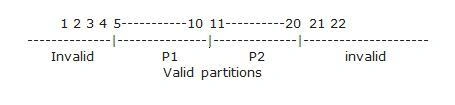
Equivalence classes may be defined according to the following
guidelines:
1. If an input condition specifies a range, one valid and two invalid
equivalence classes are defined.
2. If an input condition requires a specific value, then one valid and two
invalid equivalence classes are defined.
3. If an input condition specifies a member of a set, then one valid and one invalid
equivalence class are defined.
4. If an input condition is Boolean, then one valid and one invalid equivalence
class are defined.
Boundary
Value Analysis: This is also a Black Box Testing Technique which
consider on the Corner cases or the boundaries of the input domain rather than
its center. More application errors
occur at the boundaries of input domain.
For example If we want to test a field from 5 to 20, boundary values
will be 4 5 6 and 19 20 21
The left hand value is called the lower boundary e.g. 5 here in this
example and the Right side value 20 is called the Upper boundary and hence the
selection of values is
a. Upper boundaries +1 -1
20+1=21 (outside right boundary)
20-1=19 (inside right boundary)
b. Lower boundaries +1 -1
5+1=6 (inside left boundary)
5-1=4 (outside left boundary)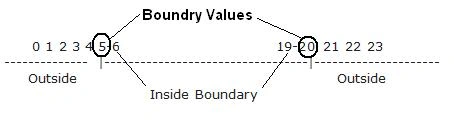
Error Guessing: Ability to guess based on previous experience in Software testing environment.
selvamPosted Oct 27, 2012, 6:36 AM
great info