

Introduction
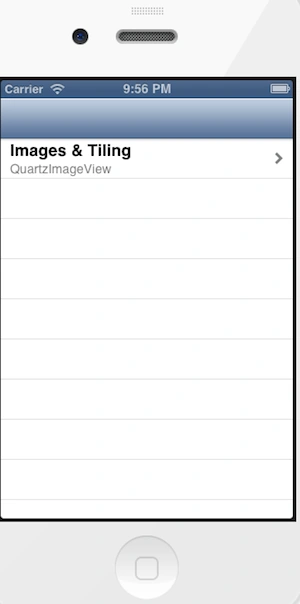
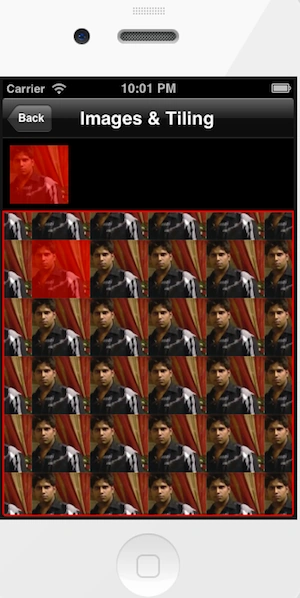
In this article I will create a Single View application. I will use a table view from xib for it. When we click on a table cell in this application we show images in a grid form.
To understand it we use the following.
Step 1
Open XCode by double-clicking on it.
Step 2
Create a New XCode Project by clicking on it.
Step 3
Now select Single View Application and click on Next.
Step 4
Now provide your Product Name and Company Identifier.
Step 5
Select the location where you want to save your project and click on Create.
Step 6
Now we write the code.
ViewController.h
#import <UIKit/UIKit.h>
#import "QuartzViewController.h"
@interface ViewController : UIViewController
{
QuartzViewController *controller;
}
@end
ViewController.m
#import "ViewController.h"
@interface ViewController ()
@end
#import "QuartzViewController.h"
#import "QuartzImages.h"
static NSString *kCellIdentifier = @"kCellIdentifier";
@implementation ViewController
- (void)viewDidLoad {
[super viewDidLoad];
NSLog(@"View Controller ");
controller = [[QuartzViewController alloc] initWithNibName:@"DemoView" viewClass:[QuartzImageView class]];
controller.title = @"Images & Tiling";
controller.demoInfo = @"QuartzImageView";
}
- (void)dealloc {
[super dealloc];
}
- (void)tableView:(UITableView *)tableView didSelectRowAtIndexPath:(NSIndexPath *)indexPath
{
QuartzViewController *targetViewController = controller;
[[self navigationController] pushViewController:targetViewController animated:YES];
}
- (NSInteger)numberOfSectionsInTableView:(UITableView *)tableView
{
return 1;
}
- (NSInteger)tableView:(UITableView *)tableView numberOfRowsInSection:(NSInteger)section
{
return 1;
}
- (UITableViewCell *)tableView:(UITableView *)tableView cellForRowAtIndexPath:(NSIndexPath *)indexPath
{
UITableViewCell *cell = [tableView dequeueReusableCellWithIdentifier:kCellIdentifier];
if (cell == nil)
{
cell = [[[UITableViewCell alloc] initWithStyle:UITableViewCellStyleSubtitle reuseIdentifier:kCellIdentifier] autorelease];
}
QuartzViewController *vc = controller;
cell.textLabel.text = vc.title;
cell.detailTextLabel.text = vc.demoInfo;
cell.detailTextLabel.adjustsFontSizeToFitWidth = YES;
cell.accessoryType = UITableViewCellAccessoryDisclosureIndicator;
return cell;
}
@end
Step 7
Finally we click on the Run button to show the output.
Step 8
Output1 in iPhone:
Output2 in iPhone:
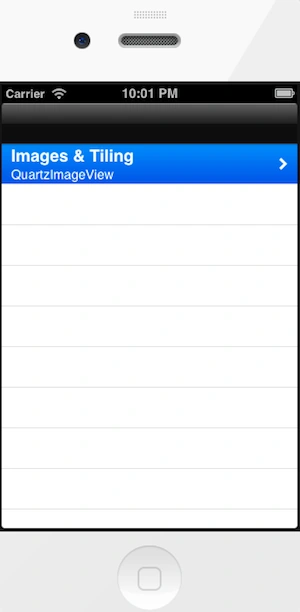
Output3 in iPhone:
Join the conversation! Your thoughts help the community grow.