
Introduction
JavaScript is a language of Web. This series of articles will talk about my observations learned during my decade of software development experience with JavaScript.
Before moving further let us look at the previous articles of the series:
- Voice of a Developer: JavaScript Data Types - Part One
- Voice of a Developer: JavaScript Objects - Part Two
- Voice of a Developer: JavaScript Engines - Part Three
- Voice of a Developer: JavaScript Common Mistakes - Part Four
- Voice of a Developer: Editors - Part Five
- Voice of a Developer: VSCode - Part Six
- Voice of a Developer: Debugging Capabilities of VSCode - Part Seven
- Voice of a Developer: JavaScript OOP - Part Eight
- Voice of a Developer: JavaScript Useful Reserved Keywords - Part Nine
- Voice of a Developer: JavaScript Functions - Part Ten
- Voice of a Developer: JavaScript Functions Invocations - Part Eleven
- Voice of a Developer: JavaScript Anonymous Functions - Part Twelve
- Voice of a Developer: JavaScript Pure And Impure Function - Part Thirteen
In an aspiration to write better code, JavaScript provides closure. We’ll understand it now, but before that, I'll shift gears to a few other concepts like scope & callback
In programming, scoping is the part of a computer program where you bind a variable and its visibility. There are two types of scope, i.e. lexical and dynamic. JavaScript is based on lexical or static scoping. The functions are lexically rather than dynamically scoped. JavaScript blocks scope using {}, and a new scope is created when you create a new function.
A quick glance at another concept called callback:
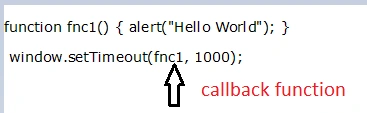
A callback is basically a function that accepts another function as a parameter, I hope it recalls your memory of higher-order functions. At some point, the higher-order function can call the function passed as a parameter, this is a callback.
The common use of closure we are familiar with is setTimeout function.
 A closure is an inner function that has access to the outer function’s variables. It can access complete chain of variables. Illustration:
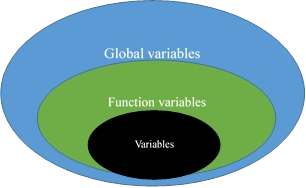 Closure function can access own variables, function variables in which it’s created and global variables. See from code perspective now,
Scoping
Callback
Closures
- var globalVar = 10;
- function localFunction() {
- var localFuncVar = 20;
- var closureFnc = function() {
- var closureVar = 30;
- console.log(globalVar);
- console.log(localFuncVar);
- console.log(closureVar);
- };
- closureFnc();
- }
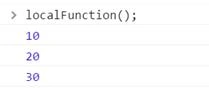
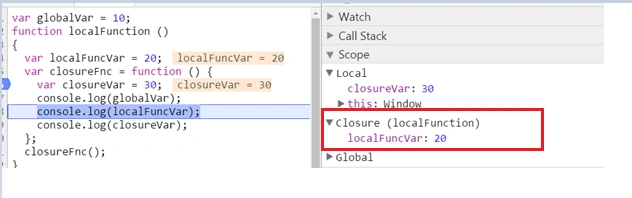
Use of closure
A very popular use case is Module pattern, so it can implement OOPS public, private methods concept. Closure help to emulate this, example:
- var modularpattern = (function() {
- // your module code goes here
- var sum = 0;
- return {
- add: function() {
- sum = sum + 1;
- return sum;
- },
- reset: function() {
- return sum = 0;
- }
- }
- }());
- console.log(modularpattern.add()); // 1
- console.log(modularpattern.add()); // 2
- console.log(modularpattern.reset()); // 0
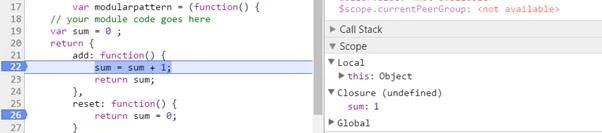
Stack
If you observe the value of sum will increment or reset.
Kuppurasu NagarajPosted May 9, 2016, 12:01 PM
Nice Sharing..
Debasis SahaPosted May 9, 2016, 8:42 AM
Good One..
Guest UserPosted May 8, 2016, 11:46 PM
Thanks devs!
Thiruppathi RPosted May 8, 2016, 3:21 PM
Good..
Neeraj KumarPosted May 8, 2016, 3:17 PM
Nice...
Bhuvanesh MohankumarPosted May 8, 2016, 2:17 PM
Good series