
JavaScript is language of the Web. This series of articles will talk about my observations learned during my decade of software development experience with JavaScript.
Before moving further let us look at the previous articles in the series:
- Voice of a Developer: JavaScript Data Types - Part One
- Voice of a Developer: JavaScript Objects - Part Two
- Voice of a Developer: JavaScript Engines - Part Three
- Voice of a Developer: JavaScript Common Mistakes - Part Four
- Voice of a Developer: Editors - Part Five
- Voice of a Developer: VSCode - Part Six
In last article we learnt about VSCode – an awesome editor. In this article we’ll learn debugging capabilities of VSCode. Before we move forward, let us setup NodeJS application.
Setup Node.js application
I am sure you must have heard about LAMP. Similarly, there is a new stack for webapplication development is MEAN (MongoDB, Express.js, AngularJS, and Node.js) — used to develop web applications.
To install Node on windows you can download online or use Chocolate Windows download manager to install it

Express.Js:
It is a framework for building and running Node applications. Below command will install it globally
npm install -g express-generator
Now, scaffold a new application,
express webApplication1
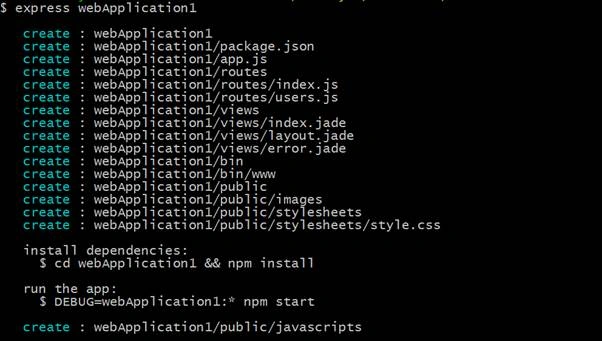
Hence it’ll create a basic setup of files to run Node.js application. Now, we can install node modules by using npm install command,


The tree structure would look like below,

Package.json file contains dependencies modules and pointer where to start. We’ll run the application using below command.
npm start
And it will open the application at 3000 port and you can browse to http://localhost:3000 to run the application,

Let us read detail in ./bin/www file. Use F1 to use open command palette to get there.
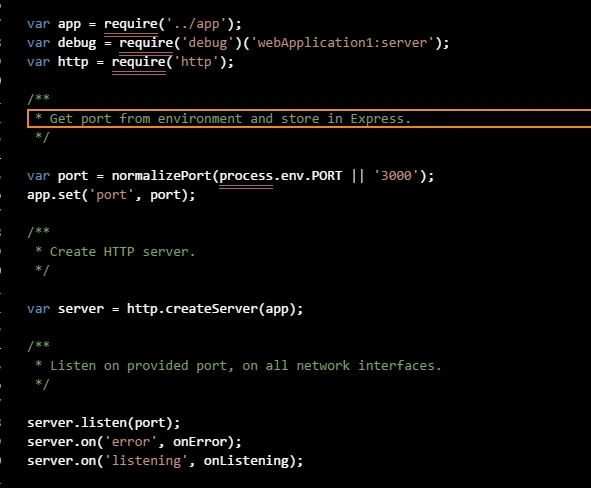
It creates an http server at port 3000 (default). If you would like run your application at another port, you could change the one that you can modify in ./bin/www file
Setup application in debug mode
Before we enable debugging Press F5 to launch application in debug mode and choose Node.js. It will create launch.json configuration file like tasks.json earlier

Run application
You can run application by F5 and see below output on Debug Console,

Run localhost:3000 and your node application is up and running (I have also attached Debug message),

Debugging
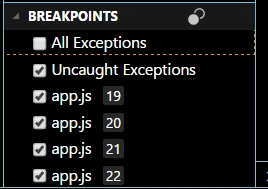
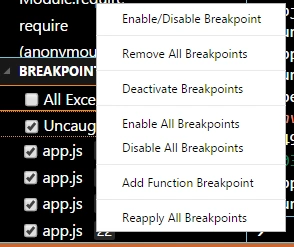
 VSCode has built-in debugging support for Node.js (JavaScript, TypeScript, and any other language that gets transpiled to JavaScript). You can open debug pane by clicking its icon and see various windows.



Bhuvanesh MohankumarPosted May 3, 2016, 12:52 PM
Good one..
Amit DavePosted May 3, 2016, 6:57 AM
Nice article!
Sonu ChaudharyPosted May 2, 2016, 5:57 AM
Thanks for sharing
Kuppurasu NagarajPosted Apr 30, 2016, 2:20 PM
Nice Sharing..
Rahul Kumar SaxenaPosted Apr 30, 2016, 1:49 PM
Good Show
Vignesh ManiPosted Apr 30, 2016, 12:49 PM
nice