

Introduction
In this article we will see how to open a text file inside the Custom Message Box control of the Windows Phone toolkit. In our app we can use the default message box to show the alerts or messages to the user. But it is very limited. The WP8 toolkit removes the limitations of the default message box by providing a Custom Message Box control. So let's get started.
Custom Message Box
Custom Message Box is a control provided in the WP8 toolkit for customizing the interface and contents of the message box. It enables you to add various UI elements in the message box that is not possible in the default message box. This demo opens a text file inside the message box. This can be useful for showing a readme, about and so on.
In the following demo I have used the following properties of a Custom Message Box:
-
Content
It takes an object as a value. It is displayed in the message box as we see a text in our default message box. A String is also an object and can be used for adding text in the message box. This demo is very specific to point out the usage of this property. In my previous article I used the plain text string but in this demo I'll try to provide you the simple download message box type alert by placing the UI elements in the message box. -
Height
To set the height of the message box. It can be set or left to auto fit as per the content size.
-
Opacity
To set the opacity of the message box. Value ranging from 0 to 1. -
Left Button Content
It also takes an object as a value. It is the left message button of the message box. -
Right Button Content
It also takes an object as a value. It is the right message button of the message box. -
IsFullScreen
It allows the message box to open full screen. Takes a true or false value.
Apart from the properties, the following method is also used:
-
Show
This method is used to show the message box.
We have also used the dismissing event of the Custom Message Box. The Dismissing event is fired when the Custom Message Box is closing.
Before you can run the following demo you need to install the WP8 toolkit in your project. It's very easy to do this.
Installing WP8 Toolkit
Use the following procedure to install the WP8 toolkit using Nugget:
-
Open your app project (either an existing one or a new one).
-
From the toolbar select "Tools" -> "NuGet Package Manager" -> "Package Manager Console".
-
Now in the package manager console type the following:
Install-Package WPtoolkit
After typing this you will probably see the log similar to this:
install-package wptoolkit
'WPtoolkit 4.2013.08.16' already installed.
Adding 'WPtoolkit 4.2013.08.16' to Demo.
Successfully added 'WPtoolkit 4.2013.08.16' to Demo.
- The next step is to add its reference in the XAML page. To do this just add this line:
xmlns:toolkit="clr-namespace:Microsoft.Phone.Controls;assembly=Microsoft.Phone.Controls.Toolkit"
Demo
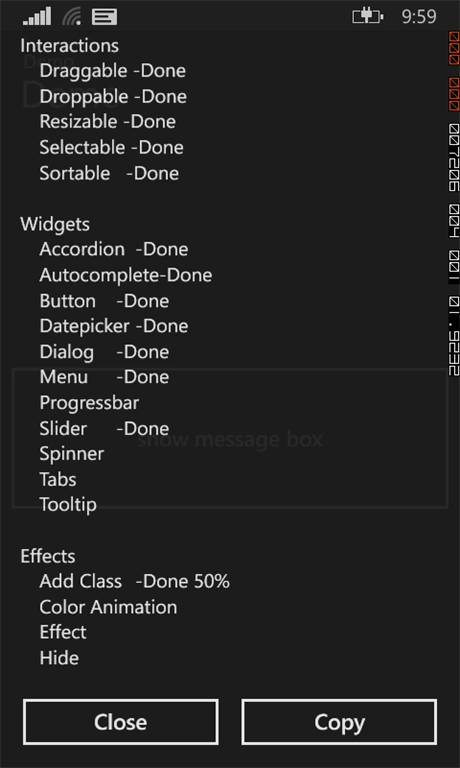
The following code demonstrates how to use the Custom Message Box with full screen enabled and customized content. Here in this demo I'm opening a text file inside the message box in full screen mode. So let's see how to code it.
XAML
<phone:PhoneApplicationPage
x:Class="Demo.MainPage"
xmlns="http://schemas.microsoft.com/winfx/2006/xaml/presentation"
xmlns:x="http://schemas.microsoft.com/winfx/2006/xaml"
xmlns:phone="clr-namespace:Microsoft.Phone.Controls;assembly=Microsoft.Phone"
xmlns:shell="clr-namespace:Microsoft.Phone.Shell;assembly=Microsoft.Phone"
xmlns:d="http://schemas.microsoft.com/expression/blend/2008"
xmlns:mc="http://schemas.openxmlformats.org/markup-compatibility/2006"
xmlns:toolkit="clr-namespace:Microsoft.Phone.Controls;assembly=Microsoft.Phone.Controls.Toolkit"
mc:Ignorable="d"
FontFamily="{StaticResource PhoneFontFamilyNormal}"
FontSize="{StaticResource PhoneFontSizeNormal}"
Foreground="{StaticResource PhoneForegroundBrush}"
SupportedOrientations="Portrait" Orientation="Portrait"
shell:SystemTray.IsVisible="True">
<!--LayoutRoot is the root grid where all page content is placed-->
<Grid x:Name="LayoutRoot" Background="Transparent">
<Grid.RowDefinitions>
<RowDefinition Height="Auto"/>
<RowDefinition Height="*"/>
</Grid.RowDefinitions>
<!--TitlePanel contains the name of the application and page title-->
<StackPanel x:Name="TitlePanel" Grid.Row="0" Margin="12,17,0,28">
<TextBlock Text="Demo" Style="{StaticResource PhoneTextNormalStyle}" Margin="12,0"/>
<TextBlock Text="Demo" Margin="9,-7,0,0" FontSize="40" />
</StackPanel>
<!--ContentPanel - place additional content here-->
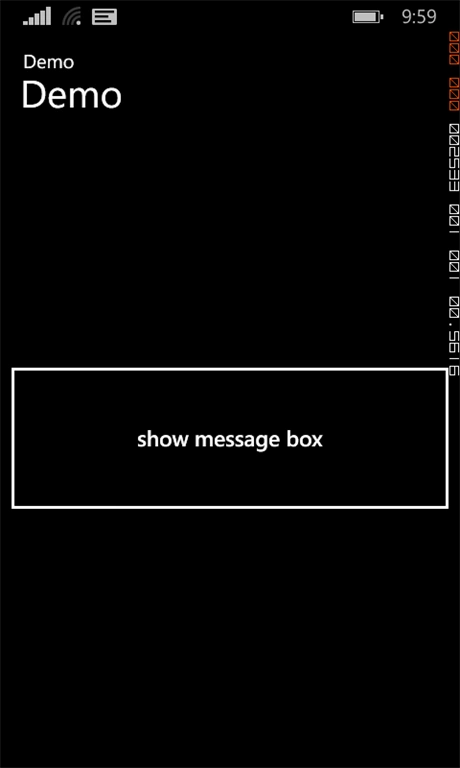
<Button Content="show message box" Click="openMsgBox" Height="171" VerticalAlignment="Bottom" Margin="0,0,0,258" Grid.Row="1"></Button>
</Grid>
</phone:PhoneApplicationPage>
C# Code Behind
using Microsoft.Phone.Controls;
using System;
using System.Collections.Generic;
using System.Linq;
using System.Net;
using System.Windows;
using System.Windows.Controls;
using System.Diagnostics;
using Microsoft.Phone.Tasks;
using System.Windows.Media;
using System.Windows.Media.Animation;
using System.IO;
namespace Demo
{
public partial class MainPage : PhoneApplicationPage
{
// Constructor
public MainPage()
{
InitializeComponent();
}
CustomMessageBox cmb;
private void openMsgBox(object sender, RoutedEventArgs e)
{
// create new Stack panel
StackPanel sp = new StackPanel() { Orientation = System.Windows.Controls.Orientation.Vertical };
string Text = getTextForLabel();
// add label in stack panal
sp.Children.Add(new TextBlock(){Text=Text, TextWrapping= TextWrapping.Wrap, Width=450, Height=800, FontSize=20});
// Create new Custom Message Box instance
cmb = new CustomMessageBox()
{
// Set its content to our Stack Panel
Content = sp,
Opacity = 0.9,
// Left button of message box Button
LeftButtonContent = "Close",
// Right button of message box
RightButtonContent = "Copy",
// To enable full screen
IsFullScreen=true
};
//Handling Message close
cmb.Dismissing += cmb_Dismissing;
//Show the message box...
cmb.Show();
}
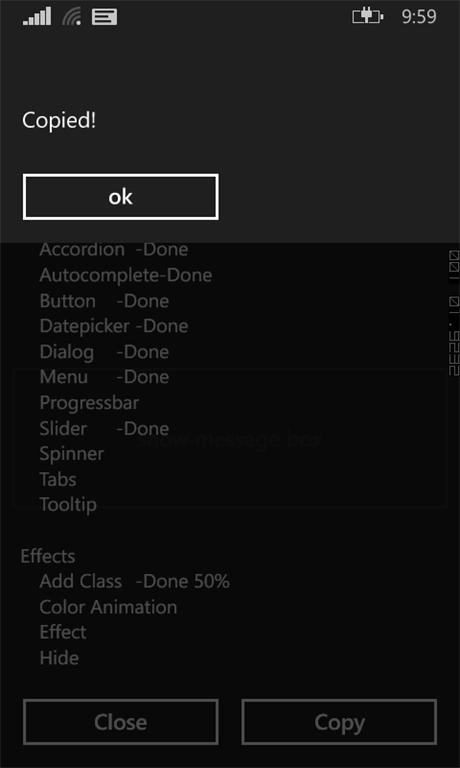
void cmb_Dismissing(object sender, DismissingEventArgs e)
{
if (e.Result==CustomMessageBoxResult.RightButton)
{
Clipboard.SetText(cmb.Content.ToString());
}
MessageBox.Show("Copied!");
}
private string getTextForLabel()
{
using(StreamReader s=new StreamReader("sample.txt"))
{
return s.ReadToEnd();
}
}
}
}
The Show method is used to launch the task.
Output
Join the conversation! Your thoughts help the community grow.