

The sample in this article shows how to use Data Access Application Block 5.0 with a real-world example in ASP.Net.
What is a Data Access Application Block (DAAB)? A Data Access Application Block encapsulates the performance and resource management best practices for accessing Microsoft SQL Server databases. It can easily be used as a building block in your own .NET-based application. If you use it then you will reduce the amount of custom code you need to create, test, and maintain. It comes with a single assembly with a class that has many useful methods. It reduces the amount of custom code.
A Data Access Application Block provides the following benefits:
- It uses the functionality provided by ADO.NET 2.0 and with it, you can use ADO.NET functionality along with the application block's functionality.
- It reduces the need to write boilerplate code to perform standard tasks.
- It helps maintain consistent data access practices, both within an application and across the enterprise.
- It reduces difficulties in changing the database type.
- It relieves developers from learning different programming models for different types of databases.
- It reduces the amount of code that developers must write when they port applications to different types of databases. Read more in http://msdn.microsoft.com/en-us/library/cc309168.aspx.
Install Enterprise Library
Please follow this link to download the Enterprise Library:
http://www.microsoft.com/en-in/download/details.aspx?id=15104
Getting Started
Begin using the following procedure:
- Start Visual Studio
- Create a new website
- Provide the name and location of website
- Click "Next"
Now add a reference for the following two assemblies in the bin folder:
Microsoft.Practices.EnterpriseLibrary.Data.dll
Microsoft.Practices.EnterpriseLibrary.Common.dll
Now open web.config in edit mode and provide database settings.
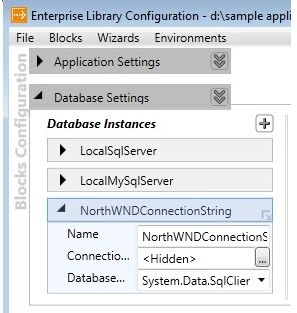
Image 1.
As you can see, two things have been added in web.config.
- <configSections>
- <section name="dataConfiguration" type="Microsoft.Practices.EnterpriseLibrary.Data.Configuration.DatabaseSettings, Microsoft.Practices.EnterpriseLibrary.Data, Version=5.0.414.0, Culture=neutral, PublicKeyToken=31bf3856ad364e35" requirePermission="true" />
- </configSections>
- <dataConfiguration defaultDatabase="NorthWNDConnectionString" />
- <connectionStrings>
- <add name="NorthWNDConnectionString" connectionString="data source=.\SQLEXPRESS;Integrated Security=SSPI;AttachDBFilename=|DataDirectory|NORTHWND.MDF;User Instance=true"
- providerName="System.Data.SqlClient" />
- </connectionStrings>
The following are my database Stored Procedures:
- CREATE PROCEDURE dbo.GetCustomers
- AS
- /* SET NOCOUNT ON */
- SELECT top 10 * FROM CUSTOMERS
- RETURN
- CREATE PROCEDURE CustOrdersDetail @OrderID int
- AS
- SELECT ProductName,
- UnitPrice=ROUND(Od.UnitPrice, 2),
- Quantity,
- Discount=CONVERT(int, Discount * 100),
- ExtendedPrice=ROUND(CONVERT(money, Quantity * (1 - Discount) * Od.UnitPrice), 2)
- FROM Products P, [Order Details] Od
- WHERE Od.ProductID = P.ProductID and Od.OrderID = @OrderID
Now to work on the coding part.
Drag and drop a GridView to the page.
Add these namespaces to the code file.
The following code shows how to call a Stored Procedure that returns a DataSet.
- using Microsoft.Practices.EnterpriseLibrary.Data;
- using Microsoft.Practices.EnterpriseLibrary.Common;
- using System.Data;
- using Microsoft.Practices.EnterpriseLibrary.Data.Sql;
- //This code is used to call stored procedure without parameter and bind gridview
- Database objDataBase = DatabaseFactory.CreateDatabase();
- DataSet ds = new DataSet();
- try
- {
- ds = objDataBase.ExecuteDataSet("GetCustomers");
- GridView1.DataSource = ds;
- GridView1.DataBind();
- }
- catch (Exception ex)
- {
- throw ex;
- }
The following code shows how to call a Stored Procedure with a parameter that returns a DataTable.
- DataTable dt = new DataTable();
- Database objDB = DatabaseFactory.CreateDatabase();
- DbCommand cmd;
- try
- {
- cmd = objDB.GetStoredProcCommand("CustOrdersDetail");
- objDB.AddInParameter(cmd, "@OrderID ", DbType.Int32, orderId);
- dt = objDB.ExecuteDataSet(cmd).Tables[0];
- GridView1.DataSource = ds;
- GridView1.DataBind();
- }
- catch (Exception ex)
- {
- throw ex;
- }
The following code shows a direct statement with a parameter that returns a DataTable.
- Database db = DatabaseFactory.CreateDatabase();
- DataTable dt = new DataTable();
- Int32 orderid = 10248;
- string query = "SELECT ProductName,UnitPrice=ROUND(Od.UnitPrice, 2),Quantity,Discount=CONVERT(int, Discount * 100),ExtendedPrice=ROUND(CONVERT(money, Quantity * (1 - Discount) * Od.UnitPrice), 2) FROM Products P, [Order Details] Od WHERE Od.ProductID = P.ProductID and Od.OrderID = @OrderID";
- DbCommand command;
- command = db.GetSqlStringCommand(query);
- db.AddInParameter(command, "@OrderID", DbType.Int32, orderid);
- dt = db.ExecuteDataSet(command).Tables[0];
- GridView3.DataSource = dt;
- GridView3.DataBind();
Press F5 to run the application.
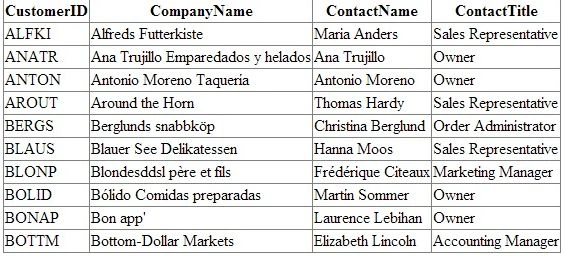
Image 2.
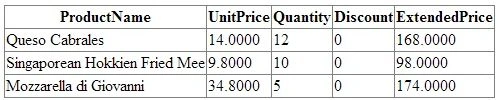
Image 3.
Arul RethinamPosted Nov 3, 2013, 11:55 PM
very simply explained. Nice Statement