

Abstraction, in the general object-oriented sense, means hiding how something works and exposing only what it does. That definition is simple enough to fit in a textbook footnote — but in enterprise applications, it becomes one of the most consequential architectural decisions a team makes. Done well, it lets a system evolve for years without breaking. Done poorly (or not at all), every requirement change turns into a multi-team fire drill.
TL;DR — In enterprise systems, abstraction isn't about elegance, it's about survival. The interfaces you place at each layer boundary (data access, cache, secrets, external systems, and — critically, when other teams consume your API — the contract itself) are what let requirements change without breaking every team downstream. This article walks through a real layered C# design for an insurance platform, showing exactly where those seams should go, why "the database will never change" is a myth, and where teams tend to overdo it.
Let's walk through this using a concrete example: Safe Mode Insurance, a large insurance platform with a big customer base, multiple internal teams, and APIs shared with external integration partners.
The Scenario
Safe Mode Insurance needs a new API to accept and manage premium customer data, and this API will be consumed by other teams — some internal, some external integration partners.
A typical layered implementation looks like this — with the interface sitting explicitly at every boundary:
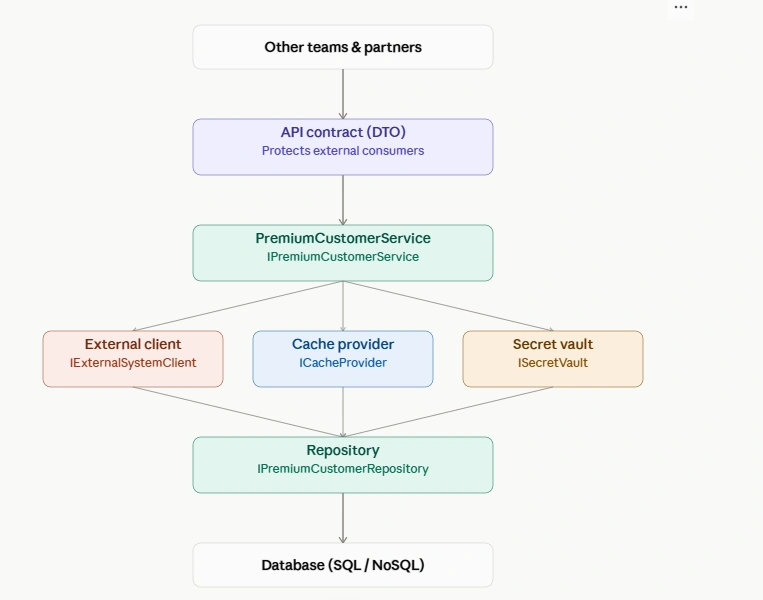
Color/role key: the contract layer (purple) protects external consumers from internal change · the service and repository (teal) hold core business logic · the three infrastructure dependencies (coral/blue/amber) are the swappable seams · the endpoints (gray) are neutral.
public interface IPremiumCustomerService
{
    Task<PremiumCustomerDto> GetCustomerAsync(int id);
    Task<PremiumCustomerDto> CreateCustomerAsync(CreatePremiumCustomerRequest request);
}

public class PremiumCustomerService : IPremiumCustomerService
{
    private readonly IPremiumCustomerRepository _repository;
    private readonly ICacheProvider _cache;
    private readonly IExternalSystemClient _externalClient;

    public PremiumCustomerService(
        IPremiumCustomerRepository repository,
        ICacheProvider cache,
        IExternalSystemClient externalClient)
    {
        _repository = repository;
        _cache = cache;
        _externalClient = externalClient;
    }

    public async Task<PremiumCustomerDto> GetCustomerAsync(int id)
    {
        var cached = await _cache.GetAsync<PremiumCustomerDto>($"customer:{id}");
        if (cached != null) return cached;

        var customer = await _repository.GetByIdAsync(id);
        var dto = MapToDto(customer);
        await _cache.SetAsync($"customer:{id}", dto, TimeSpan.FromMinutes(10));
        return dto;
    }

    private PremiumCustomerDto MapToDto(PremiumCustomer customer) => new()
    {
        Id = customer.Id,
        Name = customer.Name,
        PolicyTier = customer.PolicyTier.ToString()
    };
}
Because every dependency is injected as an interface, swapping the external system, the cache provider, or the key vault — becomes a registration change, not a rewrite:
// Before
builder.Services.AddScoped<ICacheProvider, RedisCacheProvider>();
builder.Services.AddScoped<ISecretVault, AzureKeyVaultProvider>();

// After the requirement change
builder.Services.AddScoped<ICacheProvider, InMemoryDistributedCacheProvider>();
builder.Services.AddScoped<ISecretVault, AwsSecretsManagerProvider>();
PremiumCustomerService never changes. The other teams consuming your API never know the internal swap happened. That's the payoff.
| scenario | Note |
|---|---|
| Mocking the data layer during local debugging | Classic and one of the highest-value uses of abstraction |
| Changing external API calls | Very common — partner integrations change SDKs/endpoints often |
| Switching cloud storage providers | e.g., Azure Blob Storage → AWS S3, abstracted behind IFileStorageProvider |
| Switching the DB | mergers, cost optimization, CQRS read-model splits, regional data residency laws, scaling bottlenecks |
Additional Scenarios Worth Adding
1. Regional / regulatory business rule variation Insurance premium calculation rules often differ by state or country. Abstracting the rule engine behind a strategy interface avoids branching logic scattered across the codebase:
public interface IPremiumCalculationStrategy
{
    decimal Calculate(PremiumCustomer customer);
}

public class USPremiumCalculationStrategy : IPremiumCalculationStrategy { }
public class EUPremiumCalculationStrategy : IPremiumCalculationStrategy { }
A factory or DI-based resolver picks the right strategy per region at runtime — no if (country == "US") sprawl.
2. Resilience policies (retry, circuit breaker, timeout) When calling external systems (reinsurance partners, credit bureaus, fraud-check services), wrapping calls behind an abstraction lets you change resilience behavior — e.g., swap a hand-rolled retry loop for Polly-based policies — without touching business logic:
public interface IResilientApiClient
{
    Task<TResponse> SendAsync<TResponse>(Func<Task<TResponse>> action);
}
3. Authentication mechanism for shared APIs Teams consuming your API today might authenticate via API keys; tomorrow the organization mandates OAuth2/OIDC. Abstracting authentication handling (IAuthTokenValidator) means the migration doesn't ripple through every controller.
4. Observability / telemetry provider Enterprises frequently re-platform from one observability stack to another (App Insights → Datadog → OpenTelemetry-native). An ITelemetryPublisher abstraction avoids sprinkling vendor SDK calls throughout business code.
5. Messaging / event publishing If premium customer events (created, upgraded, cancelled) are published to other systems, abstracting the message bus (IEventPublisher) means a move from Azure Service Bus to Kafka doesn't touch domain logic.
The Caution
Abstraction is powerful, but enterprise teams do overuse it — commonly called "interface soup": wrapping every internal class in an interface with only one implementation and no realistic scenario for a second one. This adds indirection with zero payoff and makes the codebase harder to navigate.
The practical rule: abstract at points of volatility — places where you genuinely expect implementation to change, need to mock for testing, or need to protect external consumers from internal change. Don't abstract stable, single-implementation, internal-only logic just because "it's good practice."
Summary
| Abstraction Point | Interface Example | Why It Matters |
|---|---|---|
| Data access | IPremiumCustomerRepository | DB swap, testing, CQRS splits |
| Caching | ICacheProvider | Redis ↔ in-memory ↔ distributed cache swaps |
| Secrets/config | ISecretVault | Key Vault ↔ Secrets Manager migration |
| External integrations | IExternalSystemClient | Partner API changes, SDK upgrades |
| File storage | IFileStorageProvider | Cloud provider migration |
| API contract | DTO + mapping layer | Protects external teams from internal churn |
| Business rules | IPremiumCalculationStrategy | Regional/regulatory rule variation |
| Resilience | IResilientApiClient | Retry/circuit breaker policy changes |
| Auth | IAuthTokenValidator | API key → OAuth2 migration |
| Observability | ITelemetryPublisher | Vendor tooling migration |
| Messaging | IEventPublisher | Message broker migration |
Closing Thought
Abstraction isn't about hiding complexity for its own sake — in enterprise systems, it's a survival mechanism for change. The teams that get burned aren't the ones with too many interfaces; they're the ones missing an interface exactly where the business decided to change something.
For Safe Mode Insurance, that meant three things had to be true from day one:
Every dependency the
PremiumCustomerServicerelies on — cache, secrets, external systems, the database — sits behind an interface, resolved through DI.The API contract other teams depend on is a separate model from the internal domain entity, so internal refactors don't become breaking changes for partners.
Not everything gets an interface — only the things that are genuinely expected to change, get mocked in tests, or need to be protected from internal churn.
Join the conversation! Your thoughts help the community grow.