

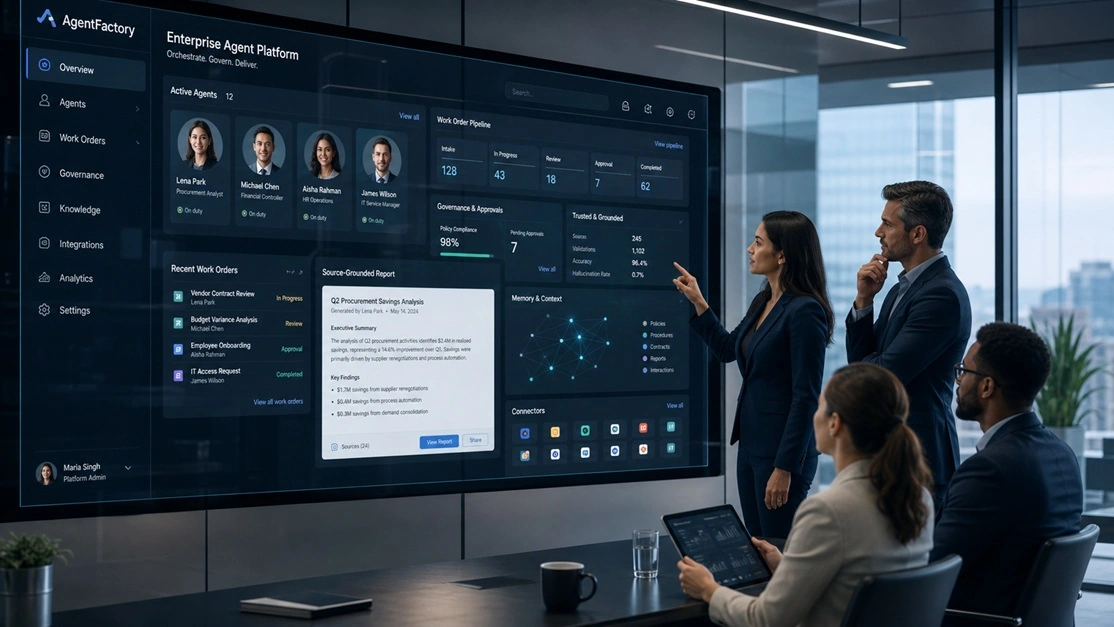
Enterprise AI is moving beyond simple chatbots. The first generation of AI tools helped users ask questions, summarize documents, and generate text. That was useful, but it was only the beginning. The next generation must do much more. It must create governed agents, connect them to enterprise systems, assign real work, produce usable deliverables, preserve trusted memory, support approvals, operate across teams, and provide audit-ready evidence.
AlpineGate AI Technology’s AgentFactory is built for that next generation.
AgentFactory is not just an AI assistant builder. It is a full enterprise agent platform designed to help organizations create, govern, deploy, test, monitor, and continuously improve AI agents across business and technical workflows.
It brings together low-code agent creation, governed work-order execution, Microsoft 365 integration, GitHub integration, AgenticSDB memory, professional agent identity, approval gates, Business Analyst clarification, quality controls, Teams collaboration, developer testing support, and enterprise evidence generation into one unified solution.
The result is a platform that feels less like a generic chatbot tool and more like a true agentic operating system for the enterprise.
Agents as Real Digital Workers
AgentFactory treats agents as governed digital workers, not simple prompt wrappers.
Each agent can have a role, skills, profile, resume-style background, persistent visual identity, knowledge sources, tool bindings, lifecycle state, governance controls, and execution history. This allows organizations to manage agents with the same seriousness they apply to business processes, software systems, enterprise applications, and controlled data.
Users can create agents, assign them structured work, monitor execution, approve important stages, inspect outputs, and review evidence. Agents can participate in work-order runs, appear in team-based PODs, communicate in role-based chat, and contribute to multi-agent delivery.
This makes AgentFactory valuable not only for experimentation, but for repeatable enterprise execution.
Instead of only asking:
“What can this AI answer?”
AgentFactory helps answer a more important question:
“What work can this agent safely, reliably, and professionally perform for the business?”
Governed Work Orders Instead of Loose Conversations
One of AgentFactory’s strongest ideas is the Work Order model.
A work order gives an agent a clear task, objective, context, constraints, expected output, execution path, and governance boundary. This helps transform AI interaction from casual prompting into structured delivery.
A work order can produce a usable HTML report, a Microsoft 365 smoke-test dashboard, a GitHub code-review artifact, a chatbot-style interface, a web page, a Teams package, a SharePoint-ready output, a business report, a test artifact, or another practical deliverable.
This is a major advantage.
Business users do not want to dig through raw model responses. Developers do not want vague suggestions without implementation context. Governance teams do not want invisible automation. Leaders do not want AI outputs that cannot be inspected or trusted.
They want something they can open, review, test, share, approve, archive, and use.
AgentFactory is designed around that reality.
Business Analyst Clarification Before Execution
AgentFactory understands that enterprise work often fails when the request is unclear at the beginning.
That is why the platform includes Business Analyst clarification behavior before major work proceeds. The BA role can ask work-order-specific questions, clarify scope, confirm assumptions, and help prevent the platform from building the wrong thing.
This is not a generic questionnaire. The clarification flow is designed to understand the current work order, its domain, its objective, and its expected outcome. A photo gallery request should receive photo-gallery questions. A Microsoft 365 smoke test should receive Microsoft 365 questions. A dashboard request should receive dashboard questions.
That matters because enterprise AI should not rush into execution when the task needs discovery.
AgentFactory’s BA-first approach helps improve quality, reduce rework, and make the final deliverable more aligned with the user’s real intent.
Professional Agent Identity
AgentFactory gives agents a more professional and human-centered presence.
Agents can have persistent profile photos, profile pages, resume-style information, role descriptions, and consistent visual identity across the platform. Profile images help users quickly recognize agents in catalog cards, resume views, POD teams, custom-agent lists, chat experiences, and role-replacement workflows.
This may sound like a small feature, but it improves the entire user experience.
In a serious enterprise platform with many agents, identity matters. Users need to know which agent they are working with, what that agent is responsible for, whether that agent is qualified for the task, and whether it is the right fit for a specific workflow.
AgentFactory makes agents feel less like anonymous records and more like trusted members of a governed digital workforce.
Real Agent Collaboration, Not Just Individual Chat
AgentFactory is designed for more than one-user-to-one-agent conversations.
Agents can operate in team-style workflows where different roles contribute to the same work order. A Business Analyst can clarify scope. A Frontend agent can build an interface. A QA agent can inspect the result. A Final Quality Gate can review delivery evidence. Other specialized agents can contribute based on the work being performed.
The platform supports richer agent interaction patterns where agents can report progress, ask relevant questions, respond to user direction, and participate in coordinated execution.
This is important because enterprise delivery is rarely a single-step conversation. Real work usually involves discovery, design, implementation, review, correction, approval, and closeout.
AgentFactory brings that workflow mindset into the agent platform itself.
Governance Built Into the Core
AgentFactory’s greatest strength is that governance is not an afterthought.
The platform includes approval checkpoints, Business Analyst clarification flows, prompt and session isolation, tool-binding controls, connector policies, audit-friendly run history, safe upload behavior, secret-handling safeguards, quality gates, Microsoft 365 permission diagnostics, GitHub policy controls, and compliance-oriented evidence generation.
This matters because enterprise AI cannot rely on blind automation.
Organizations need visibility, control, accountability, and review. They need to know what happened, who approved it, what sources were used, what tools were allowed, what output was produced, and whether the final result is trustworthy.
AgentFactory helps answer critical questions such as:
Who created this agent?
What task was it assigned?
What sources did it use?
Which tools was it allowed to access?
Was human approval required?
What output did it produce?
Did QA review the output?
Did the Final Quality Gate pass it, return it, or close with advisory notes?
Can the result be reviewed and trusted?
These are the questions enterprise AI platforms must answer to move from demos to production.
Quality Gates That Support Delivery
AgentFactory includes quality controls that help prevent weak outputs from silently becoming final deliverables.
The platform supports QA review, approval checkpoints, and Final Quality Gate behavior. It can identify delivery concerns, route work back when needed, and distinguish between true release-stopping issues and advisory polish items.
This is an important enterprise distinction.
Not every minor UI note should restart an entire delivery cycle. Not every advisory issue should block release. At the same time, serious issues should not be ignored.
AgentFactory’s quality flow is designed to support practical delivery: inspect the result, improve it when necessary, avoid endless loops, and preserve human control when a critical decision is needed.
That makes the platform feel closer to a professional software and operations workflow than a simple AI chat interface.
AgenticSDB: A Strategic Memory Foundation
AgentFactory is strengthened by its integration with AlpineGate AI Technology’s AgenticSDB, a governed memory and contextual intelligence layer.
AgenticSDB helps agents move beyond stateless conversations. It supports structured memory, contextual retrieval, scoped knowledge, temporal awareness, source grounding, and self-learning direction.
This gives AgentFactory an important long-term advantage.
Enterprise agents should not forget everything after each interaction, but they also should not remember carelessly. Memory must be useful, governed, scoped, auditable, and aligned with business context.
AgenticSDB provides that foundation.
Together, AgentFactory and AgenticSDB create a platform where agents can become more contextual, consistent, and intelligent over time while remaining controlled and inspectable.
Strong Microsoft 365 Alignment
AgentFactory is practical because it connects to the systems where enterprise work already happens.
For Microsoft 365, the platform supports SharePoint, Teams, Outlook Mail, Calendar, Teams chat, Microsoft Graph connection testing, permission diagnostics, source-grounded smoke-test work orders, safe upload-testing flows, Teams app package generation, and Teams bot integration scenarios.
The platform can help users validate Microsoft 365 connectivity, inspect what SharePoint and Teams resources are visible, test upload behavior, generate smoke-test reports, and produce practical artifacts for Microsoft 365-connected workflows.
It also includes safer handling for credentials and secrets. Saved secrets are not rendered back into the browser, and connection testing provides clearer guidance when permissions are missing or incomplete.
This is a major enterprise benefit.
Microsoft 365 is where many organizations already live. AgentFactory does not treat it as an afterthought. It treats it as a core operating environment for enterprise agents.
Teams Collaboration and Bot Readiness
AgentFactory also strengthens the connection between agents and Microsoft Teams.
The platform supports Teams-related diagnostics, Teams app package generation, Teams bot setup artifacts, adaptive-card style collaboration scenarios, and hosted-tab style experiences. It can help prepare agents for real collaboration environments where approvals, notifications, work-order updates, and agent interactions may happen inside Teams.
This matters because enterprise users do not want to jump between disconnected systems all day.
If agents are going to become part of daily work, they need to appear where work happens. Teams is one of those places.
AgentFactory’s Teams direction helps move agents from isolated web experiences into collaborative enterprise workflows.
Outlook and Calendar Scenarios
AgentFactory’s Microsoft 365 direction also includes Outlook and Calendar-oriented capabilities.
This gives the platform a broader enterprise surface. Agents can be connected not only to documents and Teams spaces, but also to communication and scheduling workflows.
That opens the door for agent scenarios such as notification support, meeting coordination, calendar-based work planning, follow-up workflows, and enterprise productivity automation.
This is important because many business processes are not limited to files and repositories. They live across email, meetings, Teams channels, calendars, documents, and approvals.
AgentFactory is moving toward that broader enterprise reality.
GitHub Integration for Technical Teams
AgentFactory is not limited to business-user scenarios.
For technical teams, the platform includes GitHub integration with repository selection, branch selection, governed code-review scenarios, generated file commits, draft pull requests, protected-branch awareness, repository creation routing, policy controls, and safer secret handling.
This gives AgentFactory reach across engineering workflows.
A developer can run a GitHub review agent. An architect can request implementation analysis. A platform owner can generate code artifacts. A governance lead can inspect repository access policy. A team can route generated changes through a safer branch and pull-request process.
That makes AgentFactory valuable for both business execution and technical delivery.
It also separates AgentFactory from simpler chatbot builders. The platform is not only answering questions. It can participate in the lifecycle of real software work.
Developer-Friendly Local Testing
Enterprise platforms must be testable by developers, not only demoed in ideal cloud environments.
AgentFactory supports local developer testing for Microsoft 365 and Teams callback scenarios through an app-managed local tunnel workflow. Instead of requiring users to manually run complex scripts, the platform can help configure, start, and apply a public HTTPS tunnel for localhost testing.
This is especially useful for Teams and Graph callback development, where external services need to reach a developer machine.
The platform can manage tunnel configuration, preserve saved token presence without exposing secrets, read the public tunnel URL, and apply it to relevant Microsoft 365 callback settings.
That is a serious developer-experience improvement.
It makes advanced Microsoft 365 and Teams testing more accessible, especially for local development, demos, and pre-production validation.
Source-Grounded, Usable Deliverables
AgentFactory focuses heavily on producing usable outputs.
Many AI systems generate answers. AgentFactory is designed to generate deliverables.
That includes reports, dashboards, static HTML pages, test results, implementation artifacts, agent packages, workflow outputs, Teams packages, SharePoint-ready files, GitHub review artifacts, and evidence bundles.
This makes the platform especially valuable in business environments where results need to be reviewed, approved, archived, shared, or deployed.
This “output as product” mindset is a major advantage.
It helps move AI from conversation into execution.
Prompt Isolation and Domain Drift Protection
A common weakness in agent systems is stale context.
Sometimes an agent carries old instructions, previous use cases, cached assumptions, or unrelated memory into a new task. This can cause the output to drift into the wrong domain.
For example, a user may ask for a photo gallery, but the system accidentally generates a restaurant page because an earlier task involved a restaurant. Or a user may request a Microsoft 365 smoke test, but the agent reuses unrelated old context from a different work order.
AgentFactory directly addresses this problem with prompt isolation, prompt fingerprinting, expected-domain handling, source-of-truth constraints, and domain-drift protection.
This helps ensure each work order is treated as its own governed execution context.
That reliability is essential for enterprise trust.
Safer Secrets and Connector Handling
Enterprise connectors are powerful, but they also introduce risk.
AgentFactory includes safeguards around credential and secret handling. Saved secrets are not casually rendered back into the browser. Placeholder values are treated carefully. Connection tests are designed to provide useful status without exposing sensitive material.
This matters for GitHub, Microsoft 365, Teams, Graph, ngrok, and other integration-heavy workflows.
A serious enterprise agent platform must not only connect to systems. It must connect responsibly.
AgentFactory’s connector design reflects that principle.
Comparison With Microsoft Copilot Studio
Microsoft Copilot Studio is a strong and mature platform, especially for organizations deeply invested in Microsoft’s ecosystem. It offers low-code agent creation, Microsoft 365 alignment, Power Platform integration, knowledge grounding, channel publishing, security controls, and enterprise governance capabilities.
AgentFactory’s advantage is different.
AgentFactory is more product-owned, source-code-oriented, artifact-driven, extensible, developer-friendly, and delivery-focused. It is designed not only to create agents, but to assign them governed work, produce usable outputs, integrate with Microsoft 365 and GitHub, preserve contextual memory through AgenticSDB, support approval-based execution, generate evidence, and evolve as a customizable enterprise platform.
Copilot Studio is excellent for standardized SaaS-based agent creation inside Microsoft’s ecosystem.
AgentFactory is stronger when an organization wants deeper ownership, broader customization, source-code control, generated deliverables, governed work-order execution, custom platform evolution, practical testing support, and a more open enterprise agent architecture.
In simple terms:
Copilot Studio helps organizations build agents inside Microsoft’s ecosystem.
AgentFactory helps organizations build their own governed agentic platform.
Key Advantages of AgentFactory
Governed Work-Order Execution
Agents can be assigned structured tasks with objectives, approvals, run status, artifacts, quality checks, and evidence.
Professional Agent Identity
Agents can have reusable profile photos, resume-style profiles, role descriptions, and recognizable visual presence across the platform.
Business Analyst Clarification
AgentFactory can clarify work-order scope before execution, helping prevent misaligned outputs and reducing rework.
Agent Team Collaboration
Agents can participate in coordinated workflows with role-based responsibilities, chat visibility, QA review, and Final Quality Gate handling.
Source-Grounded Deliverables
The platform focuses on usable outputs such as reports, dashboards, web pages, chatbot interfaces, test artifacts, Teams packages, and evidence bundles.
Microsoft 365 Integration
AgentFactory supports practical Microsoft 365 scenarios across SharePoint, Teams, Outlook, Calendar, Microsoft Graph diagnostics, upload testing, and Teams bot readiness.
GitHub Integration
The platform supports governed repository workflows, code review scenarios, branch-safe operations, generated commits, and draft pull-request delivery.
AgenticSDB Memory Layer
AgentFactory has a serious foundation for governed memory, contextual retrieval, scoped knowledge, temporal awareness, and self-learning evolution.
Prompt and Session Isolation
The platform reduces stale-context problems and domain-drift failures across different work orders and agent scenarios.
Enterprise Governance Controls
Approval gates, connector policies, audit history, safe upload behavior, tool-binding controls, quality gates, and compliance evidence are built into the platform.
Developer Testability
AgentFactory supports local developer testing for Microsoft 365 and Teams callback scenarios through app-managed tunnel support.
Customizable Ownership
Organizations can shape, extend, package, and govern AgentFactory around their own architecture, branding, security model, and roadmap.
The Bigger Vision
AgentFactory is built on a beautiful but practical idea:
Enterprise AI should not be a scattered collection of chatbots.
It should be a governed, inspectable, professional platform where agents have roles, identities, memory, permissions, workflows, outputs, approvals, quality checks, and evidence.
That is where enterprise AI is heading.
AgentFactory brings together the pieces that matter: agent creation, governed execution, enterprise connectors, practical deliverables, quality controls, memory, visual identity, Microsoft 365 alignment, GitHub workflows, developer testing, and extensibility.
It combines creativity with control.
It combines automation with accountability.
It combines intelligence with trust.
AlpineGate AI Technology’s AgentFactory is not just helping organizations use AI. It is helping them build their own agentic enterprise platform.
Join the conversation! Your thoughts help the community grow.