

Introduction
Enterprise AI is entering a new phase.
The first wave of adoption was defined by chatbots, assistants, prompt interfaces, and productivity helpers. These tools made AI accessible to employees and helped organizations understand the value of faster information access, drafting, summarization, and task support. They were useful, but they were not the end state.
The next phase is not about asking AI more questions. It is about assigning AI real work.
For C-level and EVP leaders, the strategic question has changed. The question is no longer whether AI can generate useful responses. The question is whether AI can safely participate in enterprise execution with governance, accountability, human approval, source control, review discipline, and evidence.
That is the shift AgentFactory is built for.
AgentFactory by AlpineGate AI Technologies Inc. is designed as a governed enterprise AI execution platform. It moves beyond simple conversational assistance by organizing AI work through structured WorkOrders, role-based agent PODs, enforceable skills, controlled execution, review workflows, and evidence-backed delivery.
This is the difference between using AI as a chatbot and operationalizing AI as a governed workforce capability.
The Enterprise Has Outgrown Simple Chatbots
Chatbots were an important beginning because they made AI easy to understand. Anyone could type a question and receive an answer. That simplicity helped accelerate adoption across departments.
But enterprise work is not a conversation.
Enterprise work requires scope, ownership, context, execution, review, approval, delivery, and accountability. A chatbot can assist with a moment, but it does not naturally manage a full work lifecycle. It does not inherently know which role should perform which part of the work, when human approval is required, what sources should be trusted, what actions should be restricted, or what evidence must be preserved.
This is why many organizations are now discovering the limits of chatbot-first AI adoption. The value is real, but the operating model is incomplete.
Enterprise leaders need more than productivity assistance. They need a way to convert intent into governed outcomes.
AgentFactory addresses that need by treating AI work as structured execution, not casual interaction.
From Conversational AI to Enterprise AI Execution
The next stage of AI maturity is governed execution.
In this model, AI is not only answering questions. It is participating in the delivery of work. It can help analyze requirements, understand documents, create plans, generate artifacts, review output, identify risks, suggest fixes, prepare evidence, and support approval workflows.
That requires a platform model, not only a chat interface.
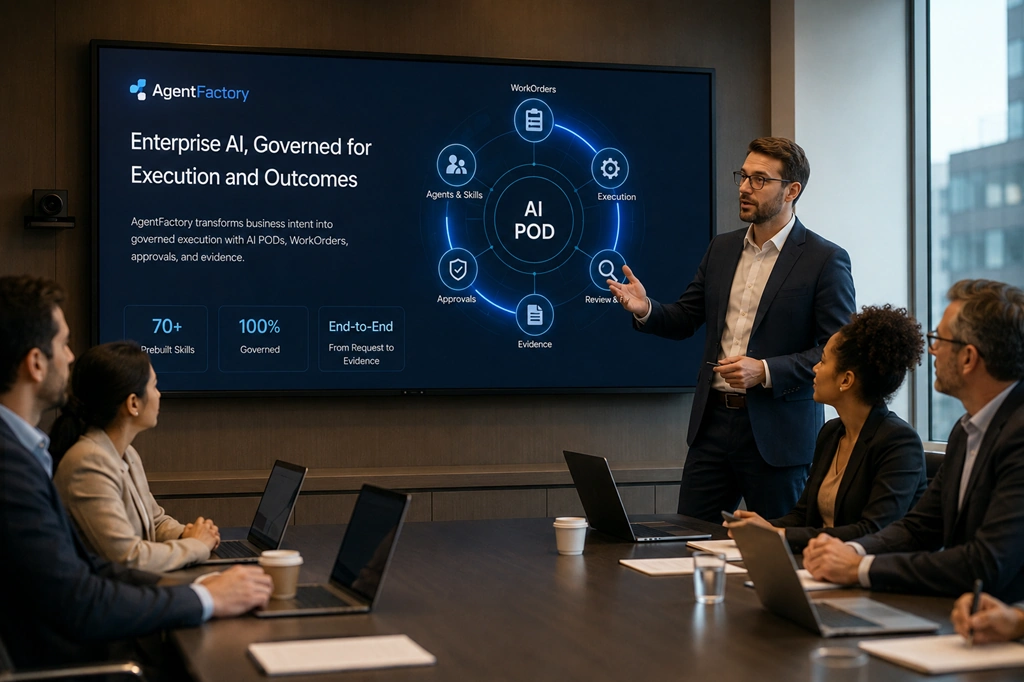
AgentFactory provides this model through WorkOrders and AI PODs. A WorkOrder becomes the execution contract. The POD becomes the coordinated delivery unit. Agents operate with roles, skills, boundaries, and responsibilities. Humans remain involved through approval gates and review decisions. The system preserves evidence so the enterprise can understand what happened.
This is how AI moves from a helpful assistant to a governed execution layer.
WorkOrders: The Enterprise Contract for AI Work
The WorkOrder is one of AgentFactory’s most important architectural concepts.
A WorkOrder is not a prompt. A prompt is a request for a response. A WorkOrder is a managed object for execution.
It can include the original business request, uploaded files, source context, requirements, acceptance criteria, role assignments, selected skills, tool boundaries, approval policies, run history, review findings, delivery artifacts, and evidence.
This gives enterprise AI work a disciplined lifecycle:
Intent becomes scope. Scope becomes execution. Execution becomes review. Review becomes decision. Decision becomes delivery. Delivery becomes evidence.
That lifecycle is what enterprises need if AI is going to participate in meaningful work.
A chatbot transcript may show what was said. A WorkOrder shows what was done, why it was done, who approved it, and what evidence remains.
AI PODs: The Managed Delivery Model
Enterprise work is rarely completed by one person or one function. It usually requires multiple roles.
A business request may need analysis, design, implementation, testing, review, security consideration, documentation, and approval. A process improvement may require discovery, workflow mapping, systems context, risk review, automation, validation, and operational signoff.
AgentFactory reflects this reality through AI PODs.
An AI POD is a coordinated group of specialized agents working against a structured WorkOrder. One agent may clarify requirements. Another may design the solution. Another may generate the implementation. Another may review quality. Another may validate risk. Another may prepare evidence.
This is a stronger enterprise model than relying on a single general-purpose bot.
A chatbot responds.
An AI POD collaborates.
A chatbot helps with interaction.
An AI POD supports delivery.
A chatbot produces answers.
An AI POD produces governed outcomes.
That is why AgentFactory’s POD model is strategically important.
Digital Workers with Roles, Skills, and Boundaries
AgentFactory treats agents as governed digital workers, not simple prompt wrappers.
This distinction matters. A prompt wrapper may produce useful output, but it does not naturally carry operational identity, role responsibility, skill boundaries, approval requirements, or evidence obligations.
In AgentFactory, agents can be defined by persona, skills, operating instructions, guardrails, tool bindings, data-source access, risk profile, and expected outputs. This creates a more manageable and governable model.
Persona defines who the agent is. Skills define what the agent can do. Tools define what the agent may access. Policies define what is allowed. Approvals define where humans must decide. Evidence defines what must be preserved.
That separation is essential for enterprise control.
Without it, organizations risk creating agents that sound professional but operate without clear boundaries. With it, organizations can begin to manage AI labor with the same seriousness they apply to human roles, system permissions, and operational workflows.
Skills Must Be Operational, Not Decorative
Many platforms allow users to describe an agent’s role or personality. That is useful, but insufficient.
In an enterprise environment, skills must become operational capability modules.
A document intelligence skill should influence how an agent uses source material. A workflow automation skill should define process boundaries. A development skill should produce reviewable artifacts. A QA skill should validate against acceptance criteria. A security skill should raise control expectations. An evidence skill should require traceability.
AgentFactory’s skill model is important because it moves beyond labels. Skills can shape the agent’s capabilities, guardrails, tool access, approval requirements, evaluation checklist, and evidence expectations.
This is how enterprises can scale agent usage without losing control.
The future of AI governance will not be only about who can create agents. It will be about who can control what those agents are allowed to do.
Governed Source Understanding
Enterprise AI must be grounded in enterprise context.
Most meaningful work depends on documents, spreadsheets, tickets, policies, database schemas, code repositories, previous decisions, operational records, and user-provided instructions. AI cannot be trusted for serious enterprise execution if it ignores the source material the organization provides.
AgentFactory’s approach is to make source material part of the WorkOrder and execution context.
Uploaded documents and enterprise sources should not merely sit beside the task. They should be understood, summarized, used for key facts, translated into task guidance, and made available to the appropriate agents.
This matters because grounded execution is a major trust requirement.
When source material exists, AI should not guess. It should use the approved context. It should preserve the relationship between source, action, output, review, and evidence.
That is the difference between generic AI assistance and enterprise-ready execution.
Secure Runtime and Gateway Control
Enterprise AI applications must not expose sensitive runtime details, secrets, or internal routing information to the browser or to external users.
AgentFactory’s secure gateway pattern is important because it keeps AI execution server-side and governed. Generated applications should call AgentFactory’s controlled runtime, not expose implementation details directly in front-end code.
This protects the enterprise in several ways.
It keeps credentials and runtime configuration private. It allows model and provider decisions to remain behind the platform boundary. It supports centralized logging, policy enforcement, monitoring, and control. It lets organizations change internal runtime behavior without changing every generated application.
For executives, this is not a technical detail. It is an enterprise control requirement.
The business experience can be simple. The execution path must remain governed.
Grounded Chatbots as Enterprise Applications
Chatbots still have a place in enterprise AI, but the enterprise version of a chatbot must be different from a simple conversational demo.
A serious enterprise chatbot should be grounded in approved content, use a secure gateway, support uploaded documents when allowed, use external context only under policy, avoid exposing internal implementation details, and provide source-aware responses where appropriate.
AgentFactory’s chatbot generation direction supports this stronger model.
The goal is not to generate a chatbot that looks convincing. The goal is to generate a governed assistant that can operate inside an enterprise environment.
This applies to employee portals, department knowledge assistants, support experiences, customer-facing assistants, partner portals, internal service desks, and operational dashboards.
The value is not only the chatbot. The value is the governance model behind it.
Embedded AI Without Losing Control
As organizations adopt AI, they will want to bring assistants into many channels: websites, portals, support centers, internal applications, operational dashboards, and department tools.
This creates a risk. If every embedded assistant becomes a separate unmanaged implementation, the enterprise loses control.
AgentFactory’s embeddable assistant direction solves this by separating the user experience from the governed runtime.
A business unit can expose a chatbot or assistant where users need it, while AgentFactory remains the control plane behind the experience. Policies, source grounding, runtime execution, allowed domains, uploads, approvals, and evidence remain centralized.
This gives organizations the ability to scale AI experiences without creating AI sprawl.
That is a key requirement for enterprise-wide adoption.
Human Approval as a Design Principle
Enterprise AI should accelerate work, not remove accountability.
AgentFactory’s approval model reflects this principle. Human approval can be required before risky actions, final delivery, reruns, external system changes, review acceptance, or completion of sensitive work.
This is the correct enterprise posture.
Some AI tasks can run autonomously. Others should pause. Some actions should be reviewed. Some decisions should remain human-owned. A mature platform must understand the difference.
AgentFactory is built around governed autonomy: AI can move work forward, but humans remain in control of material decisions.
That balance is what enterprise leaders need to trust AI execution.
Review Must Become Structured Action
Review is one of the most important parts of enterprise work.
In simple AI workflows, review often becomes informal commentary. A reviewer sees something wrong, leaves feedback, and the team manually decides what to do.
AgentFactory moves review toward structured action.
A review finding can become a fix, a change request, an addition to the current WorkOrder, a new issue, a human-review item, or an ignored item with a recorded reason. The finding can carry context such as severity, risk category, affected artifacts, acceptance criteria, recommended fix, and evidence references.
This transforms review from passive feedback into governed execution.
For enterprise leaders, this is highly significant. It means AI review can become part of the operational system, not just another comment stream.
Evidence Is the Foundation of Enterprise Trust
The future of enterprise AI depends on evidence.
It will not be enough for AI to produce useful-looking output. Organizations will need to know how the output was created, which sources were used, which agents participated, which skills were active, which tools were touched, what failed, what was repaired, who approved, and what was delivered.
AgentFactory is designed around this evidence-first direction.
Evidence is what allows AI work to be inspected. It supports auditability, governance, compliance, operational learning, and executive confidence. It makes AI execution manageable at scale.
A chatbot provides an answer.
A governed execution platform provides an outcome and a record.
That is the difference enterprises will increasingly demand.
The Competitive Landscape
The AI agent market is expanding quickly. Different competitors approach the opportunity from different starting points.
Some platforms begin from service management and enterprise workflow control. Some begin from productivity suites and collaboration. Some begin from cloud infrastructure. Some begin from automation. Some begin from integration. Some begin from team knowledge and software delivery context. Some begin from business application workflows. Some begin from developer productivity.
Each category has value.
But AgentFactory’s position is broader because it treats enterprise AI work itself as the governed object.
It is not limited to one application suite, one workflow category, one cloud environment, one automation pattern, one collaboration system, one CRM environment, or one development surface.
AgentFactory’s core operating model is WorkOrders, PODs, roles, skills, approvals, review, delivery, and evidence.
That is why it is positioned as a control plane for governed enterprise AI execution.
Competitive Grading Table
| Rank | Product | Strategic Enterprise Fit | Governance and Control | Execution Lifecycle | Evidence and Auditability | Cross-Functional Reach | Overall Grade |
|---|---|---|---|---|---|---|---|
| 1 | AgentFactory | A+ | A+ | A+ | A+ | A | A+ |
| 2 | ServiceNow AI Agents / AI Control Tower | A | A | A- | A- | A- | A |
| 3 | Microsoft Agent 365 / Copilot Studio / Agent Framework | A | A- | B+ | B+ | A | A- |
| 4 | AWS Bedrock Agents | A- | B+ | B+ | B | B+ | B+ |
| 5 | UiPath Agentic Automation | A- | B+ | A- | B+ | B+ | B+ |
| 6 | Workato Agentic | B+ | B | B+ | B | B+ | B |
| 7 | Atlassian Rovo | B+ | B | B | B | B+ | B |
| 8 | Salesforce Agentforce | B+ | B+ | B | B+ | B | B |
| 9 | Cursor Agents | B | C+ | B+ | C+ | B | B- |
This grading is based on enterprise AI work execution, not brand awareness or market size. A platform can be strong in its native ecosystem and still be narrower than a platform designed around governed work as the primary object.
AgentFactory ranks first because it aligns most directly with the enterprise need to convert intent into controlled, reviewable, auditable execution.
Why AgentFactory Leads
AgentFactory leads because it defines a more complete operating model for enterprise AI.
It does not stop at conversation. It does not stop at automation. It does not stop at code generation. It does not stop at workflow integration. It brings these concepts into a governed execution lifecycle.
The platform combines structured WorkOrders, role-based PODs, skill enforcement, source grounding, approval gates, review-to-action workflows, controlled delivery, and evidence.
That combination is what enterprises need as AI moves from experimentation to operations.
The strongest AI platforms of the next phase will not be measured only by the quality of their answers. They will be measured by their ability to complete work safely, visibly, and accountably.
AgentFactory is built for that future.
What This Means for Executives
For CEOs, AgentFactory creates a path to AI-driven acceleration without turning the enterprise into a collection of disconnected experiments.
For CIOs, it provides a governance model for agents, skills, tools, sources, approvals, and evidence across the organization.
For CTOs, it creates a structured bridge from business intent to technical delivery, validation, review, and controlled artifacts.
For COOs, it supports repeatable execution, operational accountability, and measurable work completion.
For CISOs and risk leaders, it strengthens control through boundaries, visibility, approval gates, and audit-ready evidence.
For EVPs and VPs, it gives business teams a way to convert ideas, requests, and operational needs into governed outcomes rather than isolated AI conversations.
This is why AgentFactory should be viewed not merely as an AI tool, but as an enterprise operating model for AI work.
Conclusion
The chatbot era was a necessary beginning, but it is not the final destination for enterprise AI.
The enterprise is moving toward managed AI agents, role-based digital workers, collaborative PODs, governed execution, human approval, structured review, and evidence-backed delivery.
AgentFactory is built for that transition.
It turns enterprise intent into governed WorkOrders. It organizes AI work through specialized PODs. It separates persona from skills. It grounds execution in source material. It manages approval gates. It turns review into action. It preserves evidence.
That is how AI becomes more than a conversation.
That is how AI becomes enterprise work execution.
AgentFactory and the rise of governed enterprise AI execution represents a larger shift in the market: from simple chatbots to accountable AI labor, from prompts to WorkOrders, from isolated assistants to coordinated PODs, and from impressive demos to evidence-backed enterprise outcomes.
Join the conversation! Your thoughts help the community grow.