

Let's Clear Up a Common Misunderstanding First
A lot of people think an AI agent is just an LLM wrapped inside a chat interface. It isn't or at least, it shouldn't be, the moment you're building something real.
An agentic AI system is a production software system where a model can reason over a goal, use tools, retrieve context, maintain state, and make decisions across multiple steps , decisions that trigger real actions through APIs. That's a very different thing from "type a question, get an answer."
This article breaks down agentic AI system design from a builder's perspective: a quick recap of single-agent vs. multi-agent systems, and then a deep dive into the core building blocks i.e. model routing, tools, memory, orchestration, evaluation, approvals, and the production principles (reliability, cost/latency, context design, observability, security, and privacy) that separate a demo from a system real users can actually depend on.
Single-Agent vs. Multi-Agent Systems — A Quick Recap
A basic LLM application usually takes an input, sends it to a model, and returns an output. That's it a one hop.
An agentic AI system goes much further. It can decompose a goal, decide what step to take next, call external tools, inspect the tool's result, update its own state, and keep going until it hits a stopping condition.
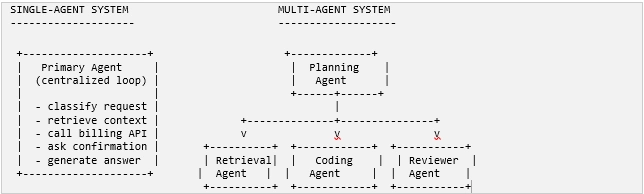
Single-agent systems: one primary agent owns the entire workflow. It may still call multiple tools, retrieve documents, update memory, and reason across several steps but the control loop is centralized. A customer support agent is a good example: it classifies the request, retrieves account context, calls a billing API, asks for confirmation, and then generates a final response in all within one agent's loop.
Multi-agent systems: the workflow is split across multiple specialized agents. One handles planning, another retrieves knowledge, another writes code, another reviews the output, and another handles execution. The key idea here is separation of responsibilities, instead of one agent doing everything, you design multiple agents with defined roles, input contracts, output contracts, and routing logic between them.
Multi-agent systems earn their complexity when the task has clear specialization, genuinely parallel work, review loops, or long-running workflows. But they also add real overhead: more coordination, more failure modes, more state to track, more logs to inspect, and more places where cost and latency can quietly creep up.
Why does this matter? Because the hard part was never getting a model to produce an answer. The hard part is designing a system that is reliable, cost-aware, fast enough for the user experience, context-aware, observable, and safe enough to be connected to real tools.
With that framing in place, let's get into the actual building blocks.
Building Block 1 — The Model Layer
The model layer includes the actual LLM (or multiple models, if you're using more than one) but just as importantly, it includes the strategy for when each model gets used.
Intuitively, you don't want one single powerful model handling every step of a workflow. That gets expensive and slow, very quickly. A better design is model routing:
Use cheaper, faster models for low-complexity steps — intent classification, routing, extraction, schema filling, and simple summarization.
Use stronger reasoning models only for steps where deeper reasoning genuinely changes the outcome.
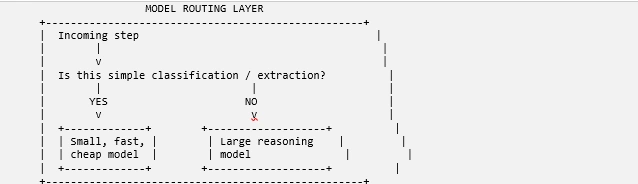
Example: In an appointment-booking agent, you probably don't need a frontier reasoning model just to detect whether the user wants to book, reschedule, cancel, or ask a question that a smaller model can classify that just fine. You also likely don't need an LLM to extract the date, time, doctor's name, and appointment type into a JSON schema. But you may want a stronger model when the user gives ambiguous constraints something like “I'll be traveling next week, I want to avoid mornings, and make sure this happens after my lab results come in.” That kind of constraint genuinely benefits from deeper reasoning.
You should also think about structured outputs at this layer. Any step that feeds into another part of the system should return predictable structure that not free-form prose. Use JSON schemas, Pydantic models, function/tool calling, or whatever structured-output mechanism your model provider supports.
The model layer should be able to answer three specific questions:
What model is being used for this particular step?
What output contract does it return?
What happens if the model fails or returns invalid output?
Building Block 2 — Tools
Tools are the interface between the model and the external world. A tool can be a database lookup, a CRM API, a calendar API, a payment API, a code interpreter, an internal search service, a ticketing system, a Slack action, a Google action or really any backend function the agent is allowed to call.
In production, tools should be designed like APIs, with strict constraints. Every tool should have a clear name, a description, an input schema, an output schema, permission boundaries, timeout behavior, retry behavior, and an error format. This matters because the model should never be allowed to send arbitrary instructions straight into your backend.
Example of a bad tool contract: a tool called update_user that accepts one vague natural-language string like “update this user based on the request” — that's far too open-ended.
Example of a safer tool contract: a user_id field, the field to update, the new value, a reason, a source, a request ID, and a confirmation_required flag.
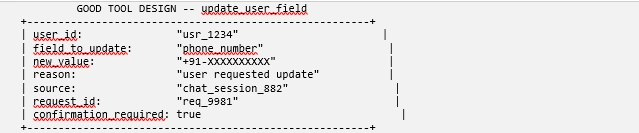
Tool outputs should also be machine-readable. If a tool fails, it returns a structured error. If it succeeds, it returns a structured result that an agent should never have to parse messy prose coming back from your backend.
A good design pattern here is to separate read tools from write tools, and build up in risk tiers:

Fetching available appointment slots is very different from canceling an appointment that you need to understand the risk factor of each tool before granting access to it.
This is also where MCP (Model Context Protocol) becomes relevant. It's an emerging pattern for exposing tools, resources, and context to agents in a standardized way. But even if you're not using MCP, the underlying system-design principle is the same: tools need contracts, they need permissions, they need boundaries, and they need logs.
Building Block 3 — Memory and State
This is where a lot of agentic systems become messy. Here's the important distinction: memory is not one thing. In agentic systems, you need to separate memory from state.
State is the current execution context for the workflow — what step are we on, what information has already been collected, which tools have been called, what did those tools return, has the user confirmed the action, and did the workflow pass or fail.
Memory is broader — it can include conversation history, user preferences, past actions, retrieved knowledge, document context, summaries, and any long-form information that might be useful later.
A common mistake is pulling all of this into a single vector database. That is not a good default. You should choose storage based on access pattern:

Example: Say an agent is helping a user reschedule a doctor's appointment. The current appointment ID, the proposed new time, the confirmation status, and the workflow step — all of that should be stored as a structured workflow step. But the user's medical history should not be casually passed through the LLM if the model only actually needs the appointment ID and the list of available slots.
You should also distinguish short-term context from long-term memory. Short-term context is what you pass into the prompt for the current turn. Long-term memory is something you retrieve selectively. The goal is never to stuff everything into the model's context window that creates context bloat. The goal is to retrieve the smallest useful context the model needs to make a decision at the current step.
This is exactly why memory design is, at its core, data architecture. You're deciding what to store, where to store it, how long to keep it, how to retrieve it, and what is safe (or unsafe) to send to the model.
Building Block 4 — Orchestration
Once you have your model layer, tools, and memory in place, you need something to actually coordinate all of them together — that's called orchestration.
Orchestration is the control layer of an agentic system. It defines how the system moves from a user request, through intermediate steps, through tool calls, to a final output. This can be implemented with plain application code, a graph-based framework like LangGraph, workflow engines like Temporal, LlamaIndex workflows, LangChain, custom state machines, queues or a combination of all of these.
The orchestration layer should define the control flow explicitly:
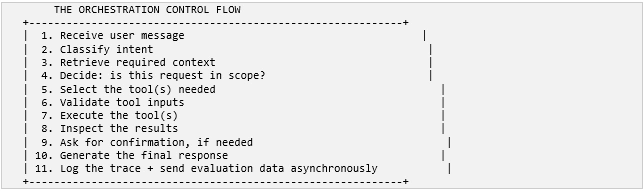
Here's a subtle but important point: for simple use cases, a deterministic pipeline is often better than a fully autonomous agent loop. Not every workflow needs planning and reflection. If a sequence of steps is mostly known ahead of time, design it as a pipeline or a state machine. Reserve agentic reasoning for workflows that genuinely need dynamic decision-making.
For more complex systems, graph-based orchestration becomes valuable because it lets you represent branching, retries, loops, approval gates, and fallback paths:
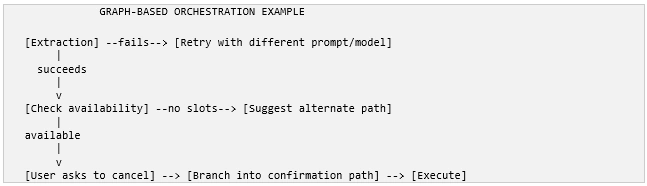
For multi-agent systems specifically, orchestration also has to include agent-to-agent routing: you need to define which agent owns the next step, what information gets passed along, what output format is expected, and how conflicts get resolved. Without this structure, multi-agent systems become extremely difficult to debug.
The key point to remember: do not confuse autonomy with a lack of structure. Production agents need a very clear control flow, even when they're making dynamic decisions inside it.
Evaluation — The Most Important, Most-Ignored Building Block
In traditional software, if a function runs and no exception is thrown, we often assume the system worked. In agentic AI systems, that assumption breaks down very quickly.
The model can return a valid JSON object that is semantically wrong. It can call the correct tool with the wrong arguments. It can retrieve irrelevant context. It can answer using stale information. It can fail to ask for confirmation when it should have. It can even refuse a perfectly valid request or comply with an unsafe one. None of these show up as a crash. Evaluation needs to be designed into the system from the very beginning.
For agentic systems, you need more than a "final answer" evaluation that you need trace-level evaluation, meaning you evaluate every important step in the trajectory: intent classification, retrieval quality, tool selection, tool arguments, policy compliance, confirmation behavior, final answer quality, and task success.

Example: A support agent could produce a very polished final answer but it may have quietly selected the wrong refund policy. If you only evaluate the final text, you miss the actual failure entirely. If you evaluate the trace, you can see that the retrieval step pulled the wrong policy document, or that the model misclassified the user's plan type.
You should maintain a test set of realistic scenarios: happy paths, ambiguous requests, out-of-scope requests, tool failures, malicious inputs, partial information, policy edge cases, and escalation cases. This becomes your regression test suite whenever you change the model, the prompt, the retrieval logic, or a tool schema.
You can also run sampled, asynchronous evaluations in production — an "LLM-as-a-judge" model can score a percentage of conversations offline, and high-signal user feedback can feed directly into your eval loop. But be careful: LLM-as-a-judge is useful, but far from perfect. For important workflows, combine model-based grading with deterministic checks and human review.
Your eval system should eventually produce metrics, not just examples — things like intent accuracy, tool-call success rate, invalid-schema rate, retrieval hit rate, refusal accuracy, escalation rate, task completion rate, user flag rate, and cost per successful task.
Approval and Policy Control
Not every action needs human approval but high-impact actions absolutely should have gates.
Sending an email, deleting data, issuing a refund, canceling an appointment, changing billing, updating a CRM record, running code, placing an order, or making a financial transaction that none of this should happen just because the model inferred the user's intent. There should always be a human in the loop for these.
A safer design pattern looks like this: MODEL SUGGESTS -> CODE VALIDATES -> USER APPROVES -> TOOL EXECUTES
The validation step should be deterministic wherever possible. Always check: ownership, permissions, whether the requested action is even allowed, whether required fields are present, and whether the user has confirmed the exact action and only then execute.
Example: If a user says “cancel my appointment,” the model can classify that intent as a cancellation and propose the target appointment. But the system should independently verify that the logged-in user actually owns that appointment, that it's cancellable, that cancellation is allowed under policy, and that the user explicitly confirms before the cancellation API is ever called.
This matters just as much in multi-agent systems: if one agent generates a plan and another agent executes it, the execution layer should never blindly trust the planning layer. Tool execution still needs its own validation and authorization. The agent should never be the source of truth for your business rules but your application code should be.
The Production Principles That Hold It All Together
Once you have the main building blocks in place, there are a set of production principles that keep the entire system reliable, affordable, and safe at scale.
a) Reliability
Reliability means the system behaves predictably even when the model does not. You get there through decomposition, contracts, retries, validation, fallbacks, and monitoring.
Decompose large prompts into smaller steps. A single giant prompt that classifies intent, retrieves context, decides policy, calls tools, and writes the final response is extremely hard to test. Smaller steps are far easier to evaluate and debug individually.
Use structured outputs. If the next step depends on the model's output, don't rely on free-form text — validate the schema. If it's invalid, retry. If it still fails, fall back to a safe path.
Wrap every model call like an unreliable upstream dependency. Timeouts, malformed outputs, rate limits, provider errors, and degraded quality should all have their own handling paths.
Separate deterministic validation from model reasoning. If the model extracts a date, your code should validate that date. If it selects a user ID, your code should verify the permissions. If it proposes a tool call, your code should validate the arguments.
Reliability isn't about making the model perfect — it's about designing the system so that the model's imperfections don't immediately become product failures.
b) Cost and Latency
Cost and latency need to be designed together, because agentic systems often involve multiple model calls per single user request. One interaction might include intent classification, query rewriting, retrieval, planning, tool selection, tool argument generation, tool result interpretation, final response generation, and evaluation. If every single step uses a large reasoning model, your system will be very slow and very expensive.
This is exactly where model routing pays off again with small models for simple classification and extraction, larger models only when ambiguity, reasoning, or synthesis is genuinely required.
A few other practical levers:
Limit tokens aggressively. Output tokens cost you both money and time. If the user only needs a two-sentence answer, don't generate a long explanation. If the downstream system only needs JSON, don't ask for prose.
Cache where it makes sense — retrieval results, repeated policy lookups, tool metadata, and stable context.
Use batching and asynchronous execution for non-blocking work like evaluation and summarization.
Stream responses for user-facing tasks that may take time — show progress states instead of leaving the user staring at a blank screen.
Enforce scope early. Out-of-scope requests can quietly burn tokens and tool calls — use cheap filters, rules, and intent gates before the expensive reasoning step ever happens.
A production agent should have real cost observability: tokens in, tokens out, cost per step, cost per conversation, and cost per successful task.
c) Context and RAG Design
This is one of the biggest differences between a toy agent and a genuinely useful production agent. The goal is never to pass everything into the prompt — the goal is to pass the right context for the current step.
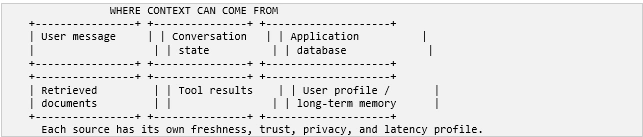
In practice, context can come from the user message, the conversation state, the application database, retrieved documents, tool results, the user profile, or even long-term memory and each of these sources has a different freshness, trust, privacy, and latency profile.
For RAG specifically, retrieval quality matters far more than simply having a vector database. You need document chunking, metadata filters, hybrid search when it's useful, reranking, freshness controls, and source attribution whenever the user needs to trust the answer.
You also need to separate trusted instructions from untrusted content. Retrieved documents should never be allowed to override system instructions. Tool outputs should be treated as data, not instructions. User-provided content should be isolated from developer or system instructions.
For long conversations, use summarization and checkpoints instead of passing the full history forever which store the summary separately from the raw conversation logs, and keep track of exactly what the summary is allowed to influence.
A context-aware system is one that knows what information it needs, where to retrieve it from, whether it's trusted, and whether it's even safe to send to the model.
d) Observability, Security, and Privacy
This is the final production layer, and it's a big one.
Observability: you need to log the full anatomy of every single agent run with model name, model version, prompt version, step name, workflow ID, conversation ID, tool name, tool arguments (masking sensitive values, of course), latency, time to first token, tokens in, tokens out, cost, number of retries, any fallbacks used, any errors, any user feedback, and eval scores. Yes, that's a lot but you need to log all of it, and more. You should always be able to answer: where exactly did the failure happen? Was it intent classification, retrieval, planning, tool selection, tool execution, policy validation, or the final response itself?
Security: treat everything that touches the model as attacker-controlled input, unless proven otherwise. User messages can contain direct prompt injection. Retrieved documents can contain indirect prompt injection. Tool outputs could contain poisoned data. Model outputs can contain unsafe commands — SQL, HTML, or other kinds of code.

So: isolate untrusted content, separate instructions from data, never execute raw model output, never run SQL or shell commands directly from model-generated text, give tools least-privilege permissions, and add approval gates for risky actions.
Privacy: send the minimum data needed to the model. If the model only needs an appointment ID and availability, don't send the full patient report. If it only needs a summarized ticket, don't send the full customer history. Always mask PII at the right time, set retention policies for logs, traces, and conversation archives, and keep sensitive fields out of the prompt unless they're actually required for the task. Your model provider, your vector database, your observability platform, and your logging systems are all part of your data boundary.
This is exactly why agentic AI system design isn't just prompt engineering. It's backend design, data design, security design, and product design, all with an LLM sitting in the loop.
The Final Takeaway
A production-grade agentic AI system needs:
Clear model routing
Strict tool contracts
Explicit memory and state management
Solid orchestration
Trace-level evaluations
Approval gates for high-impact actions
Cost and latency controls
Thoughtful context and RAG design
Observability, security, and privacy baked in from day one
It's all of it, working together not any single piece in isolation. That's the real difference between a demo that impresses people in a meeting, and a system real users can actually rely on.
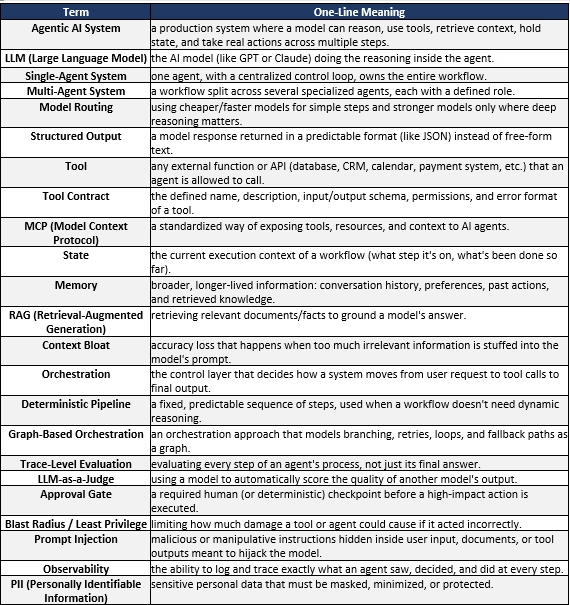
Glossary - AI Terms Used in This Article
Jasen FiciPosted Aug 3, 2026, 1:53 PM
We featured this article in DotNetNews here: https://dotnetnews.co/archive/the-net-news-daily-issue-510/