
Introduction
This article is a quick FAQ of Agile. By reading this you will understand fundamentals of Agile and different ways of implementing Agile.
What does Agile mean?
Dictionary meaning of Agile is quick moving. Now how does that apply to software? Agile development methodology considers software as the most important entity and accepts user requirement changes. Agile advocates that we should accept changes and deliver the same in small releases. Agile accepts change as a norm and encourages constant feedback from the end user.
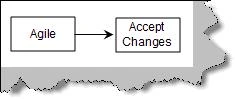
Figure: - Agile
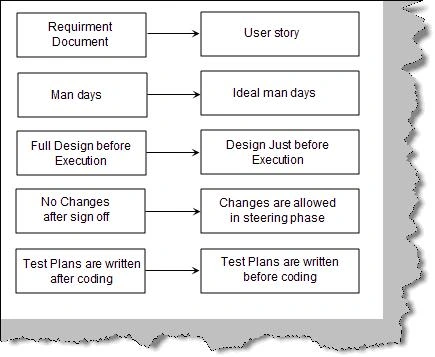
Below figure shows how Agile differs in principles from traditional methodologies.
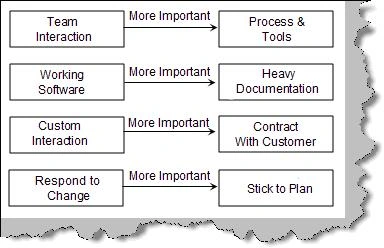
Figure: - Change of Agile thinking
- It's not necessary to have hi-fi tools and process but a good team interaction can solve lot of problems.
- Working software is more important than documentation.
- Management should not pay attention to only customer contract rather interact with customer and analyze the requirements.
- In traditional methodologies we pledge to stick our plans but agile says "If the customer wants to change, analyze and change your plan accordingly".
Below are principles of Agile methodology:-
- Welcome change and adapt to changing requirements
- Working software is the main measure of progress.
- Customer satisfaction is the most important thing and that can be attained by rapid, continuous delivery of useful software
- Day to day meetings between business people and development team is a must.
- Business and developers must work together. Face to face to communication is the most important thing.
- Deliver and update software regularly. In Agile we do not deliver software in one go, but rather we deliver frequently and deliver the important features first.
- Build projects around teams of motivated and trustful people.
- Design and execution should be kept simple.
- Strive for technical excellence in design and execution.
- Allow team to organize themselves.
Can you explain Agile modeling?
Agile modeling is an approach to the modeling aspects of software development. It's a practice for modeling and documentation for software systems. In one line
It's a collection of best practices for software modelling in light-weight manner.
In abstraction we can say it augments other software processes. For instance let's say your company is using UML and then Agile applies approach practices on UML.For example "Keep things simple" is Agile approach. So it means that we do not need to use all diagrams in our project, use only which are needed. If we summarize then in one word we can say Agile modeling says "Do only what's needed and nothing more than that".
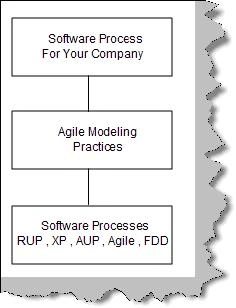
Figure: - Agile Modeling
What are core and supplementary principles in Agile modeling?
Agile modeling defines set of practices which can show us the way towards becoming successful Agile modelers. These practices are divided in to two sections one the "Core Principles" and other "Supplementary Principles". Below figure 'Agile Model Principles' shows the same in a pictorial format.
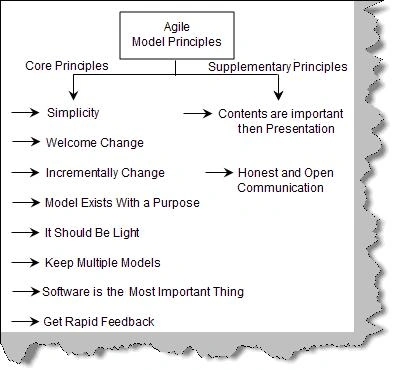
Figure: - Agile Model Principles
Let's understand one by one what those principles mean.
Core Principles
- Simplicity: - Do not make complex model keep it simple. When you can explain your team with a pen and paper do not complex it by using modeling tool like rational rose. Do not add complexity to show off something. If the developer understands only flow chart then explain him with a flow chart, if he understand pseudo-code then use pseudo-code and so on. So look at your team what they understand and prepare document in a similar fashion.
- Welcome Change: - Requirements grow with time. Users can change the requirements as the project moves ahead. In traditional development cycle you will always hear the word "Freeze the requirement", this has changed with Agile coming in. In Agile we welcome change and the same is reflected in the project.
- Incrementally change: - Nothing can be right at the first place itself. You can categorize your development with "The most required", "Needed features" and "Luxury features". In the first phase try to deliver the "The most required" and then incrementally deliver the other features.
- Model exists with a purpose: - Model should exist for a purpose and not for the sake of just existing. We should know who our target audience for whom the model is made. For instance if you are making a technical documents it's for the developers, a power point presentation it's for the top management and so on. If the model does not have target audience then it should not exist probably. In short "just deliver enough and not more".
- It should be light: - Any document or artifact you create should be also updated over a period of time. So if you make 10 documents then you should note that as the source code changes you also need to update those documents. So make it light as possible. For instance if your technical document is made of all diagrams existing in UML, it becomes important to update all diagrams over a period of time, which is again a pain. So keep it light weight make a simple technical document and update the same when you have logical ends in the project, rather than updating it periodically.
- Keep multiple models: - Project issues vary from project to project and the same project behavior can vary from organization to organization. So do not think one model can solve all issues keep yourself flexible and think about multiple models. Depending on situation apply the model. For instance if you are using UML for technical documentation then every diagram in UML can reflect the same aspects in different way. For instance a class diagram shows the static view of project while a flow chart a dynamic view. So keep yourself flexible by using different diagrams and see which best fits your project or the scenario.
- Software is the most important thing:- The main goal of a software project is to produce high quality software which can be utilized by your end customer in a effective manner. Many projects end up with bulky documents and management artifacts. Documentation is for the software and not software for the documentation. So any document or activity which does not add value to the project should be questioned and validated.
- Get Rapid and regular feedbacks: - Software is finally made for the user. So try to get feedback on regular basis from the end user. Do not work in isolation involve the end user. Work closely with the end customer, get feedback, analyze requirements and try to meet there need.
Supplementary principles
- Content is important than presentation: - The look and feel is not important rather the content or the message to be delivered by the content is important. For instance you can represent project architecture using complex UML diagrams, simple flow chart or by using simple text. It will look fancy that you can draw complex UML diagrams but if the end developer does not understand UML then it ends no where. A simple textual explanation could have met the requirement for communicating your architecture to the end developer / programmer.
- Honest and open communication: - Take suggestion, be honest and keep your mind open to new model. Be frank with the top management if your project is behind schedule. An open and free environment in project keeps resources motivated and the project healthy.
What is the main principle behind Agile documentation?
The main deliverable in Agile is a working software and not documentation. Documentation is a support to get the working software. In traditional delivery cycle lot of documentation where generated in design and requirement phase. But we are sure many of documentation where either created just for the sake of it or it was just created. Below are the some of the key points to make documentation Agile:-
- Before creating any document ask a question do we need it and if we who is the stake holder. Document should exist only if needed and not for the sake of existence.
- The most important thing is we need to create documentation to provide enough data and no more than that. It should be simple and should communicate to stakeholders what it needs to communicate. For instance below figure 'Agile Documentation' shows two views for a simple class diagram. In the first view we have shown all the properties for "Customer" and the "Address" class. Now have a look at the second view where we have only shown the broader level view of the classes and relationships between them. The second view is enough and not more. If the developer wants to get in to details we can do that during development.
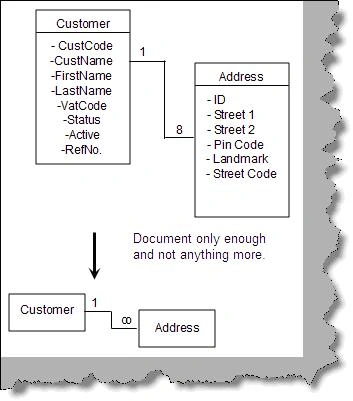
Figure: - Agile documentation
- Document only for the current and not for future. In short whatever documentation we require now we should produce and not something we need in the future. Documentation changes its form as it travels through every cycle. For instance in the requirement phase it's the requirement document, in design it's the technical documentation and so on. So only think which document you want to create now and not something in the future.
What are the different methodologies to implement Agile?
Agile is a thinking approach to software development which promises to remove the issues we had with traditional waterfall methodology. In order to implement Agile practically in projects we have various methodologies. Below figure 'Agile Methodologies' shows the same in more detailed manner.

Figure: - Agile Methodologies
Note: - We will cover each methodogly in detail in the coming sections.
What is XP?
Extreme Programming (also termed as XP) is an agile software development methodology. XP focuses on coding of the software. XP has four core values and fourteen principles.
XP has four core values:-
- Communication: - Team should communicate on a regular basis, share information, discuss solutions and so on. Teams who communicate very often are able to solve problems more efficiently. For instance any kind of issues which are resolved in a cryptic fashion send an email to the whole team. This ensures that knowledge is shared with every one and in your absence some other developer can solve the problem.
- Simplicity: - Keep things simple. Either it's from a process angle, technical angle or from a documentation point of view. An over complicated process or a technical architecture is only calling for problems.
- Feedback: - Regular feedback from end user helps us to keep the project on track. So regular feedbacks should be enabled from end user and testing team.
- Courage: - To bring change or to try something new, needs courage. When you try to bring change in an organization you are faced with huge resistance. Especially when your company is following traditional methodologies applying XP will always be resisted.
From the above four core values 14 principles are derived. Values give a broader level view while the 14 principles go deep in to how to implement XP.
- Rapid feedbacks: - Developers should receive rapid feedbacks from the end user. This avoids confusion in the last minute of delivery. In water fall model feedbacks are received in late intervals. This is minimized in XP.
- Keep it Simple: - Encourage simplicity in project design and process. For instance rather than using complex tools probably simple handwritten flowcharts on board can solve the problem.
- Give incremental changes: - Whenever you update patches and updates, release it in small pieces. If you are updating numerous patches in one go and if there is a defect, it will be difficult to track the same.
- Embrace Change: - Do not be rigid with the customer saying that we have already signed the requirement so we can not change the architecture. End customer or users are finally human beings so they can change as the project moves ahead....Accept it if it's logical.
- Light Weight: - Keep documentation and process as simple as possible. Do not overdose the developer with unnecessary documentation. Developer's main work is coding and ensuring that the code is defect free, so he should be more concentrating on the code rather than documentation.
- Deliver Quality: - Any code you deliver should be defect free. Be committed to your work and deliver defect free code.
- Start small and grow big: - Many times the end customer wants to start with a big bang theory. He can start with a big team, wants all the functionalities at the first roll out and so on. Start with small team and the "must have" features to be delivered. As we add features and the work load increases gradually increase your team strength.
- Play to win: - Take all steps which are needed to make a project success. Any type of deadline and commitment try to meet the same with true spirit.
- Encourage honest communication: - Promote honest communication. If communication happens face to face then there is less leakage of requirement. Encourage end user to sit with developers and give feedbacks; this makes your project stronger.
- Conduct testing honestly: - Test plans should not be created for the sake of creation. Test plan should prove actually that you are on track record.
- Adapt according to situation: - No two projects are same, no two organization are same and behavior of people from person to person. So it's very essential that our approach also adapts according to situations.
- Metric honesty: - Do not gather metrics for the sake of gathering or showing off to external people how many metrics your project derives. Pick metrics which makes sense to your project and helps you measure your project health.
- Accept responsibility: - Do not impose or assign people on task which they do not like. Rather question the resource once which tasks he likes and assign accordingly. This will increase productivity to a huge level and maintains your project enthusiasm high.
- Work with people's instincts: - Normally in a project team there are highly motivated people, moderately motivated and people with less motivation. So give power to your motivated team members and encourage them.

Manjiri BhuranPosted Oct 30, 2017, 4:57 AM
Nice artical...It help me lot
Sonu ChaudharyPosted Jun 8, 2016, 2:54 PM
good one ..
Humayun Kabir MamunPosted May 3, 2016, 2:57 AM
Nice as usual...
Ravi PatelPosted Mar 20, 2015, 2:29 AM
great article