

Artificial Intelligence has become one of the biggest shifts in product management since Agile transformed software delivery.
Just a few years ago, AI was primarily used for writing emails or generating meeting notes. Today, it has evolved into a true Product Management Co-Pilot—helping Product Managers research faster, make better decisions, automate repetitive work, and spend more time solving customer problems.
But here's the important distinction:
AI automates execution. Product Managers own strategy.
The future doesn't belong to Product Managers who resist AI. It belongs to those who know when to use AI—and when to rely on human judgment.
Why Every Technical Product Manager Should Embrace AI
As Product Managers, we spend a significant portion of our time on activities such as:
Customer research
Requirement analysis
Documentation
Sprint planning
Stakeholder communication
Product analytics
Release management
Many of these tasks are repetitive, time-consuming, and data-heavy.
AI can dramatically reduce this workload, allowing Product Managers to focus on activities that create the highest business value.
Typical benefits include:
Saving 30–50% of time on repetitive work
Better decisions through data-driven insights
Improved collaboration across Engineering, QA, Design, and Business teams
More focus on customer outcomes and product strategy instead of documentation
AI Across the Technical Product Management Lifecycle
Instead of viewing AI as a chatbot, think of it as a co-pilot throughout the entire product lifecycle.
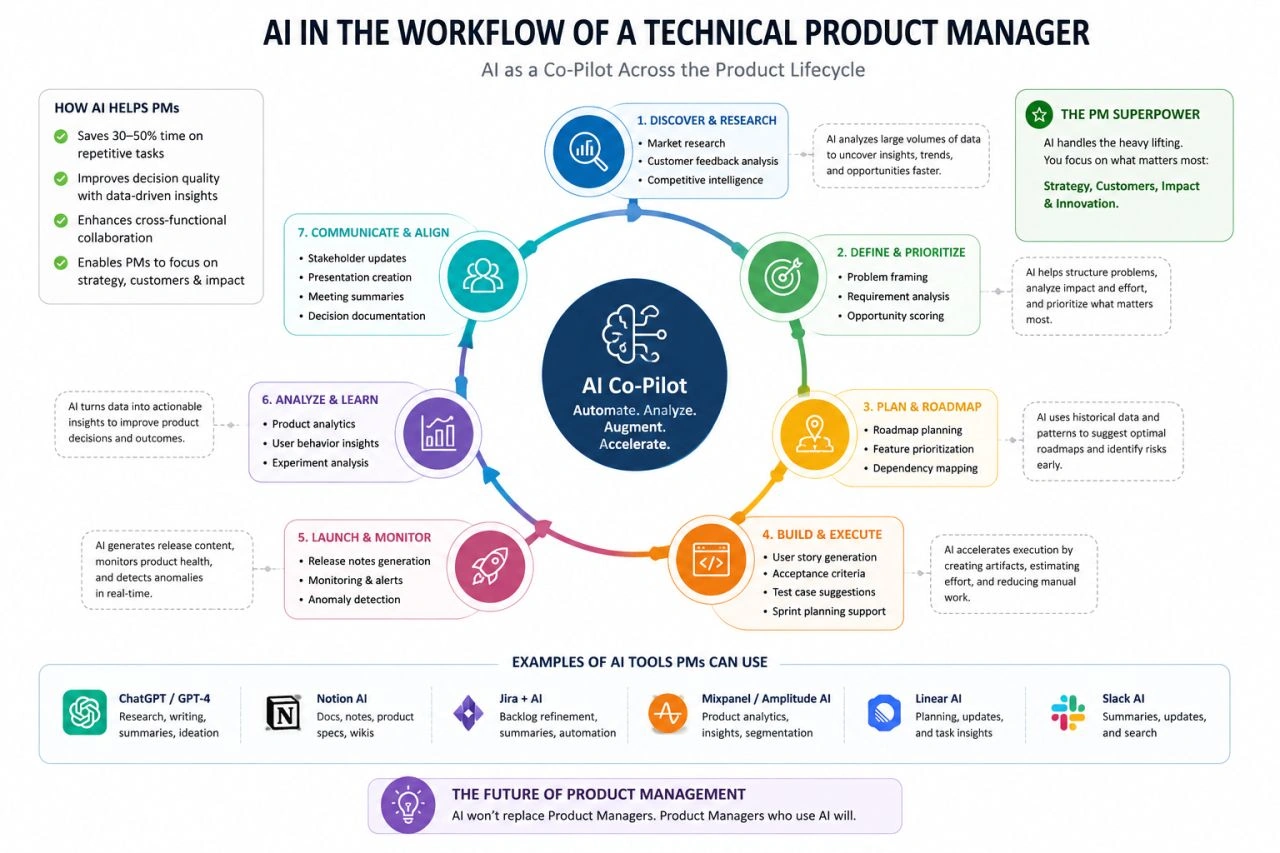
1. Discover & Research
Every successful product begins with understanding the problem.
AI can rapidly analyze thousands of data points that would otherwise take days.
Examples include:
Customer feedback analysis
Support ticket clustering
Market research
Competitor analysis
Trend identification
User interview summarization
Instead of spending hours reading feedback, AI identifies recurring pain points within minutes.
2. Define & Prioritize
One of the hardest responsibilities of a Product Manager is deciding what not to build.
AI helps structure product thinking by assisting with:
Problem framing
Requirement analysis
Opportunity scoring
Impact vs. Effort evaluation
Feature prioritization
Risk identification
Remember:
AI recommends. Product Managers decide.
Strategic trade-offs still require business understanding, customer empathy, and organizational context.
3. Product Planning & Roadmapping
Roadmap planning requires balancing customer needs, engineering capacity, technical debt, and business priorities.
AI can assist by:
Creating roadmap drafts
Identifying dependencies
Predicting delivery risks
Grouping related initiatives
Suggesting milestone planning
Rather than replacing roadmap discussions, AI provides better inputs for smarter conversations.
4. Build & Execute
This is where many Product Managers experience immediate productivity gains.
AI can generate:
User Stories
Acceptance Criteria
PRDs
Technical Specifications
Edge Cases
Test Scenarios
Sprint Planning Inputs
Estimation Assistance
For Technical Product Managers working closely with Engineering teams, AI significantly reduces documentation effort while improving consistency.
5. Launch & Monitor
Launching a feature is only the beginning.
AI helps Product Managers monitor product health by:
Drafting Release Notes
Creating Customer Announcements
Monitoring KPIs
Detecting anomalies
Summarizing production incidents
Highlighting adoption trends
Instead of manually collecting information from multiple dashboards, AI surfaces the insights that matter.
6. Analyze & Learn
Modern Product Management is driven by continuous learning.
AI accelerates post-launch analysis by examining:
Product analytics
User behavior
Funnel performance
Experiment results
Customer retention
Usage trends
Rather than simply presenting dashboards, AI helps answer questions like:
Why are users dropping off?
Which features increase retention?
What behaviors predict churn?
Which experiments generated the highest impact?
7. Communicate & Align
A Product Manager spends a considerable amount of time communicating across teams.
AI makes this easier by generating:
Executive summaries
Sprint updates
Meeting minutes
Product documentation
Stakeholder presentations
Decision logs
Project status reports
This enables Product Managers to spend less time writing and more time leading.
Where AI Stops—and Product Managers Begin
Despite rapid advances in AI, there are areas where human judgment remains irreplaceable.
AI cannot truly understand:
Customer emotions
Organizational politics
Business strategy
Long-term product vision
Team dynamics
Market intuition
Leadership
These are the qualities that define exceptional Product Managers.
AI provides information. Product Managers provide direction.
AI Tools Every Technical Product Manager Should Explore
While new tools emerge almost every month, these categories consistently provide value:
| Category | Example Use Cases |
|---|---|
| ChatGPT / GPT Models | Research, brainstorming, documentation, summarization |
| Notion AI | Product specs, meeting notes, knowledge management |
| Jira AI | Story generation, backlog refinement, sprint planning |
| Analytics AI | Product insights, segmentation, trend analysis |
| Linear AI | Planning, issue management, project updates |
| Slack AI | Search, meeting summaries, team communication |
The best workflow often combines multiple AI tools rather than relying on a single solution.
Practical AI Use Cases I've Found Valuable
Here are some real-world ways AI can make a Technical Product Manager more effective:
Convert raw customer feedback into prioritized feature requests.
Generate well-structured User Stories and Acceptance Criteria.
Draft comprehensive Product Requirement Documents (PRDs).
Estimate feature complexity by analyzing historical implementations.
Identify dependencies across teams before sprint planning.
Summarize lengthy stakeholder meetings into actionable decisions.
Generate release notes and customer-facing announcements.
Analyze product analytics to uncover user behavior trends.
Prepare executive updates in minutes instead of hours.
The Biggest Misconception About AI
Many professionals ask:
"Will AI replace Product Managers?"
A better question is:
Will Product Managers who use AI outperform those who don't?
The answer is increasingly becoming yes.
AI doesn't replace:
Customer empathy
Strategic thinking
Product vision
Leadership
Decision-making
Instead, it removes repetitive work so Product Managers can focus on the activities that create real business impact.
Final Thoughts
The role of a Technical Product Manager is evolving—not disappearing.
The most successful Product Managers of the next decade won't be those who know every framework or write the longest PRDs. They'll be the ones who combine human judgment with AI-powered execution to deliver value faster, make smarter decisions, and build products customers genuinely love.
The future of Product Management isn't Human vs. AI.
It's Human + AI.
What About You?
How are you using AI in your Product Management workflow?
Which AI tools have become indispensable for your day-to-day work?
What repetitive tasks have you successfully automated?
Have you discovered any unique AI use cases that improved product outcomes?
Share your experiences in the comments—I'd love to learn from your workflow and continue the conversation.
If you found this article helpful, please 👍 like, 💬 comment, and 🔁 share it with fellow Product Managers who are exploring how AI can transform the way they build products.
Summary
Artificial Intelligence is transforming Technical Product Management by automating repetitive tasks, accelerating research, improving decision support, and enhancing collaboration across teams. While AI serves as a powerful execution partner throughout the product lifecycle, strategic thinking, customer empathy, leadership, and product vision remain uniquely human responsibilities. The most effective Product Managers will be those who combine AI-powered productivity with sound business judgment to build products that deliver meaningful customer value.
Join the conversation! Your thoughts help the community grow.