

What is Overfitting?
Too Good to Be True When Accuracy Lies
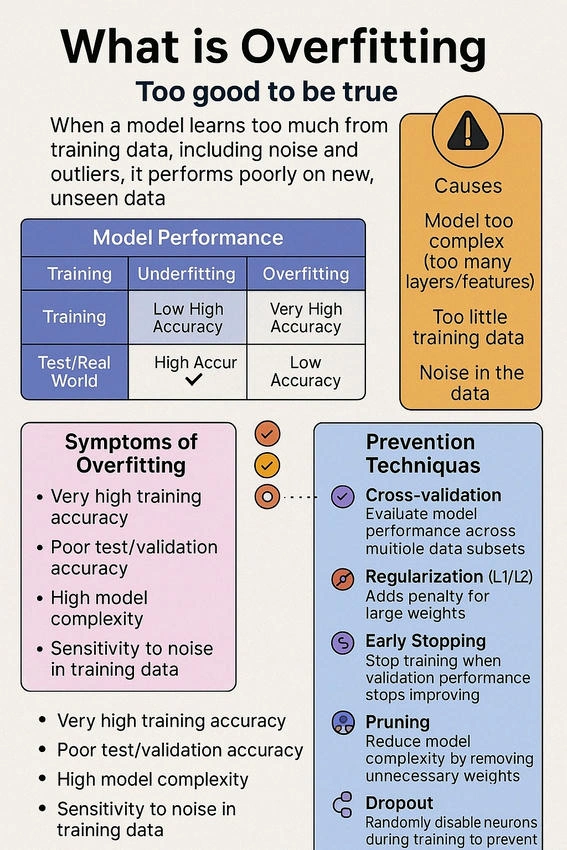
Overfitting occurs when a machine learning model becomes too familiar with the training data, memorizing it rather than learning to generalize from it. This includes not just the useful patterns but also the noise, anomalies, and outliers that don’t represent real-world conditions. As a result, the model performs exceptionally well on training data but fails to deliver accurate results when tested on new, unseen data. It’s like a student who aces practice tests by rote memorization but struggles when asked to apply concepts in different scenarios.
Model Performance Breakdown
| Dataset Type | Underfitting | Good Fit | Overfitting |
|---|---|---|---|
| Training | Low Accuracy – The Model hasn't learned enough. | High Accuracy –The Model understands underlying patterns. | Very High Accuracy – The Model memorizes data, including noise. |
| Test/Real World | Low Accuracy – Poor performance due to underlearning. | High Accuracy – Generalizes well to new data. | Low Accuracy – Performance drops as the model can't adapt beyond training data. |
Key Symptoms of Overfitting
- Very high accuracy on training data but disappointing results on test or validation sets.
- Poor generalization: The model struggles with new data it hasn’t seen before.
- Excessive complexity: Overly deep neural networks or too many parameters.
- Sensitivity to noise: Even small changes in input data can throw off predictions.
Common Causes of Overfitting
- Overly complex models: too many layers, neurons, or features relative to the amount of data.
- Insufficient training data: not enough examples to learn general patterns.
- Noisy datasets: Training data that includes irrelevant or random patterns.
- Training for too long: The model starts to adapt to noise if trained for excessive epochs.
Techniques to Prevent Overfitting
- Cross-validation: Use methods like k-fold cross-validation to test model performance on multiple data subsets, ensuring it generalizes well beyond the training set.
- Regularization (L1/L2): Introduce penalty terms in the loss function to discourage overly complex models with large weights.
- Early Stopping: Monitor validation performance during training and halt the process when improvements plateau or begin to reverse.
- Pruning: Remove redundant or less important parameters after training to simplify the model without sacrificing performance.
- Dropout: Randomly deactivate neurons during training, forcing the model to learn more robust and independent features.
- More Data / Data Augmentation: Collect more real-world data or artificially expand the dataset with techniques like rotation, flipping, or noise injection to help the model learn general patterns.
Join the conversation! Your thoughts help the community grow.