

Abstract
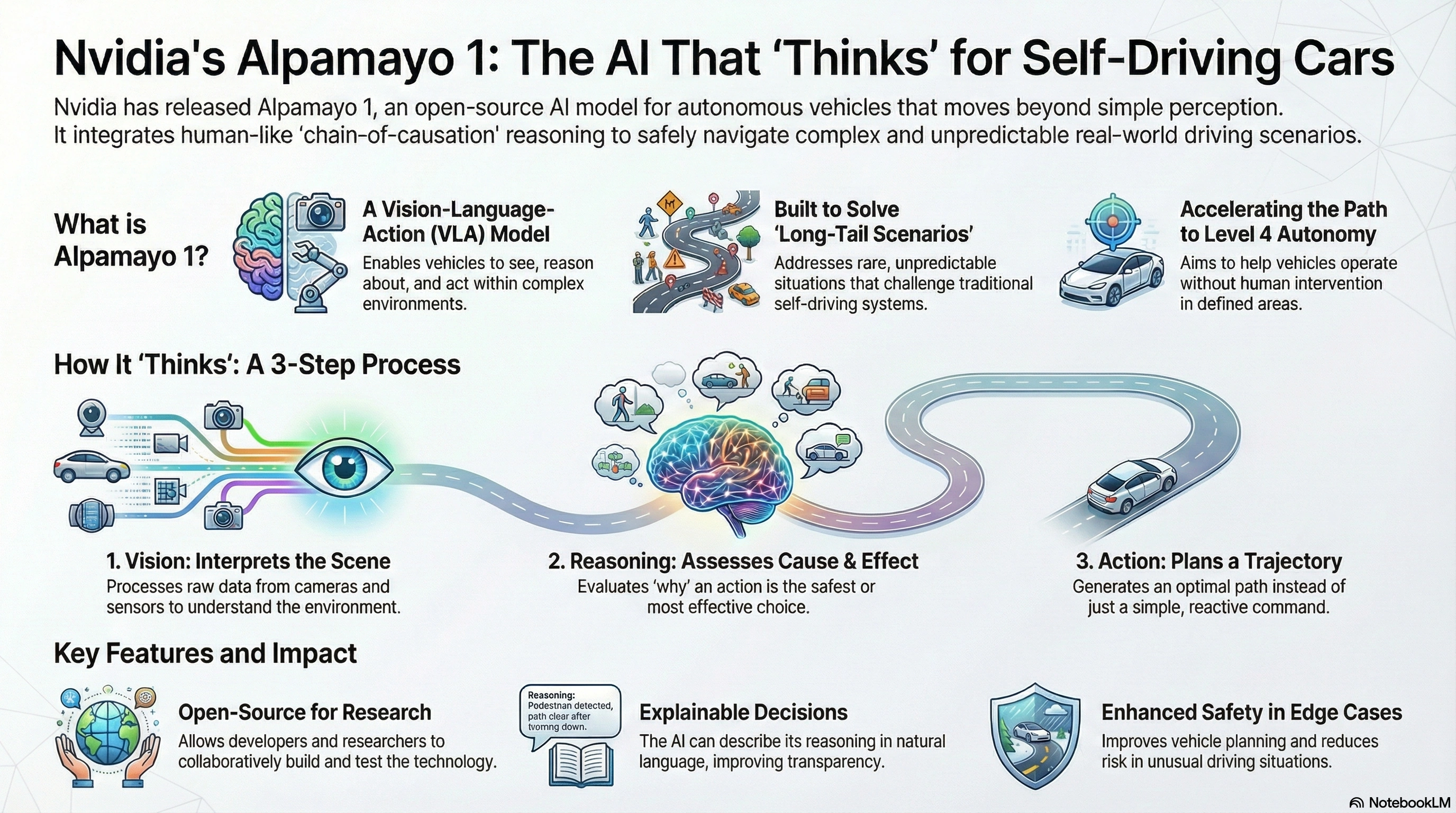
Alpamayo 1—also known as Alpamayo-R1—is a next-generation vision-language-action (VLA) artificial intelligence model developed by Nvidia to enable autonomous vehicles to see, reason, and act in complex real-world environments. Built on “chain-of-causation” reasoning and trajectory planning, this AI model is open-sourced to accelerate research toward Level 4 autonomy and to improve transparency and safety in self-driving systems. (Hugging Face)
Background and Context
Autonomous driving systems historically focused on perception and pattern recognition—identifying objects like pedestrians, vehicles, and road signs from sensor data. However, these systems often struggled with long-tail scenarios—rare or unpredictable situations that require judgment beyond pattern matching. Nvidia’s Alpamayo 1 was designed to address this limitation by integrating reasoning capabilities directly into the model. (NVIDIA Blog Korea)
The model is named after Alpamayo, a notoriously difficult mountain peak in Peru, symbolizing the complexity of real-world driving environments and the advanced reasoning required to navigate them. (CBT News)
What Is Alpamayo 1?
Alpamayo 1 (technically released as Alpamayo-R1) is a vision-language-action (VLA) AI model that combines:
Vision processing: Interprets camera and sensor inputs.
Language understanding: Translates what the vehicle “sees” into contextual descriptions or reasoning.
Action planning: Computes optimal vehicle controls (steering, acceleration, braking) based on interpreted context. (Hugging Face)
Instead of simply reacting to visual inputs, the model breaks down driving scenarios with chain-of-causation reasoning and selects decisions that a human driver might logically choose—considering multiple alternative routes and outcomes. (NVIDIA)
How Alpamayo 1 Works
Vision-Language-Action Integration
Alpamayo 1’s architecture merges sensory perception with language reasoning, and decision planning. Raw sensor data (such as camera images or LiDAR summaries) is processed into a representation that the model can interpret semantically. These interpretations are then paired with reasoning steps before producing a control action. (Hugging Face)
Chain-of-Causation Reasoning
The model uses reasoning chains to assess why a certain action might be safest or most effective in a scenario. For example, when detecting complex situations like detours, pedestrians, or unusual obstacles, Alpamayo 1 evaluates potential paths, weighing cause and effect before guiding the vehicle. (NVIDIA Blog Korea)
Trajectory Planning
Rather than outputting simple reaction commands, the model generates trajectories that integrate safety, legality, and comfort. These plans are adjusted continuously based on real-time perception and reasoning feedback. (NVIDIA)
Key Features and Innovations
1. Open-Source Model
Nvidia released Alpamayo 1 for non-commercial research and development under open-source licenses on platforms like GitHub and Hugging Face. This allows researchers, developers, and OEMs to customize and improve autonomous driving systems collaboratively. (MarkLines)
2. Transparency and Explainability
Unlike many traditional “black-box” neural networks, Alpamayo 1 can generate natural-language reasoning traces that describe its decisions. This transparency helps developers diagnose and improve safety performance. (Technology.org)
3. Enhanced Safety in Edge Cases
Early evaluations show the model significantly improves planning accuracy and reduces instances of off-road excursions or risky encounters in simulation studies, particularly in long-tail scenarios that are difficult for conventional systems. (arXiv)
Use Cases and Scenarios
Advanced Research
Academia and mobility researchers can use Alpamayo 1 to benchmark reasoning-centric approaches to autonomous driving, compare performance against baseline models, and explore safety implications.
Autonomous Vehicle Development
Automakers and autonomous system developers can include or adapt the model in test vehicles to push toward higher levels of autonomy (e.g., Level 4 in defined environments).
Simulation and Testing
Simulation platforms and virtual testing environments benefit from Alpamayo 1’s reasoning data, enabling evaluations of vehicle behavior under rare or complex situations.
Limitations and Considerations
Non-Commercial Licensing
While open for research and experimentation, the model has licensing restrictions for commercial deployment. Developers must verify permissions and compliance for production use. (Hugging Face)
Integration Complexity
Practical deployment in a full automotive stack requires integration with other systems—sensor fusion, control modules, safety verification, and hardware acceleration—which requires expertise and infrastructure.
Computational Demands
Reasoning and action planning at real-time speeds require significant compute resources, particularly when running on vehicles with strict latency constraints.
Future Prospects
Alpamayo 1 represents a foundational step toward more human-like autonomous vehicle intelligence. As research progresses, future models may include:
Expanded multi-modal training data for diverse global driving conditions.
Enhanced causal reasoning frameworks for rare extreme scenarios.
Hardware-aware optimization for faster inference on vehicle computers.
FAQs
Q: What makes Alpamayo 1 different from other autonomous driving AI?
A: It integrates vision, language, and action with reasoning capabilities, letting vehicles “think” through scenarios rather than just react. (ContentGrip)
Q: Is Alpamayo 1 ready for commercial vehicles?
A: Currently, it is open for research and testing; commercial deployment requires licensing and integration work. (Open Source For You)
Q: Can Alpamayo 1 explain its decisions?
A: Yes—the model’s reasoning can be expressed in natural language, helping developers understand why a vehicle took a specific action. (Technology.org)
Conclusion
Nvidia’s Alpamayo 1 (Alpamayo-R1) marks a significant advance in autonomous driving AI by bringing reasoning and explainability into the core of vehicle decision-making systems. By open-sourcing this vision-language-action model, Nvidia empowers the research community and industry to push the boundaries of safe, intelligent mobility. As autonomous systems continue to evolve, Alpamayo 1 sets a new benchmark for how machines perceive, interpret, and act in dynamic real-world environments.
Join the conversation! Your thoughts help the community grow.