

Abstract / Overview
AlphaSim is NVIDIA’s open-source, end-to-end simulation framework designed to accelerate the development and validation of autonomous driving systems. It is part of the larger NVIDIA Alpamayo ecosystem, which combines reasoning AI models, simulation tools, and physical AI datasets to help researchers and automotive developers build safer, more robust autonomous vehicle (AV) stacks. AlphaSim provides high-fidelity sensor modeling, configurable traffic environments, and closed-loop testing, enabling virtual testing across millions of scenarios before real-world deployment. (NVIDIA Newsroom)
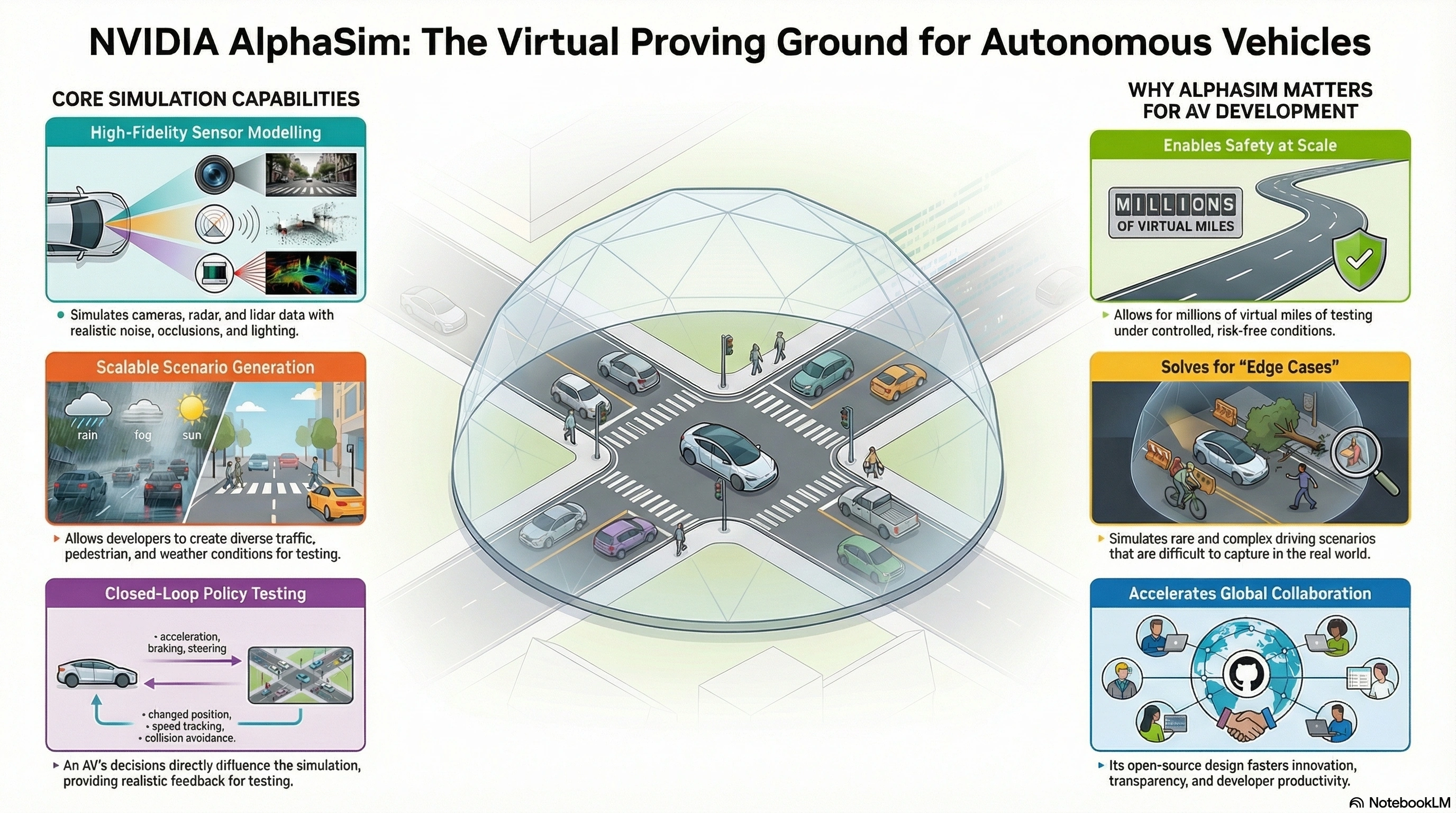
What Is AlphaSim?
AlphaSim is an open-source autonomous vehicle simulation platform launched by NVIDIA as part of its Alpamayo family of tools for physical AI and AV development. (NVIDIA Newsroom) It is designed to provide a realistic virtual environment where autonomous driving policies can be tested and iterated:
Realistic Sensor Modeling: AlphaSim simulates cameras, radar, lidar, and environmental conditions with fidelity suitable for modern AV algorithms. (NVIDIA)
Configurable Traffic Dynamics: Developers can create diverse traffic situations and edge cases that vehicles must navigate safely. (Mobile World Live)
Closed-Loop Testing: Policies tested in AlphaSim operate in a feedback loop where decisions influence future states, mimicking real driving conditions. (GitHub)
AlphaSim is hosted on GitHub under an open-source license, enabling developers and researchers to extend, modify, and integrate it into custom workflows. (GitHub)
How AlphaSim Fits Into NVIDIA’s Autonomous Vehicle Strategy
AlphaSim is a key component of NVIDIA’s broader Alpamayo initiative—a suite of open AI models, simulation frameworks, and datasets meant to accelerate the adoption of reasoning-based autonomy in vehicles. (NVIDIA Newsroom) The Alpamayo toolkit includes:
Alpamayo 1: A 10-billion-parameter Vision-Language-Action (VLA) reasoning model that interprets sensor inputs and predicts vehicle actions with causal, chain-of-thought logic. (NVIDIA Newsroom)
AlphaSim: The simulation framework where research and policy validation occur. (Mobile World Live)
Physical AI Open Datasets: A large collection of real driving data (1,700+ hours) covering diverse scenarios to train and evaluate AI models. (NVIDIA)
Together, these components form a self-reinforcing AV development loop: models are trained on real and synthetic data, tested in AlphaSim, iterated, and improved before being distilled into deployable systems. (NVIDIA Newsroom)
Why AlphaSim Matters
AlphaSim tackles several longstanding challenges in autonomous driving research and deployment:
Safety at Scale: Real-world testing is slow, expensive, and risky. AlphaSim enables millions of virtual miles of testing under controlled conditions. (NVIDIA)
Edge Case Handling: Rare, complex driving scenarios (“long tail”) are hard to capture in real data alone. Simulation expands coverage dramatically. (NVIDIA Newsroom)
Developer Productivity: Open source and modular design let teams plug in custom perception, planning, or control modules, accelerating innovation. (GitHub)
Global Collaboration: Being open source encourages academic and industry collaboration, enhancing transparency and reproducibility. (NVIDIA)
How AlphaSim Works — Key Capabilities
Realistic Sensor and Environment Modeling
AlphaSim’s simulation environment reproduces camera, lidar, and radar sensor data that reflect real-world physics, including noise, occlusions, and lighting variations. This enables training and validating perception systems with lifelike inputs. (GitHub)
Scalable Traffic and Scenario Generation
Developers can configure diverse traffic behaviors, pedestrian movements, road layouts, and weather conditions—allowing them to create both routine and edge case scenarios for rigorous testing. (Mobile World Live)
Closed-Loop Policy Testing
Unlike static testing, closed-loop simulation means the AV’s decisions affect future states (e.g., vehicle motion influencing next sensor frame), providing feedback more representative of real driving dynamics. (GitHub)
Extensibility and Integration
AlphaSim’s modular architecture supports integrations with AI models, control stacks, and third-party tools. This makes it suitable for both research experiments and industry scale-ups. (GitHub)
Use Cases / Scenarios
AI Policy Validation:
Researchers can validate path-planning and decision-making models against thousands of designed scenarios without risking real hardware.
Safety Benchmarking:
Developers use AlphaSim to benchmark performance metrics such as collision rates, compliance with traffic rules, and reaction times across variations.
Edge Case Simulation:
Rare situations, including unusual intersections or mechanical failures, can be modeled and tested repeatedly until policies generalize effectively.
Algorithm Debugging:
Closed-loop feedback allows detailed insights into failure modes and helps debug complex behaviors in isolation.
Limitations / Considerations
While powerful, AlphaSim is not a substitute for all real-world testing. Virtual environments may yet miss nuanced physical interactions found on real roads, and overreliance on synthetic data could mask real sensor complexities. Combining simulated and real data remains essential for robust performance.
Additionally, high-fidelity simulation can be resource intensive, requiring significant compute for rendering detailed environments and processing sensor simulations.
Conclusion
AlphaSim, launched by NVIDIA as part of its Alpamayo ecosystem, marks a significant step forward in open-source simulation for autonomous vehicle development. It provides a flexible, high-fidelity simulation platform where researchers and developers can test, refine, and benchmark AI driving policies at scale. By enabling extensive virtual validation and integrated workflows with reasoning AI models and large datasets, AlphaSim helps accelerate safer, more explainable, and more scalable autonomous systems. (NVIDIA Newsroom)
Join the conversation! Your thoughts help the community grow.