
Introduction
When it comes to database for .NET, there are several options in addition to the well known ones such as SQL Server or MySQL. One of them is Matisse, a post-relational database by Matisse Software.
Why Matisse? It is the only SQL database that I know of, which is extended with complete object capabilities and natively supports .NET. It features user defined types, inheritance, polymorphism, and a simple data model with declarative constraints, etc. Over the last two years I have acquired practical knowledge of Matisse while working on several .NET projects that required complex data modeling.
While one can find press articles that provide high-level comparisons between mainstream relational databases and other products, I have not seen yet a simple step-by-step tutorial to help developers who wish to try their hand at new generation databases. I therefore resolved to publish a series of short articles to help address this void. Here is the first one.
This first article covers a quick overview of SQL programming with Matisse. The subsequent articles, coming weekly, will show how to develop database applications with .NET and ASP.NET in more detail.
Installation
Installation of Matisse is quick and easy. Go to the Matisse download site http://www.matisse.com/developers/downloads/, and download the next two files under "Matisse DBMS 7.0.x" section:
- Intel - MS Windows (file name is matisse70x.exe)
- .NET binding (file name is matisseDotNet70x.exe)
The first file installs the database server, administration and development tools, and a common client library shared by diverse language interfaces for Matisse including .NET (i.e., C# and VB.NET). The second file contains a .NET assembly that provides object persistence services and a native ADO.NET data provider.
To install Matisse, you need to have the Windows Administrator privilege. System requirements are Windows NT, 2000, or XP, 64MB of RAM, and 100 MB of disk space. First, start the matisse70x.exe file, follow the instructions, and select "Typical/Full" as the type of setup. The installation will be completed within a couple of minutes. Then, start the matisseDotNet70x.exe to install the .NET interface. Choose the same directory for destination folder as the first installation (i.e., matisse70x.exe).
The documents you want to look at first are
- Discovering Matisse Enterprise Manager (from Readme.html)
- Building reusable components with SQL PSM (from Readme.html)
- Getting Started with Matisse
A lot of documents including programming guides, administration guide, and installation guide are also available at http://www.matisse.com/developers/documentation/
If you have the Rational Rose modeling tool, you can download
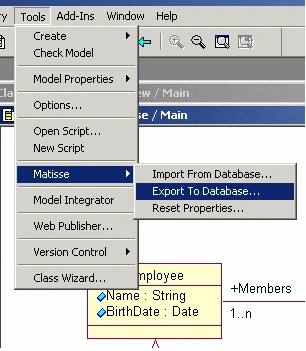
Matisse Rose Link (matisseRoseLink70x.exe). You can define and maintain database schema using UML with Rational Rose.
Note that you can run the database server on Linux when deploying your .NET application on Windows. Download the Linux version of Matisse (matisse-7.0-x.i386.rpm) and install it using rpm. If you are using RedHat 8, you need to set the environment variable RPM_INSTALL_PREFIX to /usr/local/matisse before running rpm.
> rpm -ihv matisse-7.0-x.i386.rpm
What you can do with the Matisse Enterprise Manager
Before writing a simple demo program using SQL, let us visit some interesting features of the Enterprise Manager.
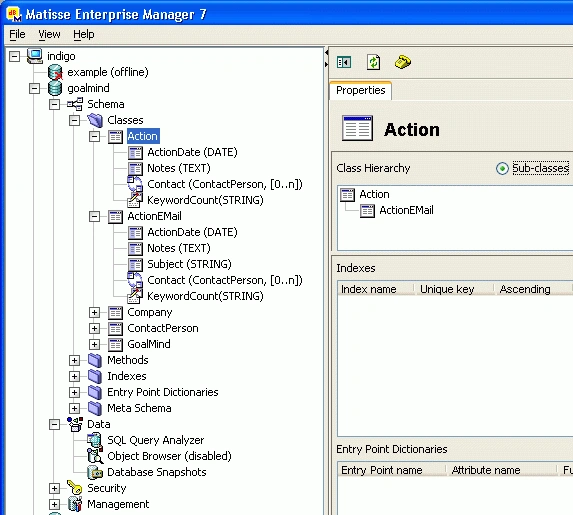
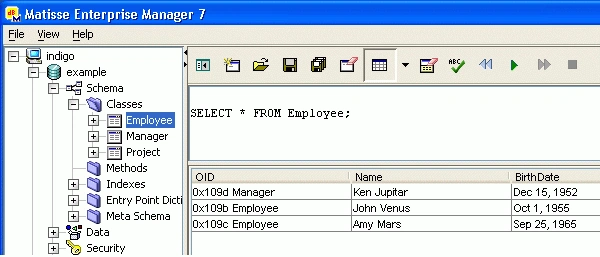
You can browse classes, attributes, relationships, and SQL methods in a database just like any other vendors' tools. An interesting feature is that a class can show all its properties (i.e., attributes, relationships, and methods) including its superclasses' properties. So, when you write an SQL statement on a class, this feature is useful, since you do not have to go back and forth between superclasses and subclasses to find out properties.
Data Import (CSV)
You can import data from your relational database using CSV (Comma-Separated Value) files. When you import a CSV file, each line (row) in the file is stored as a data object in the Matisse database. After importing all the CSV files, you specify an XRD file (XML Relationship Definition), which describes how to establish links between objects in the database. Then, objects in the database are inter-related to each other building a meaningful semantic network that matches your UML description. Relationships between objects also provide a significant performance benefit on SQL queries as well.
Simple Demo
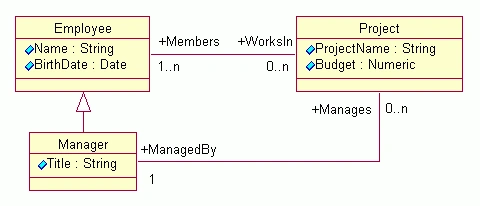
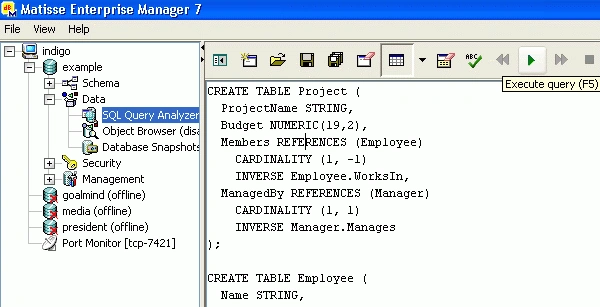
In this article, I am going to show a simple demo application that demonstrates how you can use SQL to define a schema and manipulate data objects with Matisse. More detailed discussions will follow in the subsequent articles.
Join the conversation! Your thoughts help the community grow.