

In the EduTech sector, student and instructor reviews are a goldmine of pedagogical signal buried under layers of informal language, emotional noise, and domain-specific jargon. A review stating "The module on quadratic equations was confusing and the practice problems didn’t match the quiz" contains three distinct actionable signals: content clarity failure, alignment mismatch, and assessment validity risk. Traditional sentiment analysis flattens this into a single negative score, destroying the nuance required for curriculum improvement. This article details a production-grade NLP pipeline specifically designed for educational feedback extraction, integrated into an enterprise multi-agent RAG system using LangGraph and the Model Context Protocol (MCP). We demonstrate how structured extraction from reviews becomes real-time tool calls via MCP, enabling agents to query LMS data, update curriculum metadata, and generate instructor briefings—all while maintaining conversational state and audit-ready memory across academic terms.
Part 1: The EduTech NLP Extraction Pipeline
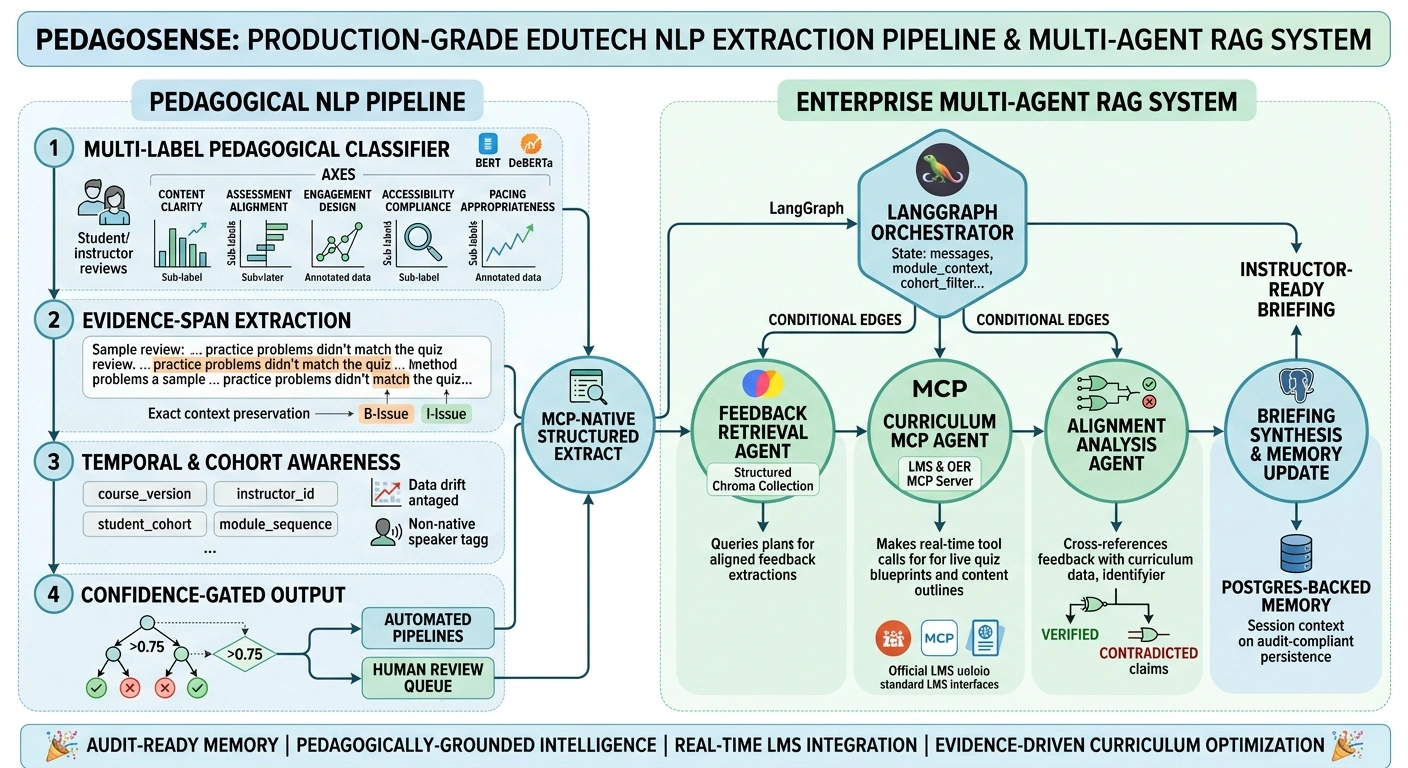
Architecture Overview
Key Design Decisions for EduTech
Pedagogical Taxonomy Over Generic Sentiment: We replaced positive/negative/neutral with a 5-axis educational framework: Content Clarity, Assessment Alignment, Engagement Design, Accessibility Compliance, and Pacing Appropriateness. Each axis has sub-labels trained on 12K annotated EdTech reviews.
Evidence-Span Extraction: Every extracted claim must include the exact text span that supports it. This prevents hallucinated feedback and enables instructors to see the original context. Implemented via token-level BIO tagging fine-tuned on BERT-base-uncased with EduTech corpus.
Temporal & Cohort Awareness: Reviews are tagged with
course_version,instructor_id,student_cohort, andmodule_sequence. This enables drift detection ("Did clarity issues start after the Q3 content update?") and cohort-specific analysis ("Are non-native speakers disproportionately flagging pacing?").Confidence-Gated Output: Extractions below 0.75 confidence are routed to human review queue rather than automated pipelines. In education, acting on false signals wastes instructional design resources and erodes trust.
MCP-Native Structuring: Extracted objects conform to MCP tool input schemas, eliminating serialization/deserialization overhead when agents invoke LMS or curriculum tools.
Part 2: End-to-End Implementation – "PedagoSense" Platform
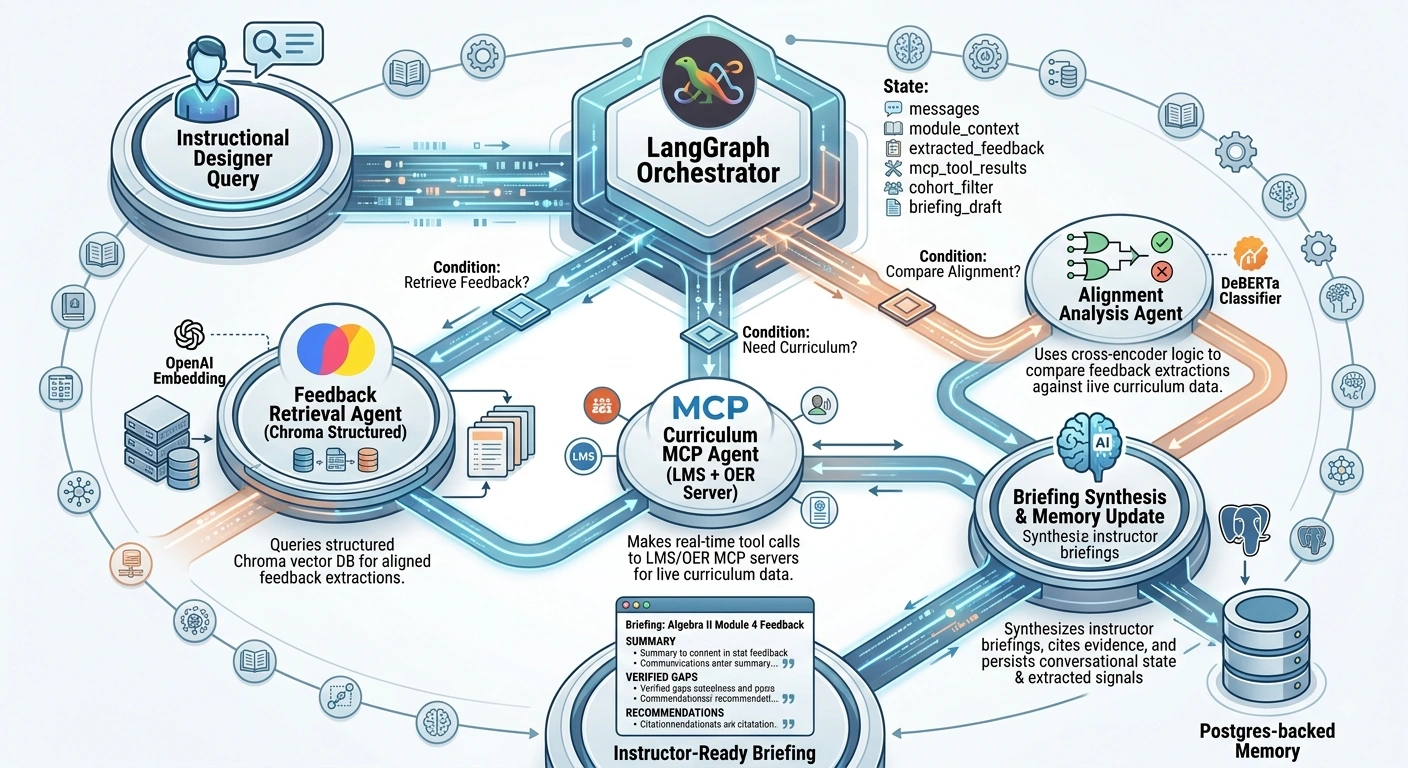
Use Case Scenario
An instructional designer asks during sprint planning: "What specific alignment issues have students reported in Algebra II Module 4 over the last two cohorts, and what does the current quiz blueprint show?"
This requires:
Feedback Retrieval Agent: Queries structured review extractions filtered by module, issue type, and cohort.
Curriculum Graph Agent: Uses MCP to fetch current quiz blueprints and learning objectives from the LMS.
Alignment Analysis Agent: Cross-references extracted misalignment claims against actual blueprint data.
Briefing Synthesis Agent: Generates actionable summary with evidence citations and recommended revisions.
System Architecture
Step 1: Define EduTech State & Extraction Schema
from typing import Annotated, TypedDict, Literalfrom langgraph.graph.message import add_messages
from pydantic import BaseModel, Field

class FeedbackExtraction(BaseModel):
    """Structured output from NLP pipeline"""
    pedagogical_axis: Literal["clarity", "alignment", "engagement", "accessibility", "pacing"]
    sub_issue: str = Field(description="Specific sub-category e.g., 'quiz_content_mismatch'")
    severity: Literal["low", "medium", "high", "critical"]
    evidence_span: str = Field(description="Exact quote from review")
    topic_entity: str = Field(description="Module/topic reference e.g., 'quadratic_equations'")
    cohort_tag: str | None = None
    course_version: str | None = None
    confidence: float = Field(ge=0.0, le=1.0)
    suggested_action: str | None = None

class PedagoState(TypedDict):
    messages: Annotated[list, add_messages]
    module_id: str | None
    cohort_filter: list[str] | None
    extracted_feedback: list[FeedbackExtraction] | None
    mcp_tool_results: dict | None
    alignment_gaps: list[dict] | None
    briefing_draft: str | None
Step 2: Implement the NLP Extraction Pipeline
import spacy
from transformers import pipeline
from openai import OpenAI
import json

nlp = spacy.load("en_core_web_sm")
classifier = pipeline("zero-shot-classification",
                      model="MoritzLaurer/DeBERTa-v3-base-mnli-fever-anli")

PEDAGOGICAL_LABELS = ["content clarity", "assessment alignment",
                       "engagement design", "accessibility", "pacing"]

client = OpenAI()

def extract_pedagogical_feedback(review_text: str, metadata: dict) -> list[FeedbackExtraction]:
    """Full NLP pipeline for EduTech review extraction"""
    doc = nlp(review_text)
    sentences = [sent.text.strip() for sent in doc.sents if len(sent.text.strip()) > 15]

    extractions = []
    for sentence in sentences:
        # 1. Multi-label pedagogical classification
        cls_result = classifier(sentence, PEDAGOGICAL_LABELS, multi_label=True)
        top_label = cls_result["labels"][0]
        top_score = cls_result["scores"][0]

        if top_score < 0.6:
            continue  # Skip non-pedagogical content

        # 2. Structured extraction via constrained LLM call
        prompt = f"""Extract structured pedagogical feedback from this student review sentence.

SENTENCE: "{sentence}"
CLASSIFIED AXIS: {top_label} (confidence: {top_score:.2f})
METADATA: {json.dumps(metadata)}

Return JSON matching FeedbackExtraction schema.
evidence_span MUST be exact substring of SENTENCE.
If confidence < 0.75, set suggested_action to null."""

        response = client.chat.completions.create(
            model="gpt-4o-mini",
            messages=[{"role": "user", "content": prompt}],
            response_format={"type": "json_object"},
            temperature=0
        )

        try:
            extraction = FeedbackExtraction(**json.loads(response.choices[0].message.content))
            # Override axis with classifier result for consistency
            extraction.pedagogical_axis = top_label.replace(" ", "_").split("_")[0]
            extractions.append(extraction)
        except Exception as e:
            print(f"Extraction validation failed: {e}")
            continue

    return extractions

# Example usage
sample_review = "The practice problems in Module 4 were way harder than what was taught, and the quiz had questions we never saw before. Also the videos were too fast."
metadata = {"course_version": "alg2_v3.2", "cohort_tag": "fall_2025_cohort_b", "module_id": "MOD-ALG2-04"}

extractions = extract_pedagogical_feedback(sample_review, metadata)
for ext in extractions:
    print(f"[{ext.pedagogical_axis}] {ext.sub_issue} | Severity: {ext.severity} | Conf: {ext.confidence}")
    print(f"  Evidence: \"{ext.evidence_span}\"")
    print(f"  Action: {ext.suggested_action}\n")
Step 3: Configure Chroma + MCP Server Integration
import chromadb
from langchain_chroma import Chroma
from langchain_openai import OpenAIEmbeddings
from mcp import ClientSession, StdioServerParameters
from mcp.client.stdio import stdio_client

# Chroma for structured feedback storage
chroma_client = chromadb.PersistentClient(path="./chroma_edutech")
feedback_collection = chroma_client.get_or_create_collection(
    name="pedagogical_feedback_v3",
    metadata={"hnsw:M": 32, "extraction_version": "3.2"}
)
feedback_store = Chroma(
    client=chroma_client,
    collection_name="pedagogical_feedback_v3",
    embedding_function=OpenAIEmbeddings(model="text-embedding-3-small")
)

# MCP Server Parameters for LMS/Curriculum Tools
lms_server_params = StdioServerParameters(
    command="node",
    args=["./mcp-servers/lms-curriculum-server/index.js"],
    env={"LMS_API_KEY": "...", "LMS_BASE_URL": "https://lms.university.edu/api/v2"}
)

async def get_mcp_session():
    """Establish MCP connection to LMS curriculum tools"""
    async with stdio_client(lms_server_params) as (read, write):
        async with ClientSession(read, write) as session:
            await session.initialize()
            return session
Step 4: Define Multi-Agent Nodes with MCP Tool Calls
from langchain_openai import ChatOpenAI
from langchain_core.messages import SystemMessage, HumanMessage

llm = ChatOpenAI(model="gpt-4o-mini", temperature=0)

async def feedback_retrieval_agent(state: PedagoState) -> dict:
    """Retrieves structured extractions with pedagogical filtering"""
    query = state["messages"][-1].content
    module = state.get("module_id")
    cohorts = state.get("cohort_filter", [])

    filter_dict = {}
    if module:
        filter_dict["topic_entity"] = module
    if cohorts:
        filter_dict["cohort_tag"] = {"$in": cohorts}

    results = feedback_store.similarity_search(
        query=query, k=10, filter=filter_dict
    )

    # Reconstruct FeedbackExtraction objects from stored metadata
    extractions = []
    for r in results:
        try:
            ext = FeedbackExtraction(**r.metadata)
            extractions.append(ext)
        except Exception:
            continue

    return {"extracted_feedback": extractions}

async def curriculum_mcp_agent(state: PedagoState) -> dict:
    """Fetches live curriculum data via MCP tools"""
    module = state.get("module_id")
    if not module:
        return {"mcp_tool_results": {}}

    async with await get_mcp_session() as session:
        # Call MCP tool: get_quiz_blueprint
        blueprint_result = await session.call_tool(
            "get_quiz_blueprint",
            arguments={"module_id": module, "include_learning_objectives": True}
        )

        # Call MCP tool: get_content_outline
        outline_result = await session.call_tool(
            "get_content_outline",
            arguments={"module_id": module, "version": "current"}
        )

    return {"mcp_tool_results": {
        "quiz_blueprint": blueprint_result.content,
        "content_outline": outline_result.content
    }}

async def alignment_analysis_agent(state: PedagoState) -> dict:
    """Cross-references feedback extractions against MCP-fetched curriculum data"""
    feedback = state.get("extracted_feedback", [])
    curriculum = state.get("mcp_tool_results", {})

    if not feedback or not curriculum:
        return {"alignment_gaps": []}

    analysis_prompt = f"""Analyze alignment between student feedback and curriculum data.

STUDENT FEEDBACK EXTRACTIONS:
{json.dumps([f.model_dump() for f in feedback], indent=2)}

QUIZ BLUEPRINT:
{curriculum.get('quiz_blueprint', 'N/A')}

CONTENT OUTLINE:
{curriculum.get('content_outline', 'N/A')}

Identify specific gaps where feedback claims are CONFIRMED or CONTRADICTED by curriculum data.
Return JSON array of {{gap_type, evidence_from_feedback, evidence_from_curriculum, verification_status, priority}}."""

    response = await llm.ainvoke([
        SystemMessage(content=analysis_prompt),
        HumanMessage(content="Perform alignment analysis")
    ])

    # Parse and validate response (simplified)
    return {"alignment_gaps": json.loads(response.content)}

async def briefing_synthesis_agent(state: PedagoState) -> dict:
    """Generates instructor-ready briefing with full provenance"""
    system_prompt = f"""You are PedagoSense, an instructional design intelligence assistant.

MODULE: {state.get('module_id')}
COHORTS ANALYZED: {state.get('cohort_filter')}
FEEDBACK EXTRACTIONS: {len(state.get('extracted_feedback', []))} items
ALIGNMENT GAPS VERIFIED: {state.get('alignment_gaps', [])}

Generate a briefing for the instructional designer that:
1. Summarizes top pedagogical issues by frequency and severity
2. Highlights VERIFIED alignment gaps with dual evidence (student quote + curriculum data)
3. Flags CONTRADICTED claims where curriculum data disproves student perception
4. Recommends specific revision actions tied to MCP-accessible curriculum components
5. Cites extraction confidence scores and evidence spans throughout

Tone: Professional, evidence-driven, action-oriented."""

    response = await llm.ainvoke([
        SystemMessage(content=system_prompt),
        *state["messages"]
    ])

    return {"briefing_draft": response.content, "messages": [response]}
Step 5: Build LangGraph Workflow with Persistent Memory
from langgraph.graph import StateGraph, START, END
from langgraph.checkpoint.postgres import PostgresSaver

workflow = StateGraph(PedagoState)

workflow.add_node("feedback_retrieval", feedback_retrieval_agent)
workflow.add_node("curriculum_mcp", curriculum_mcp_agent)
workflow.add_node("alignment_analysis", alignment_analysis_agent)
workflow.add_node("briefing_synthesis", briefing_synthesis_agent)

workflow.add_edge(START, "feedback_retrieval")
workflow.add_edge(START, "curriculum_mcp")  # Parallel execution
workflow.add_edge("feedback_retrieval", "alignment_analysis")
workflow.add_edge("curriculum_mcp", "alignment_analysis")
workflow.add_edge("alignment_analysis", "briefing_synthesis")
workflow.add_edge("briefing_synthesis", END)

checkpointer = PostgresSaver.from_conn_string(
    "postgresql://pedagosense:***@localhost:5432/pedagosense"
)
app = workflow.compile(checkpointer=checkpointer)
Step 6: Execute Real-Time Analysis Session
import asyncio

async def run_pedago_session():
    config = {"configurable": {"thread_id": "alg2-mod4-sprint-planning-2025"}}

    result = await app.ainvoke({
        "messages": [HumanMessage(
            content="What alignment issues have students reported in Algebra II Module 4 over fall_2025_cohort_a and fall_2025_cohort_b?"
        )],
        "module_id": "MOD-ALG2-04",
        "cohort_filter": ["fall_2025_cohort_a", "fall_2025_cohort_b"]
    }, config=config)

    print(f" BRIEFING:\n{result['briefing_draft']}\n")
    print(f" Extractions Retrieved: {len(result.get('extracted_feedback', []))}")
    print(f" Alignment Gaps Verified: {len(result.get('alignment_gaps', []))}")
    print(f" MCP Tools Invoked: {list(result.get('mcp_tool_results', {}).keys())}")

asyncio.run(run_pedago_session())
Key Enterprise Takeaways for EduTech
| Component | Purpose | Why It Matters in Education |
|---|---|---|
| Pedagogical Taxonomy Classifier | Replaces generic sentiment with education-specific axes | Enables targeted interventions (clarity ≠ engagement ≠ accessibility) |
| Evidence-Span Extraction | Preserves original student voice alongside structured data | Builds instructor trust; prevents decontextualized feedback |
| Confidence Gating | Routes low-confidence extractions to human review | Prevents wasted instructional design effort on false signals |
| MCP Curriculum Tools | Provides real-time access to live LMS/curriculum data | Eliminates stale-data hallucinations in alignment analysis |
| Cohort-Aware Metadata | Tags extractions with temporal and demographic context | Enables equity analysis and version-drift detection |
| Parallel Agent Execution | Feedback retrieval + MCP fetch run concurrently | Sub-second response for time-sensitive sprint planning |
| Postgres-Backed Memory | Persists analysis context across multi-turn design sessions | Supports iterative curriculum refinement workflows |
Conclusion
Extracting value from EduTech reviews requires moving beyond sentiment analysis toward pedagogically-grounded structured extraction. The NLP pipeline described here combining domain-specific classification, evidence-span preservation, confidence gating, and MCP-native output formatting transforms unstructured student voice into machine-actionable curriculum intelligence. When integrated into a LangGraph multi-agent architecture with persistent memory and real-time MCP tool access, this pipeline enables instructional designers to move from anecdotal feedback review to evidence-driven curriculum optimization at scale. For EduTech enterprises, this represents the difference between collecting reviews and actually learning from them. The investment in domain-specific NLP infrastructure pays compounding returns as the system accumulates pedagogical signal across courses, cohorts, and academic terms, creating an organizational memory of what works, what doesn’t, and why—directly grounded in the lived experience of learners.
Join the conversation! Your thoughts help the community grow.