


What is Domain Driven Design?
Domain-Driven Design (DDD) is a software development approach that focuses on understanding and modeling the domain problem as closely as possible within the software system.
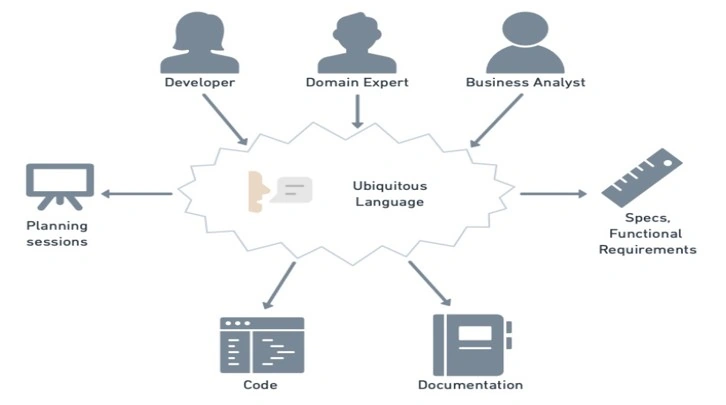
It emphasizes collaboration between domain experts, software developers, and other stakeholders to create a shared understanding of the domain and its complexities.
DDD is not about a certain technology. Domain-Driven Design (DDD) is an approach to the development of complex software consisting of multiple puzzle pieces.
- Focus on the core complexity and opportunity in the domain.
- Explore the models in collaboration with domain experts, software developers, and other stakeholders. (The domain expert is the person who has the knowledge of the system or domain for which the software has to be developed. The developer is responsible for taking in requirements from the Domain Expert and modeling software according to their needs.)
- Speak a ubiquitous language within a bounded context.
- Domain: It refers to the subject area or problem space that the software system is being built to address. It encompasses the real-world concepts, rules, and processes that the software is intended to model or support. For example, in a banking application, the domain includes concepts like accounts, transactions, customers, and regulations related to banking operations.
- Driven: “Driven” implies that the design of the software system is guided or influenced by the characteristics and requirements of the domain. In other words, the design decisions are based on a deep understanding of the domain rather than being driven solely by technical considerations or implementation details.
- Design: “Design” refers to the process of creating a plan or blueprint for the software system. This includes decisions about how the system will be structured, how different components will interact, and how the system will fulfill its functional and non-functional requirements. In the context of Domain-Driven Design, the focus is on designing the software in a way that accurately reflects the structure and behavior of the domain.
DDD was introduced by Eric Evans in his book "Domain-Driven Design: Tackling Complexity in the Heart of Software."
Key principles and concepts of DDD
DDD provides a set of principles, patterns, and practices to help developers effectively capture and express domain concepts in their software designs.
In Domain-Driven Design (DDD), both strategic design and tactical design are crucial aspects of building software systems that accurately model and address complex business domains.
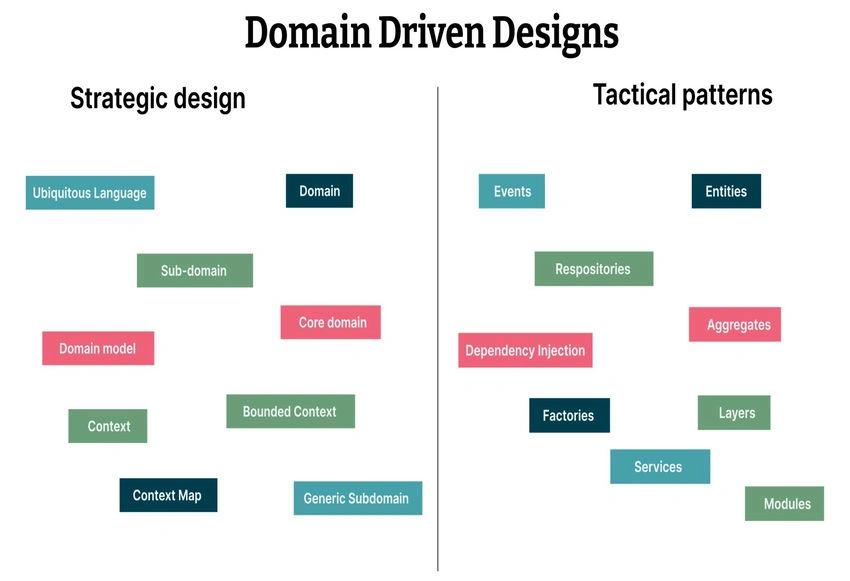
- Strategic design shapes the solution by focusing on high-level architectural decisions and the structure of a software system in a way that aligns with the problem domain. It answers the questions of what software we are building and why we are building it. It addresses high-level concerns such as how to organize domain concepts, how to partition the system into manageable parts, and how to establish clear boundaries between different components. Strategic Patterns explore patterns like context mapping, subdomains, and anti-corruption layers.
- Tactical design is used to implement a rich domain model,, which involves the detailed design of individual components within a bounded context, such as entities, value objects, and services. These patterns help developers effectively capture the domain's complexity while also promoting maintainability, flexibility, and scalability.
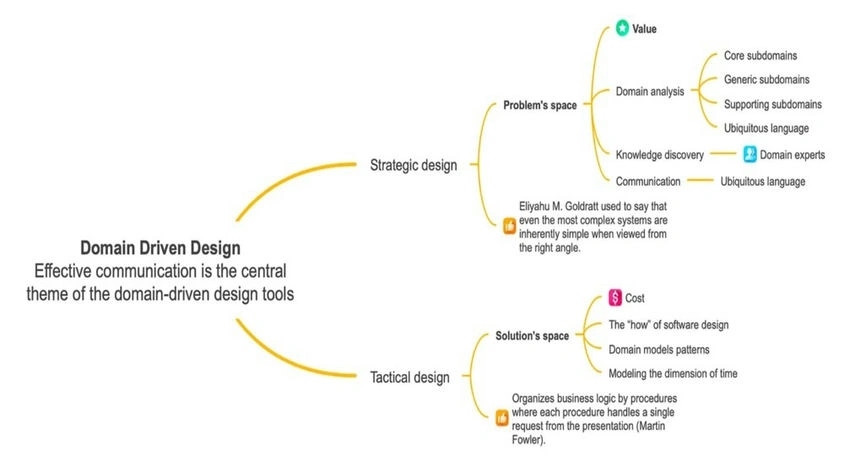
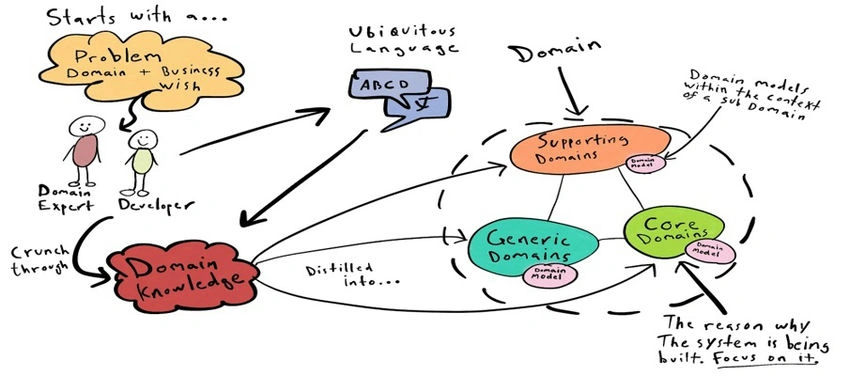
- Domain: The subject area or the problem space that the software system addresses. It encapsulates the business rules, processes, and concepts relevant to the problem being solved.
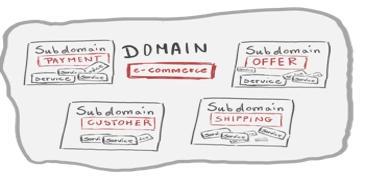
A large problem domain can be decomposed into subdomains to manage complexity and separate important parts from the rest of the system. This can be a “core” domain, a “generic” domain, or a “supporting” domain.
- Core domain: domains are where we want to excel as a business and our specific skills here really differentiate us from the rest of the market. The most important part of the system is that this will give you a competitive advantage, so focus on this and make it as good as possible.
- Generic domain: This is not the core, but the core depends on it. e.g. email sending service, monitoring service, and such. Try to reuse existing parts, and don’t spend too much time on these systems.
- Supporting domain: domains that help to support the core but do not provide any competitive advantage. It is not recommended to invest heavily in but still needed in order to succeed in the core domain.
Example
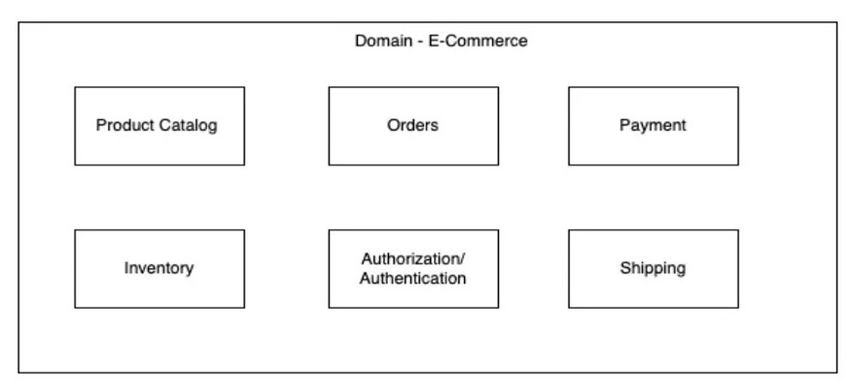
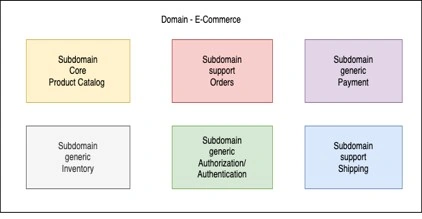
Let's illustrate the identification of domains, including core, generic, and supporting domains, with an example of an e-commerce platform.
- Identifying the Domain: The domain of the e-commerce platform encompasses various aspects such as product management, inventory management, order processing, customer management, and payment processing.
- Core Domain: In our example, the core domain of the e-commerce platform could be order processing. This is where the platform differentiates itself and provides a competitive advantage. Efficient order processing, inventory management, and timely delivery are crucial for customer satisfaction and retention. The rules and processes governing order placement, inventory tracking, and shipping logistics constitute the core domain.
- Generic Domain: A generic domain in the context of an e-commerce platform might include functionalities such as user authentication, session management, logging, and email notifications. While essential for the operation of the system, these functionalities are not unique to the e-commerce domain and are commonly found in many software applications.
- Supporting Domain: Supporting domains in the e-commerce platform could include functionalities like payment processing, tax calculation, and shipping integration. These are necessary for the operation of the platform but are not directly related to its core business functions. While payment processing ensures smooth transactions, tax calculation ensures compliance with tax regulations, and shipping integration facilitates the delivery of goods to customers.
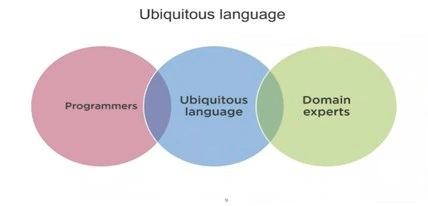
- Ubiquitous Language: DDD promotes the use of a common language that is shared between domain experts and software developers. This language should accurately represent the concepts and terminology of the problem domain. This helps in bridging the communication gap and ensures that everyone involved in the project has a clear understanding of the domain. We have to use an actual language as the core foundation for communication, but we mentioned earlier that developers need to implement the domain into something tangible as code. This is where the developers would come up with class names, variables, etc., in their code.
Example
- Product: An item available for sale on the e-commerce platform.
- Order: A request made by a customer to purchase one or more products.
- Customer: A person or entity who places orders on the e-commerce platform.
- Order Item: A specific product selected by a customer as part of an order.
- Event Storming: Event Storming is a collaborative modeling technique used in Domain-Driven Design (DDD) to explore complex business domains, uncover domain events, and design software systems. It involves gathering stakeholders from different domains and roles in a workshop setting to visualize domain events, commands, aggregates, and other domain concepts using sticky notes on a large wall or whiteboard. Event Storming helps uncover domain complexity, identify bounded contexts, and refine the ubiquitous language used in the domain.
Now, let’s dive into the details of event storming.
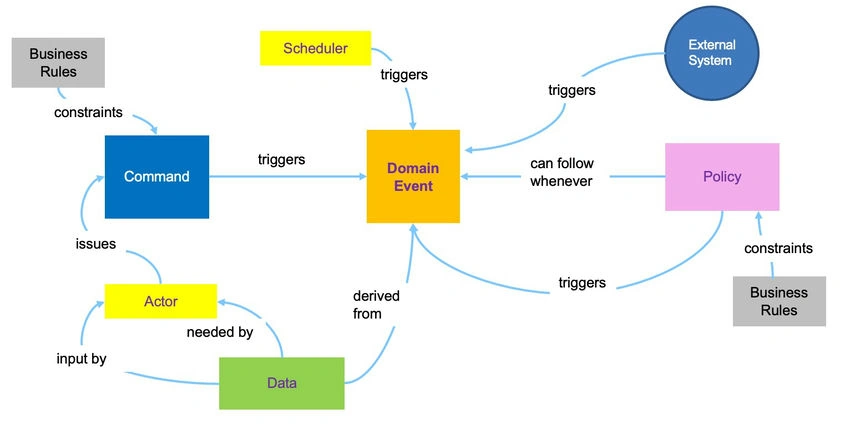
One of the first things to understand is the different types of details that are captured about the domain. These different types of details are typically represented by different colored sticky notes.
- Events (orange): These are the most important and widely used components in Event Storming and represent the domain events.
- Commands (blue): These are requests to do something. They can originate from a user or system or from another event.
- System (pink): These represent systems involved in the domain. They may issue commands or receive commands along with triggering events.
- User (yellow): These are human users involved in the process. They may be a single person or a department/team.
- Aggregate (tan): This is the first level of categorization and can be thought of as the “thing” that a group of events operates on. Typically they’re nouns and can be identified when there’s a cluster of events dependent on one another.
- Read Model (green): This represents data that may be critical for a user or system to make a decision.
- Policy (grey): These represent standards or rules that may need to be executed, such as rules for a compliance policy.
2. Putting the Process Into Action.
- Event Discovery: This step usually takes the longest, and it’s important to allow enough time for the foundation of events to be captured. Using e-commerce as an example, some possible events could be things like orders submitted, payments processed, or inventory updated.
- Placing the Events in Sequence: The next series of steps help identify any missing events by placing the events in sequence. Once the order is established, you can go backward to help identify additional events. In our e-commerce example, the order information is entered first, followed by the inventory being checked. While putting them in order we discovered we left out an event for the input checks being performed.
- Modeling Out the Broader Ecosystem: After putting the events in sequence, the next step is to model out the broader ecosystem surrounding the events by asking questions such as, What triggered the event? Is it a system? A user? Another event? What commands are involved? In our example, a user is what triggers the order information entered event, and they do it through the webpage (system).
- Categorization of Events: The first categorization is known as aggregates. These are the nouns, or the things, that the events operate on. DDD also has a concept of entities, which you can think of as the next level down from aggregates. In our example, Inventory, Order, and Offer are all examples of aggregates. They are the things that the events are operating on.
- Bounded Context Categorization of Events: All related events would fall within a single bounded context. For example, all events related to a shopping cart would fall within a shopping cart-bound context.
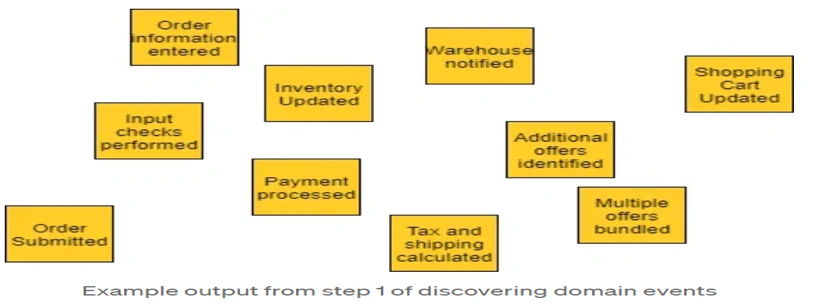
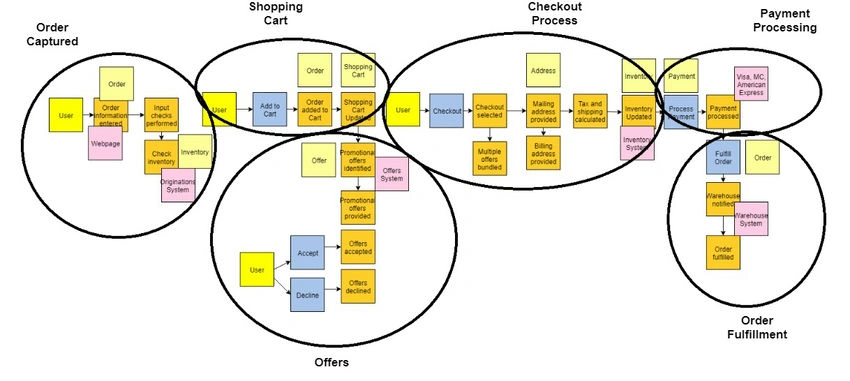
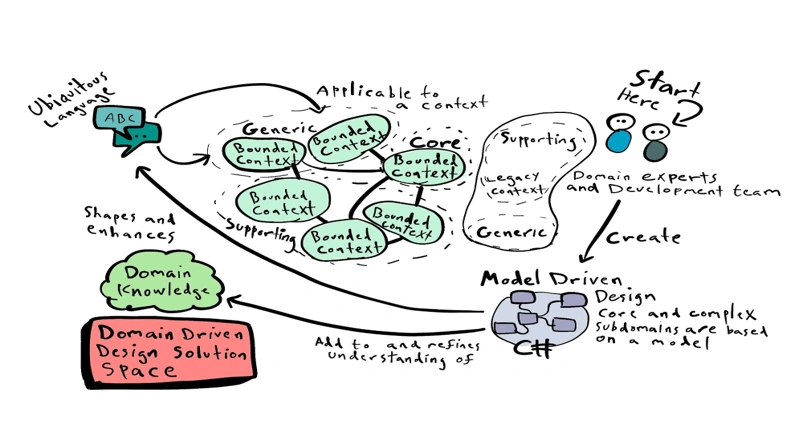
- Bounded Contexts: Large and complex domains can be divided into smaller, more manageable parts called bounded contexts. Each bounded context represents a specific area of the domain and defines its own terms, concepts, and models. Since domains often can become very complex and big, it is a good approach to distill the domain into smaller and separate models. So, instead of having one big model for the domain, you have many smaller ones that are properly defined and have specific boundaries of what they are to encapsulate. Many larger domains will have multiple bounded contexts within them.
Example
In our e-commerce application, we may have bounded contexts such as “Order,” “Product Catalog,” “Payment,” Inventory, Shipping, and “User Management Authentication and Authorization.
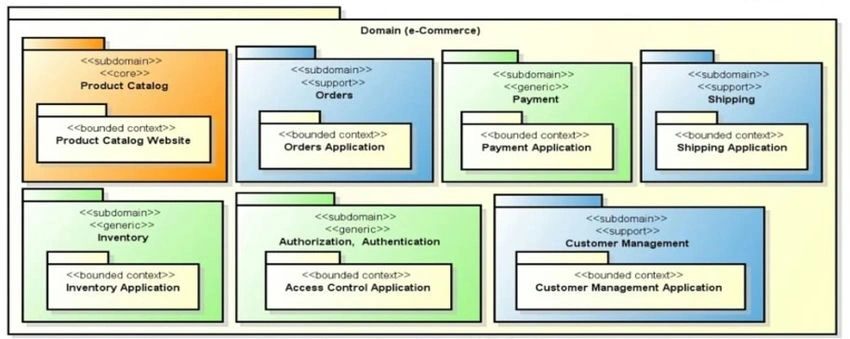
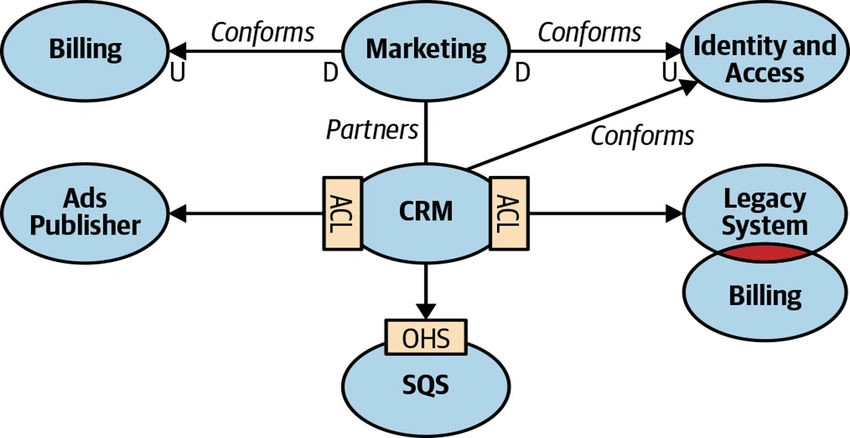
Context mapping is a technique used to manage the interactions and relationships between bounded contexts. It helps to identify integration points, establish communication protocols, and handle inconsistencies between different parts of the system. Context maps don’t need to show the detail of a model; instead, they must demonstrate the integration points and the flow of data between bounded contexts.
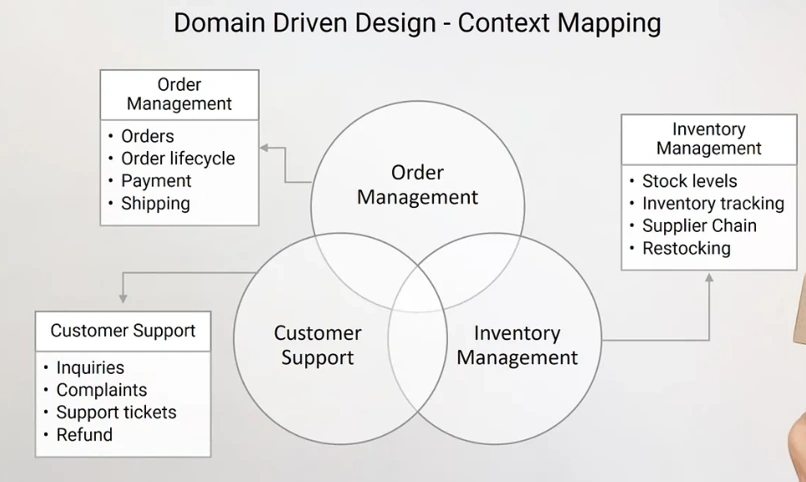
A very important factor in DDD context maps is the direction of the relationship between two contexts. DDD uses the terms upstream or downstream.
An upstream context will influence the downstream counterpart while the opposite might not be true. These are often shortened to the letters d and u respectively.
In the example, you have a context map that illustrates a Personal Finance Management Application that talks to an online banking service through an API. So, in this case, the PFM application is the downstream, and the online banking service is the upstream.
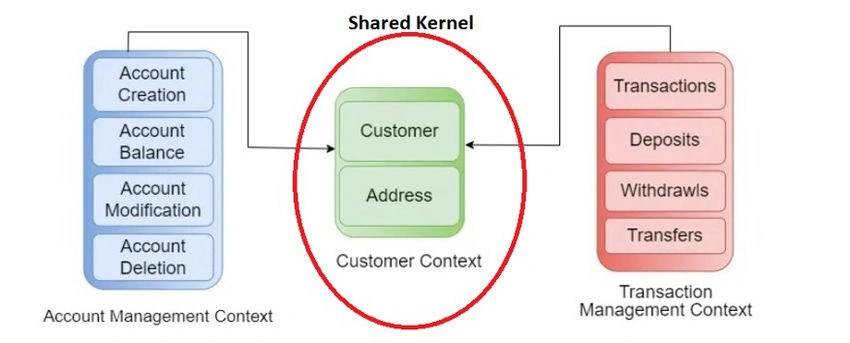
A Shared Kernel is a strategic pattern that involves identifying areas of commonality between different Bounded Contexts and establishing a shared subset of the domain model that is used by multiple contexts. This shared subset, or kernel helps facilitate collaboration and integration between contexts while still allowing each context to maintain its own distinct model.
In our e-commerce example, the “Order Management” and “Payment Processing” bounded contexts might need to share certain core concepts, such as customer information and order status.
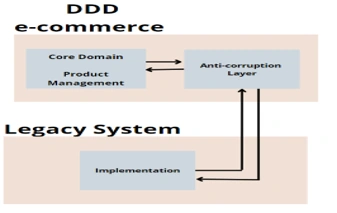
- ACL(Anti Corruption Layer): Imagine a scenario where a legacy system with complex and outdated terminology needs to interact with a modern, DDD-based system. The modern system can implement a façade or adapter layer between different subsystems that don't share the same semantics as an anti-corruption layer to shield itself from the complexities of the legacy system. The anti-corruption layer translates the concepts and language of the legacy system into the domain language of the modern system, ensuring that the modern system remains clean and maintainable.
- Domain Model: The domain model is a representation of the key concepts, entities, relationships, and behaviors within the domain. It captures the essential elements of the problem domain and serves as the backbone of the software design. The domain model should evolve iteratively based on continuous collaboration and feedback from domain experts. Example: Entities, Value Objects, Aggregates, Domain Services, Domain Events.
DDD distinguishes between different types of domain objects.
- Entities: An entity is a domain object that has a distinct identity and lifecycle. Entities are characterized by their unique identifiers and mutable state. They encapsulate behavior and data related to a specific concept within the domain. Entities are compared by their unique identifier (usually a UUID or Primary Key of some sort).
Examples For example, in a banking application, a BankAccount entity might have properties like account number, balance, and owner, along with methods to deposit, withdraw, or transfer funds e-commerce application, including Customer, Order, Product, and Card. - Order object that represents and maintains a state about a specific order and implements different operations (add items, add a shipping address, add payment details, etc) that can be carried out on that order.
- Value Objects: A value object is a domain object that represents a conceptually immutable value. Unlike entities, value objects do not have a distinct identity and are typically used to represent attributes or properties of entities. Value objects are equality-comparable based on their properties rather than their identity. Value objects can be used as attributes within an entity too. Examples include Money, Address, and PhoneNumber, CardNum
For example, a Money value object might represent a specific amount of currency, encapsulating properties like currency type and amount.
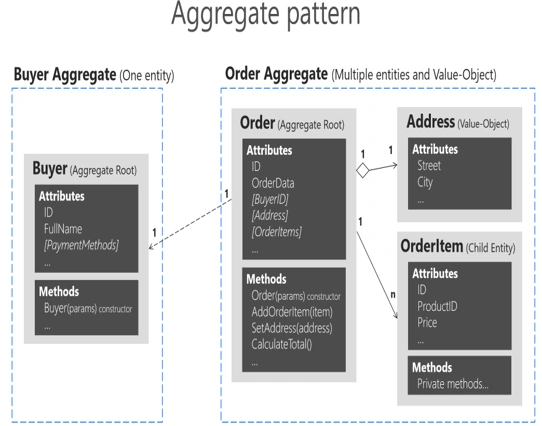
- Aggregates: Clusters of domain objects that are treated as a single unit for data changes. Aggregates ensure consistency and encapsulate business rules within them. Aggregates consist of one or more entities and value objects, with one entity designated as the aggregate root. The aggregate root serves as the entry point for accessing and modifying the aggregate’s internal state. Aggregates enforce consistency boundaries within the domain model, ensuring that changes to related objects are made atomically.
As an example, consider two aggregates Buyer and Order. Order has as entities Order and OrderItem; and Address as a value object. However, all external interactions are via the Order entity, which is the aggregate root. This entity refers to the root of the Buyer by identity (foreign key).
- Domain Services: A service is a domain object that represents a behavior or operation that does not naturally belong to any specific entity or value object. Services encapsulate domain logic that operates on multiple objects or orchestrates interactions between objects. Services are typically stateless and focus on performing specific tasks or enforcing domain rules.
- For example, PaymentService: Manages the process of initiating and processing payments for orders. It may interact with multiple entities such as Order, Payment, and Customer to validate payment details, deduct funds from the customer's account, and update the order status.
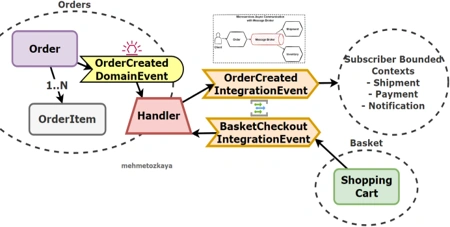
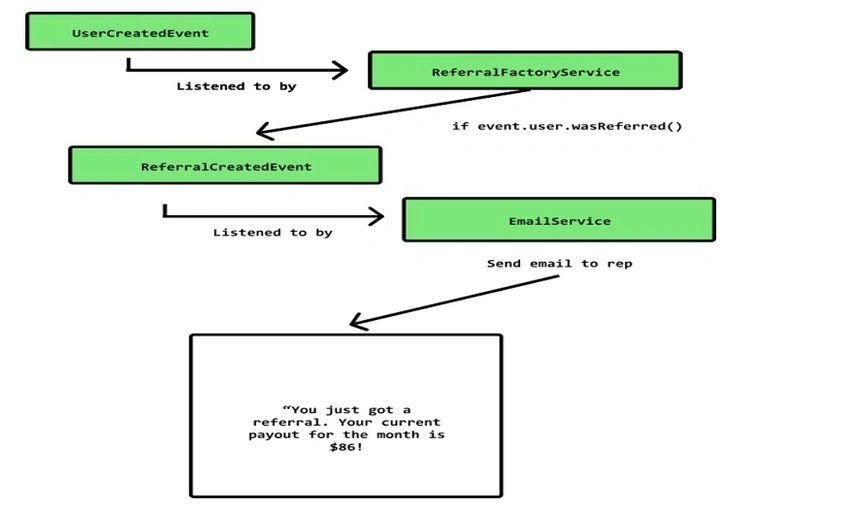
- Domain Events: Events that represent significant changes or occurrences within the domain. They can be used to communicate between different parts of the system and maintain consistency. Domain events are immutable and represent a past event that has already occurred.
For example, represents an event triggered when a user places an order containing information such as the details of Items user ID, Shipping Address, and payment.
- Integration Events: When dealing with distributed systems or multiple bounded contexts within an application, it's often necessary to communicate between these contexts. Integration events serve as a means of communication between these bounded contexts or microservices. They encapsulate the information about a domain event in a format that can be passed between different parts of the system.
Domain-Driven Design blueprint
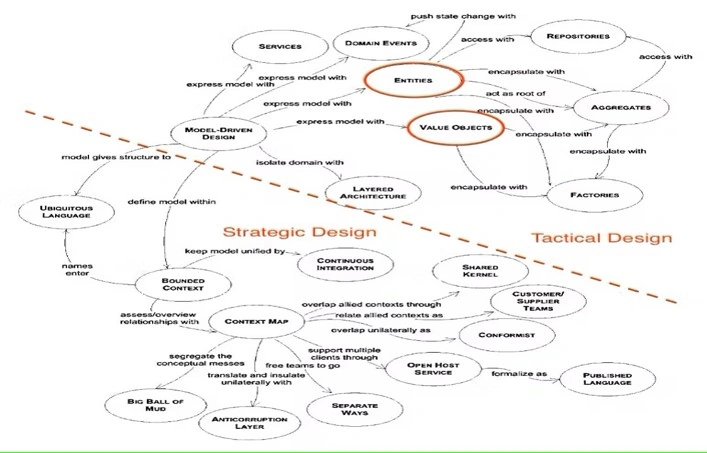
The DDD principles can be split into two parts, respectively into Strategic and Tactical sides.
By splitting it up, we can define certain boundaries and tackle elements that are relevant to that part. Strategic patterns shape the solution, while Tactical patterns are used to implement a rich domain model.
The two parts of DDD's Strategic and Tactical sides are connected through ubiquitous language — the binding between the code and the analysis model.
How to get started with DDD?
Steps to implement DDD
- Understand the Domain: Start by thoroughly understanding the problem domain, including its business rules, processes, and concepts. Engage with domain experts to gain insights into the domain's complexities. Identify the core aspects of the domain that provide the most significant value to the business.
- Create a Ubiquitous Language: Work closely with domain experts to identify and establish a common language, known as a ubiquitous language, that is shared by domain experts and developers. Use this language consistently throughout the project to ensure clear communication and understanding. Document these terms in a glossary or domain dictionary to serve as a reference for the entire team.
- Implement Bounded Contexts: Define clear boundaries, known as bounded contexts, within which a particular model, language, and set of concepts apply. Bounded contexts help manage complexity by isolating different parts of the domain and ensuring clear communication between them. In a microservices architecture, each bounded context can be implemented as a separate microservice. Ensure that each microservice is focused on a specific business capability and encapsulates a cohesive set of functionality.
- Develop the Domain Model (Entities and Value Objects): Use modeling techniques such as domain modeling workshops, event storming, and domain-driven design patterns and principles to create a domain model that accurately represents the problem domain. Focus on capturing the essential entities, value objects, aggregates, and their relationships.
- Design and Implement Aggregates, Aggregate Roots: Identify aggregate roots within the domain model—entities that act as the root of an aggregate and enforce consistency and transactional boundaries within the aggregate. Implement business logic within aggregates to enforce domain invariants and ensure data consistency. Use techniques like domain events and domain services to orchestrate complex behaviors.
- Implement Domain Services, Domain Events: Implement domain services to encapsulate behavior that doesn't naturally belong to entities or value objects. Domain services represent domain-level operations and can be used to orchestrate interactions between multiple domain objects. Identify significant events or state changes within the domain that need to be communicated or reacted to by other parts of the system.
- Test and Iterate: Write unit tests, integration tests, and acceptance tests to validate the behavior of the domain model and its interactions with other parts of the system. Test-driven development (TDD) can help ensure that the domain model meets the specified requirements. Continuously iterate on the domain model based on feedback from stakeholders and domain experts.
When to use DDD?
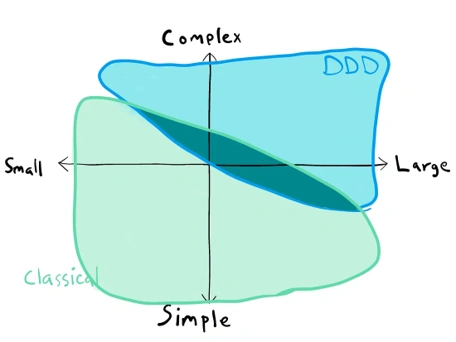
Some say you can apply DDD principles to every project, whilst others tend to use DDD in projects where business logic is complex. In some cases, DDD would be a great fit, but in others not. Don’t try to apply DDD to everything.
While Domain-Driven Design provides many technical benefits, such as maintainability, it should be applied only to complex domains where the model and the linguistic processes provide clear benefits in the communication of complex information and in the formulation of a common understanding of the domain.
Draw a context map and decide on where you will proceed for DDD and where you will not.
Benefits of Domain-Driven Design(DDD)
- Shared Understanding: It encourages collaboration between domain experts, developers, and stakeholders. By encouraging a shared understanding of the problem domain through the ubiquitous language, teams can communicate more effectively and ensure that the software accurately reflects the needs and requirements of the business.
- Focus on Core Domain: It helps teams identify and prioritize the core domain of the application—the areas of the system that provide the most value to the business. By focusing development efforts on the core domain, teams can deliver functionality that directly addresses business objectives and differentiates the software from competitors.
- Resilience to Change: It emphasizes designing software systems that are resilient to change by modeling the domain in a way that reflects the inherent complexities and uncertainties of the problem domain. By embracing change as a natural part of software development, teams can respond more effectively to evolving business needs and market conditions.
- Clear Separation of Concerns: DDD encourages a clear separation of concerns between domain logic, infrastructure concerns, and user interface concerns. By isolating domain logic from technical details and infrastructure concerns, teams can maintain a clean and focused domain model that is independent of specific implementation details or technological choices.
- Improved Testability: It promotes the use of domain objects with well-defined boundaries and behaviors, making it easier to write better and more focused tests that verify the correctness of domain logic. By designing software systems with testability in mind, teams can ensure that changes to the codebase are safe and predictable, reducing the risk of introducing regressions or unintended side effects.
- Support for Complex Business Rules: It provides patterns and techniques for modeling and implementing complex business rules and workflows within the domain model. By representing business rules explicitly in the domain model, teams can ensure that the software accurately reflects the intricacies of the business domain and enforces domain-specific constraints and requirements.
- Alignment with Business Goals: Ultimately, It aims to align software development efforts with the strategic goals and objectives of the business. By focusing on understanding and modeling the problem domain, teams can deliver software solutions that directly support business objectives, drive innovation, and create value for stakeholders and end-users.
Challenges of Domain-Driven Design (DDD)
Complexity
- DDD can introduce complexity, especially in large and complex domains. Modeling intricate business domains accurately requires a deep understanding of the domain and may involve dealing with ambiguity and uncertainty.
- Managing this complexity effectively requires careful planning, collaboration, and expertise.
Ubiquitous Language Adoption
- Establishing and maintaining a ubiquitous language—a shared vocabulary that accurately represents domain concepts—can be challenging. It requires collaboration between developers and domain experts to identify and agree upon domain terms and meanings.
- Achieving consensus on the ubiquitous language may require overcoming communication barriers and reconciling differences in terminology and perspectives.
Bounded Context Alignment
- In large and complex domains, different parts of the domain may have distinct models and bounded contexts. Aligning these bounded contexts and ensuring consistency between them can be challenging.
- It requires clear communication, collaboration, and coordination between teams working on different parts of the domain to avoid inconsistencies and conflicts.
Technical Complexity
- Implementing DDD principles and patterns effectively may require adopting new technologies, frameworks, and architectural approaches. Integrating DDD with existing systems or legacy codebases can be complex and may require refactoring or redesigning existing code to align with DDD principles.
- Technical challenges such as performance, scalability, and maintainability must be carefully addressed to ensure the success of DDD adoption.
Why is DDD important in modern-day software architecture?
Domain-driven design (DDD) plays a crucial role in modern software architecture by providing a pragmatic approach to building complex and maintainable systems.
Improved Collaboration
- DDD encourages collaboration between technical teams and domain experts (such as business analysts or subject matter experts). By involving domain experts in the software development process, teams can create software that accurately models the problem domain.
- This collaboration ensures that the software aligns with the actual business needs, leading to better outcomes.
Focused Development
- DDD places the problem domain at the forefront, advocating for a deep understanding and modeling of the domain. It emphasizes Ubiquitous Language, rich domain models, and domain-centric design.
- DDD helps identify and focus on the most critical parts of your application—the core domain. By understanding the core concepts, relationships, and behavior of the domain, developers can build software that truly addresses business requirements.
- Focusing on the core domain allows teams to allocate resources efficiently and prioritize development efforts where they matter most.
Better Model Representation
- DDD emphasizes a deep understanding of the business domain through concepts like ubiquitous language, bounded contexts, and aggregates.
- The use of a common language between domain experts and developers ensures that the software accurately reflects the business domain. This alignment leads to a better model representation in the codebase.
Flexibility and Adaptability
- The modular nature of DDD fosters enhanced flexibility in design and development. Systems built using DDD can adapt more readily to changes in the business domain.
- By modeling the system around domain events and explicitly defining them, developers create systems that are responsive, loosely coupled, and adaptable.
Monolith system architecture with DDD
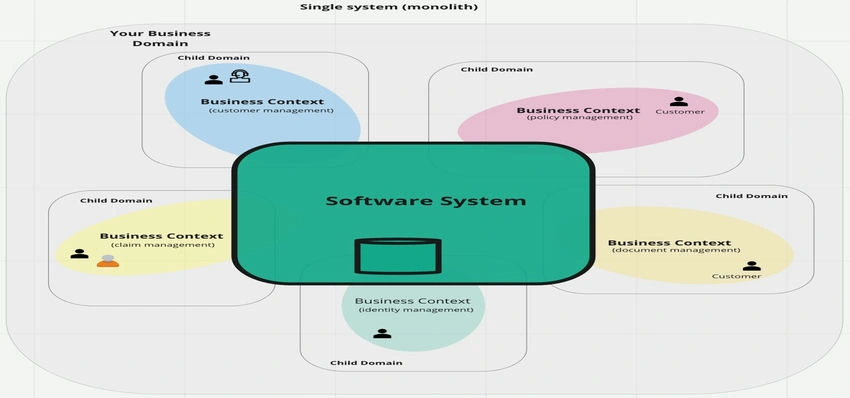
A monolithic application is a software architecture where different components of the application are combined into a single codebase and deployed as a single unit.
Pros
- Simplicity: Monolithic architectures are often simpler to develop, deploy, and manage compared to distributed architectures. They have fewer moving parts, making them easier to understand and maintain.
- Development Speed: Developing a monolithic application can be faster because all components are developed within the same codebase. Developers can easily navigate and make changes across the entire application.
- Ease of Testing: Testing a monolithic application is relatively straightforward since all components are tightly integrated. Unit tests, integration tests, and end-to-end tests can be performed more easily compared to distributed systems.
Cons
- Limited Scalability: Monolithic architectures can become difficult to scale as the application grows in size and complexity. Horizontal scaling (adding more instances of the application) may be challenging due to the tight coupling of components.
- Technology Stack Lock-In: Monolithic applications are typically built using a single technology stack. Switching to a different technology stack or adopting new technologies can be challenging and may require a significant rewrite of the application.
- Maintainability: As monolithic applications grow larger, they can become difficult to maintain and evolve. Making changes to one part of the application may have unintended consequences elsewhere, leading to codebase fragility and technical debt.
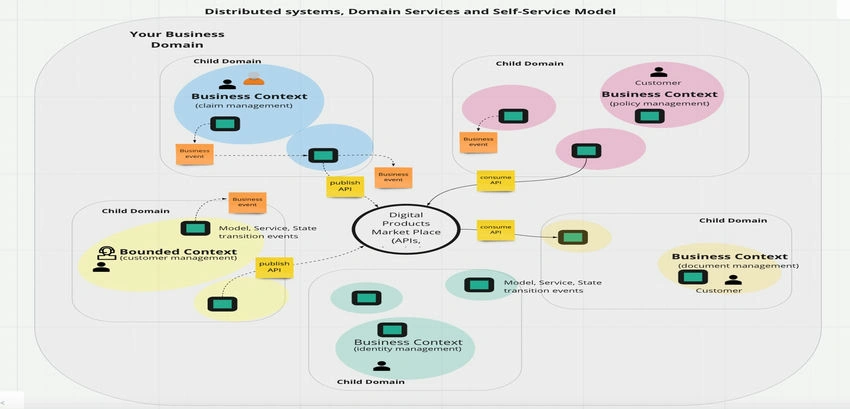
Distributed systems with DDD
- Distributes system Architecture is an emerging service-based architectural style that focuses on the design and implementation of highly scalable distributed software systems.
- To analyze the business domain and its decomposition into services, Domain-driven Design (DDD) is commonly applied.
- DDD is an approach for designing software that relies on various model-based concepts to express knowledge about the business domain, e.g. the Bounded Context, which clusters a set of coherent Domain Models.
- Use Domain Driven Design to construct the right boundaries from our business contexts using techniques such as event-storming. This process then leads to a context map which shows the relationship between bounded contexts.
- Once we have the bounded contexts, we can begin to express the model and capture transaction boundaries in interactions to build a view of “domain aggregates”.
- DDD offers an approach to modeling software based on bounded contexts and provides strategic and tactical design techniques for building autonomous software capabilities as services.
Step-by-Step Guide
Incorporating DDD in an E-commerce Application.
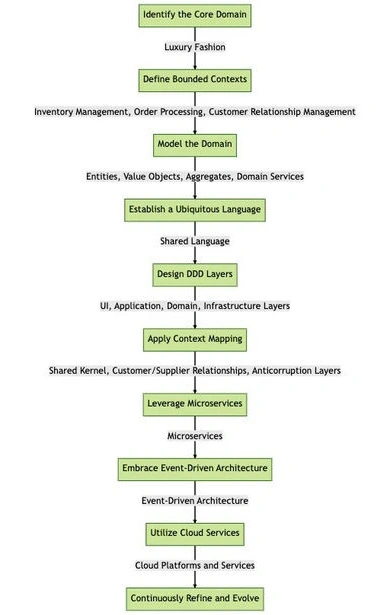
- Identify the Core Domain: Let’s say we are building an e-commerce application focused on luxury fashion. The core domain could be “Product Catalog Management,” where the central focus is on managing and showcasing high-end fashion products.
- Define Bounded Contexts: Identify distinct subdomains within the e-commerce system. For example, we can have “Inventory Management” to handle stock availability, “Order Processing” to manage customer orders, and “Customer Relationship Management” to handle customer interactions and profiles. Define clear boundaries for each of these bounded contexts.
- Model the Domain: Apply DDD tactical patterns to design entities, value objects, aggregates, and domain services specific to each bounded context. For the “Product Catalog Management” bounded context, we might have entities like “Product” and “Brand,” value objects like “Price” and “Color,” aggregates like “ProductCatalog” or “BrandCatalog,” and domain services like “ProductRecommendationService” or “ProductSearchService.”
- Establish a Ubiquitous Language: Create a shared language that unifies stakeholders, domain experts, and development teams. For instance, use terms like “Product SKU,” “Availability Status,” “Customer Wishlist,” and “Product Review” to accurately reflect the concepts and processes within the luxury fashion domain.
- Design DDD Layers: Implement the strategic pattern of domain-driven design layers. The user interface (UI) layer could include features like product browsing, search, and shopping carts. The application layer would handle use cases such as adding products to the catalog or processing orders. The domain layer would encapsulate the core business logic, including validation rules, calculations, and workflows. The infrastructure layer would provide technical infrastructure and integration with external services.
- Apply Context Mapping: Identify the relationships and interactions between the bounded contexts. For example, the “Inventory Management” context might interact with the “Order Processing” context when updating stock availability. Implement context mapping techniques like shared kernel or customer/supplier relationships to ensure consistency and integration between these contexts.
- Leverage Microservices: Divide the e-commerce application into microservices aligned with the bounded contexts identified earlier. Each microservice should encapsulate a specific domain and have its own data storage, business logic, and API endpoints. For instance, the “Inventory Management” microservice would handle stock tracking and availability, while the “Order Processing” microservice would handle order placement and fulfillment.
- Embrace Event-Driven Architecture: Identify important business events within the e-commerce application. For example, when a customer places an order, it triggers an “OrderPlaced” event. Design the system to react to these events, using event-driven architecture. Implement event-driven communication between microservices to enable loose coupling and flexibility. For instance, the “Inventory Management” microservice could listen to the “OrderPlaced” event and update stock availability accordingly.
- Utilize Cloud Services: Leverage cloud platforms and services to deploy your microservices and support the scalability, availability, and global accessibility of the e-commerce application. For example, you can use serverless computing services like AWS Lambda or container orchestration platforms like Kubernetes to optimize resource allocation and reduce operational overhead.
- Continuously Refine and Evolve: DDD is an iterative process. Collaborate with domain experts, stakeholders, and development teams to refine and evolve the domain model, adjust bounded contexts, and adapt the system to changing business requirements. Regularly revisit and refine your architecture to ensure it aligns with the evolving needs of your luxury fashion e-commerce application.
Example
- Domain: E-commerce Platform
Bounded Contexts
- Order Management: Responsible for managing orders, customers, and payments.
- Subdomains: Order, Customer, Payment.
- Inventory Management: Responsible for managing orders, customers, and payments.
- Subdomains: Order, Customer, Payment.
Entities
Order Management
- Order: Represents an order placed by a customer. It has attributes such as order ID, customer ID, status, total amount, etc.
- Customer: Represents a customer who places orders. It has attributes such as customer ID, name, email, shipping address, etc.
Inventory Management
- Product: Represents a product available for purchase. It has attributes such as product ID, name, description, price, quantity in stock, etc.
Value Objects
- Address: Represents a shipping address. It contains attributes such as street, city, state, postal code, and country.
Inventory Management
- Price: Represents a price for a product. It encapsulates attributes such as amount and currency.
Aggregates
Order Management
- Order: Aggregate root for the Order Bounded Context. It encapsulates the Order entity and related entities such as OrderLineItem.
- OrderLineItem: Represents a line item within an order. It contains attributes such as product ID, quantity, price, etc.
Inventory Management
- Product: Aggregate root for the Inventory Bounded Context. It encapsulates the Product entity and related entities such as InventoryItem.
- InventoryItem: Represents an item in the inventory for a specific product. It contains attributes such as product ID, quantity in stock, warehouse location, etc.
Aggregate Roots
- Order: Aggregate root for the Order Bounded Context. It controls access to order-related entities such as OrderLineItem and ensures consistency within the order.
- Product: Aggregate root for the Inventory Bounded Context. It controls access to product-related entities such as InventoryItem and ensures consistency within the product inventory.
Domain Services
- PaymentService: Manages the process of initiating and processing payments for orders. It may interact with multiple entities such as Order, Payment, and Customer to validate payment details, deduct funds from the customer's account, and update the order status.
- InventoryService: Handles inventory management operations such as checking product availability, updating stock levels, and reserving items for orders. It collaborates with entities like Product and OrderItem to ensure accurate inventory tracking.
Domain Events
- OrderPlacedEvent: Represents an event triggered when a new order is placed by a customer. It contains data such as order ID, customer ID, products, and total amount.
- ProductStockUpdated: This represents an event triggered when the stock level of a product is updated due to an order being placed or inventory management actions. It contains data such as product ID, quantity in stock, and timestamp.
Summary
In summary, combining Domain-Driven Design principles with distributed architecture in modern software systems enables the creation of scalable, resilient, and domain-driven applications that can adapt to changing business requirements and technological advancements. By aligning domain concepts with distributed services, organizations can build software architectures that are well-suited to the complexities of today's digital landscape.
Join the conversation! Your thoughts help the community grow.