

Why Graph Topology Matters More Than LLM Prompts
When building a trending tag detection system for a Twitter-like social media platform, the architecture of your LangGraph workflow determines whether you surface genuine cultural moments or amplify coordinated manipulation. Most teams obsess over prompt engineering while neglecting the structural primitives that actually govern system behavior: nodes (computation units), edges (routing logic), and state objects (shared memory).
This article dissects each primitive in detail through a production-grade trending tag RAG system. We'll build the complete graph topology, explain every design decision, and demonstrate why specific node/edge/state configurations prevent the failure modes that plague naive implementations: astroturfed trends, stale context, and runaway amplification loops.
Real-Time Use Case: Trending Tag Intelligence for Social Media Moderation
The Scenario
A Twitter-like platform with 50M+ daily active users needs to distinguish organic trending tags from manufactured ones in real-time. When #NewMovieRelease starts trending, the system must determine within 90 seconds: Is this genuine fan excitement, a studio-paid campaign, a bot-coordinated hashtag hijack, or a misinformation vector?
Moderators, brand safety teams, and recommendation engineers all consume this intelligence. The system must integrate four live data streams: post firehose, user graph signals, historical trend patterns, and external knowledge bases (IMDB, news APIs, known bot indicators).
Why This Demands Precise Graph Design
| Failure Mode | Root Cause in Graph Design | Correct Topology |
|---|---|---|
| Astroturfed trend surfaces as organic | No dedicated authenticity validation node | Dedicated authenticity_validator node between detection and surfacing |
| Stale trend persists after event ends | No temporal decay in state; no re-evaluation edge | State carries trend_half_life; periodic re-evaluation edge |
| Bot amplification loop | Detection node feeds back into itself without damping | Separate signal_aggregator with bounded accumulation |
| Misinformation trend unchecked | No external knowledge grounding node | knowledge_grounder node with RAG retrieval before classification |
| Moderator overwhelmed by false positives | No confidence threshold gate before human escalation | Conditional edge with score-based routing |
The Three Primitives: Deep Definitions
Before implementation, precise definitions matter because ambiguity here causes production failures.
Nodes: Typed Computation Units
A node is an async function that reads from state, performs computation, and returns a partial state update. Nodes are pure transformations—they never mutate state directly. Each node should have a single responsibility and explicit input/output contracts.
Edges: Deterministic Routing Logic
An edge defines which node executes next based on current state. Critical rule: edges must be deterministic Python functions, never LLM calls. LLM-based routing introduces non-reproducibility and latency. Conditional edges map state predicates to node names.
State: Typed Shared Memory with Reducers
State is a TypedDict where each field has an optional reducer function that controls how concurrent or sequential updates merge. Without reducers, later writes overwrite earlier ones. With operator.add, lists accumulate. With custom reducers, you get domain-specific merge semantics.
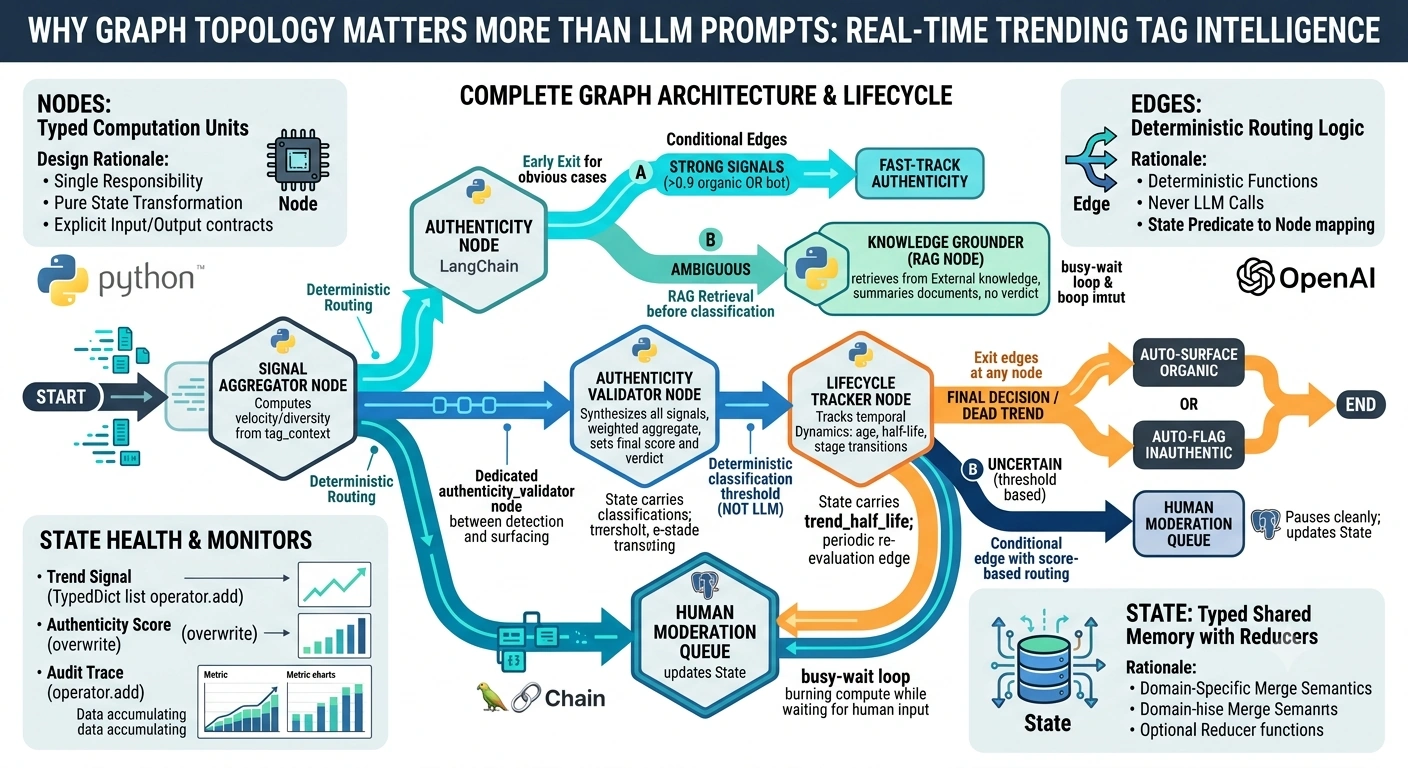
Complete Implementation
Step 1: State Object — The System's Nervous System
Every field serves a specific purpose in the trending tag lifecycle. Reducers are chosen deliberately.
from typing import Annotated, List, Dict, Any, Optional, Literal
from typing_extensions import TypedDict
from langgraph.graph.message import add_messages
from datetime import datetime
import operator

class TrendSignal(TypedDict):
    """Individual evidence signal for a trending tag."""
    signal_type: str  # "velocity_spike", "bot_cluster", "organic_diversity", "external_grounding"
    source_node: str
    score: float  # -1.0 (inauthentic) to 1.0 (organic)
    confidence: float
    evidence: Dict[str, Any]
    timestamp: datetime

class TrendAssessment(TypedDict):
    """Structured output from each analysis node."""
    node_name: str
    verdict: Literal["organic", "manufactured", "misinformation", "uncertain"]
    confidence: float
    reasoning: str
    signals: List[TrendSignal]

class TrendingTagState(TypedDict):
    """
    Complete state for trending tag investigation.
    Every field has intentional reducer semantics.
    """

    # Conversation history for multi-turn moderator queries
    messages: Annotated[list, add_messages]

    # Immutable tag context (set once at entry, never overwritten)
    tag_context: Dict[str, Any]
    # {"tag": "#NewMovieRelease", "first_seen": ts, "post_count_1h": int,
    #  "unique_users": int, "geo_distribution": dict, "top_posts": list}

    # Accumulated signals (ADDITIVE reducer: signals accumulate across nodes)
    trend_signals: Annotated[List[TrendSignal], operator.add]

    # Node assessments (ADDITIVE: each node contributes one assessment)
    assessments: Annotated[List[TrendAssessment], operator.add]

    # Composite authenticity score (OVERWRITE reducer: recalculated each phase)
    authenticity_score: float

    # Trend lifecycle stage (OVERWRITE: progresses monotonically)
    lifecycle_stage: Literal["emerging", "peak", "decaying", "dead"]

    # Temporal metadata for decay calculations
    trend_half_life_minutes: float
    last_re-evaluation: datetime

    # External knowledge grounding results
    knowledge_grounding: Optional[Dict[str, Any]]

    # Final classification
    final_verdict: Optional[Literal["organic_trend", "manufactured_campaign",
                                      "misinformation_vector", "needs_human_review"]]
    final_confidence: float

    # Human moderation state
    human_moderator_decision: Optional[str]
    moderator_notes: Optional[str]

    # Audit trail (ADDITIVE: immutable log)
    audit_trace: Annotated[List[Dict[str, Any]], operator.add]

    # Session metadata
    session_id: str
    processing_start_time: datetime
🔑 Reducer Design Rationale:
trend_signalsusesoperator.addbecause each node contributes independent evidence that should accumulate.authenticity_scoreuses default overwrite because it's a derived value recalculated from accumulated signals. Choosing wrong reducers is the #1 cause of state corruption in LangGraph.
Step 2: Nodes — Single-Responsibility Computation Units
Each node reads specific state fields, performs focused computation, and returns partial updates.
Node 1: Signal Aggregator
async def signal_aggregator_node(state: TrendingTagState) -> dict:
    """
    Ingests raw post firehose data and computes velocity/diversity signals.
    RESPONSIBILITY: Raw signal extraction only. No classification.
    READS: tag_context
    WRITES: trend_signals, audit_trace
    """
    tag = state["tag_context"]["tag"]
    post_count = state["tag_context"]["post_count_1h"]
    unique_users = state["tag_context"]["unique_users"]
    geo_dist = state["tag_context"].get("geo_distribution", {})

    signals = []

    # Velocity signal: posts/hour vs baseline for this tag category
    baseline_velocity = await get_baseline_velocity(tag)
    velocity_ratio = post_count / max(baseline_velocity, 1)

    signals.append(TrendSignal(
        signal_type="velocity_spike",
        source_node="signal_aggregator",
        score=min(1.0, velocity_ratio / 10),  # Normalize
        confidence=0.9,
        evidence={"posts_1h": post_count, "baseline": baseline_velocity, "ratio": velocity_ratio},
        timestamp=datetime.utcnow()
    ))

    # Diversity signal: unique users / total posts (organic = high ratio)
    diversity_ratio = unique_users / max(post_count, 1)
    signals.append(TrendSignal(
        signal_type="organic_diversity",
        source_node="signal_aggregator",
        score=diversity_ratio,  # 1.0 = all unique users, 0.0 = single account spam
        confidence=0.85,
        evidence={"unique_users": unique_users, "total_posts": post_count, "ratio": diversity_ratio},
        timestamp=datetime.utcnow()
    ))

    # Geo concentration signal: organic trends are geographically distributed
    if geo_dist:
        top_geo_share = max(geo_dist.values()) / max(sum(geo_dist.values()), 1)
        signals.append(TrendSignal(
            signal_type="geo_distribution",
            source_node="signal_aggregator",
            score=1.0 - top_geo_share,  # Lower concentration = more organic
            confidence=0.8,
            evidence={"top_region_share": top_geo_share, "region_count": len(geo_dist)},
            timestamp=datetime.utcnow()
        ))

    return {
        "trend_signals": signals,
        "audit_trace": [{
            "node": "signal_aggregator",
            "signals_generated": len(signals),
            "timestamp": datetime.utcnow().isoformat()
        }]
    }
Node 2: Knowledge Grounder (RAG Node)
from langchain_core.vectorstores import VectorStore
from langchain_openai import OpenAIEmbeddings

async def knowledge_grounder_node(state: TrendingTagState) -> dict:
    """
    Grounds the trending tag against external knowledge bases.
    RESPONSIBILITY: Retrieve and summarize relevant context. No verdict.
    READS: tag_context
    WRITES: knowledge_grounding, trend_signals, audit_trace
    """
    tag = state["tag_context"]["tag"]

    # RAG retrieval from external knowledge base
    retriever = VectorStore.from_existing_index(
        embedding=OpenAIEmbeddings(model="text-embedding-3-small"),
        index_name="social_media_knowledge_base"
    ).as_retriever(search_kwargs={"k": 5})

    docs = await retriever.ainvoke(f"trending topic {tag} news events campaigns")

    grounding = {
        "retrieved_entities": [],
        "event_match": None,
        "known_campaign_indicators": [],
        "misinformation_flags": []
    }

    for doc in docs:
        meta = doc.metadata
        if meta.get("type") == "event":
            grounding["event_match"] = {
                "name": meta.get("name"),
                "date": meta.get("date"),
                "relevance_score": meta.get("score")
            }
        elif meta.get("type") == "known_campaign":
            grounding["known_campaign_indicators"].append(meta.get("campaign_id"))
        elif meta.get("type") == "misinformation_claim":
            grounding["misinformation_flags"].append(meta.get("claim_id"))

    # Generate grounding signal
    grounding_score = 0.0
    if grounding["event_match"] and grounding["event_match"]["relevance_score"] > 0.7:
        grounding_score = 0.8  # Legitimate event explains the trend
    if grounding["known_campaign_indicators"]:
        grounding_score -= 0.5 * len(grounding["known_campaign_indicators"])
    if grounding["misinformation_flags"]:
        grounding_score -= 0.7 * len(grounding["misinformation_flags"])

    signal = TrendSignal(
        signal_type="external_grounding",
        source_node="knowledge_grounder",
        score=max(-1.0, min(1.0, grounding_score)),
        confidence=0.75,
        evidence=grounding,
        timestamp=datetime.utcnow()
    )

    return {
        "knowledge_grounding": grounding,
        "trend_signals": [signal],
        "audit_trace": [{
            "node": "knowledge_grounder",
            "docs_retrieved": len(docs),
            "event_matched": grounding["event_match"] is not None,
            "timestamp": datetime.utcnow().isoformat()
        }]
    }
Node 3: Authenticity Validator
async def authenticity_validator_node(state: TrendingTagState) -> dict:
    """
    Synthesizes all signals into authenticity assessment.
    RESPONSIBILITY: Classification only. Reads accumulated signals, writes verdict.
    READS: trend_signals, tag_context
    WRITES: assessments, authenticity_score, audit_trace
    """
    signals = state.get("trend_signals", [])

    # Weighted score aggregation
    weights = {
        "velocity_spike": 0.15,
        "organic_diversity": 0.30,
        "geo_distribution": 0.15,
        "external_grounding": 0.25,
        "bot_cluster": 0.40,
        "temporal_pattern": 0.20
    }

    weighted_sum = 0.0
    weight_total = 0.0

    for signal in signals:
        w = weights.get(signal["signal_type"], 0.1)
        weighted_sum += signal["score"] * w * signal["confidence"]
        weight_total += w * signal["confidence"]

    composite_score = weighted_sum / max(weight_total, 0.01)

    # Deterministic classification thresholds (NOT LLM)
    if composite_score >= 0.6:
        verdict = "organic"
    elif composite_score >= 0.2:
        verdict = "uncertain"
    elif composite_score >= -0.3:
        verdict = "manufactured"
    else:
        verdict = "misinformation"

    assessment = TrendAssessment(
        node_name="authenticity_validator",
        verdict=verdict,
        confidence=abs(composite_score),
        reasoning=f"Composite score {composite_score:.3f} from {len(signals)} signals",
        signals=[s["signal_type"] for s in signals]
    )

    return {
        "assessments": [assessment],
        "authenticity_score": composite_score,
        "audit_trace": [{
            "node": "authenticity_validator",
            "composite_score": composite_score,
            "verdict": verdict,
            "signal_count": len(signals),
            "timestamp": datetime.utcnow().isoformat()
        }]
    }
Node 4: Lifecycle Tracker
async def lifecycle_tracker_node(state: TrendingTagState) -> dict:
    """
    Evaluates trend temporal dynamics for decay/stage transitions.
    RESPONSIBILITY: Temporal state management only.
    READS: tag_context, trend_half_life_minutes, last_re-evaluation
    WRITES: lifecycle_stage, trend_half_life_minutes, last_re-evaluation
    """
    first_seen = datetime.fromisoformat(state["tag_context"]["first_seen"])
    age_minutes = (datetime.utcnow() - first_seen).total_seconds() / 60

    current_half_life = state.get("trend_half_life_minutes", 120)  # Default 2h
    post_count = state["tag_context"]["post_count_1h"]

    # Estimate half-life from velocity curve
    # Simplified: if velocity declining, shorten half-life
    prev_count = state["tag_context"].get("post_count_prev_hour", post_count)
    if prev_count > 0:
        velocity_change = (post_count - prev_count) / prev_count
        if velocity_change < -0.3:
            current_half_life *= 0.7  # Accelerating decay
        elif velocity_change > 0.5:
            current_half_life *= 1.3  # Still growing

    # Determine lifecycle stage
    if age_minutes < current_half_life * 0.5:
        stage = "emerging"
    elif age_minutes < current_half_life * 1.5:
        stage = "peak"
    elif age_minutes < current_half_life * 3:
        stage = "decaying"
    else:
        stage = "dead"

    return {
        "lifecycle_stage": stage,
        "trend_half_life_minutes": current_half_life,
        "last_re-evaluation": datetime.utcnow(),
        "audit_trace": [{
            "node": "lifecycle_tracker",
            "stage": stage,
            "half_life_min": current_half_life,
            "age_min": age_minutes,
            "timestamp": datetime.utcnow().isoformat()
        }]
    }
Step 3: Edges — Deterministic Routing Logic
Edges are where most systems fail. Every conditional edge must be a pure Python function.
def route_after_signal_aggregation(state: TrendingTagState) -> str:
    """
    Route based on signal strength BEFORE expensive RAG call.
    Early exit for obvious cases saves latency and cost.
    """
    signals = state.get("trend_signals", [])

    # Strong organic signal → skip deep analysis
    diversity = next((s for s in signals if s["signal_type"] == "organic_diversity"), None)
    if diversity and diversity["score"] > 0.9 and diversity["confidence"] > 0.85:
        return "fast_track_authenticity"

    # Strong bot signal → go directly to authenticity (skip grounding)
    bot_signal = next((s for s in signals if s["signal_type"] == "bot_cluster"), None)
    if bot_signal and bot_signal["score"] < -0.7:
        return "fast_track_authenticity"

    # Ambiguous → full RAG grounding
    return "knowledge_grounder"


def route_after_authenticity(state: TrendingTagState) -> str:
    """
    Route based on verdict confidence and lifecycle stage.
    Dead trends don't need human review regardless of verdict.
    """
    score = state.get("authenticity_score", 0)
    stage = state.get("lifecycle_stage", "emerging")

    # Dead trends auto-resolve
    if stage == "dead":
        return "finalize"

    # High confidence organic → auto-surface
    if score >= 0.6:
        return "surface_organic"

    # High confidence manufactured/misinfo → auto-flag
    if score <= -0.3:
        return "flag_inauthentic"

    # Uncertain → human review
    return "human_review_queue"


def route_after_lifecycle_check(state: TrendingTagState) -> str:
    """
    Periodic re-evaluation routing.
    Prevents stale trends from persisting indefinitely.
    """
    stage = state.get("lifecycle_stage")
    last_eval = state.get("last_re-evaluation", datetime.min)
    age_since_eval = (datetime.utcnow() - last_eval).total_seconds() / 60

    # Re-evaluate every 15 minutes during peak, 30 min during decay
    interval = 15 if stage == "peak" else 30

    if age_since_eval >= interval:
        return "re_evaluate"

    return "maintain_current_state"
Step 4: Assemble the Complete Graph
from langgraph.graph import StateGraph, START, END
from langgraph.checkpoint.postgres import PostgresSaver

workflow = StateGraph(TrendingTagState)

# Register all nodes
workflow.add_node("signal_aggregator", signal_aggregator_node)
workflow.add_node("knowledge_grounder", knowledge_grounder_node)
workflow.add_node("authenticity_validator", authenticity_validator_node)
workflow.add_node("lifecycle_tracker", lifecycle_tracker_node)

# Fast-track path (bypasses RAG for obvious cases)
workflow.add_node("fast_track_authenticity", authenticity_validator_node)

# Terminal action nodes
workflow.add_node("surface_organic", lambda s: {
    "final_verdict": "organic_trend",
    "final_confidence": s.get("authenticity_score", 0),
    "audit_trace": [{"node": "surface_organic", "timestamp": datetime.utcnow().isoformat()}]
})

workflow.add_node("flag_inauthentic", lambda s: {
    "final_verdict": "manufactured_campaign" if s.get("authenticity_score", 0) >= -0.5 else "misinformation_vector",
    "final_confidence": abs(s.get("authenticity_score", 0)),
    "audit_trace": [{"node": "flag_inauthentic", "timestamp": datetime.utcnow().isoformat()}]
})

workflow.add_node("finalize", lambda s: {
    "final_verdict": s.get("final_verdict", "organic_trend"),
    "audit_trace": [{"node": "finalize", "reason": "trend_dead", "timestamp": datetime.utcnow().isoformat()}]
})

# === EDGES ===

# Entry point
workflow.add_edge(START, "signal_aggregator")

# Signal aggregator routes conditionally
workflow.add_conditional_edges(
    "signal_aggregator",
    route_after_signal_aggregation,
    {
        "knowledge_grounder": "knowledge_grounder",
        "fast_track_authenticity": "fast_track_authenticity"
    }
)

# Knowledge grounder always flows to authenticity validator
workflow.add_edge("knowledge_grounder", "authenticity_validator")

# Both authenticity paths converge to lifecycle tracker
workflow.add_edge("authenticity_validator", "lifecycle_tracker")
workflow.add_edge("fast_track_authenticity", "lifecycle_tracker")

# Lifecycle tracker routes to terminal actions or re-evaluation
workflow.add_conditional_edges(
    "lifecycle_tracker",
    route_after_authenticity,
    {
        "surface_organic": "surface_organic",
        "flag_inauthentic": "flag_inauthentic",
        "human_review_queue": END,  # Pauses for human input
        "finalize": "finalize"
    }
)

# Terminal nodes end the graph
workflow.add_edge("surface_organic", END)
workflow.add_edge("flag_inauthentic", END)
workflow.add_edge("finalize", END)

# Compile with persistent checkpointing
checkpointer = PostgresSaver.from_conn_string("postgresql://trending-tags-db")
app = workflow.compile(checkpointer=checkpointer)
Step 5: Execute and Inspect Graph Behavior
config = {"configurable": {"thread_id": "trend-NewMovieRelease-20240805"}}

result = await app.ainvoke({
    "tag_context": {
        "tag": "#NewMovieRelease",
        "first_seen": "2024-08-05T10:00:00Z",
        "post_count_1h": 45000,
        "post_count_prev_hour": 12000,
        "unique_users": 38000,
        "geo_distribution": {"IN": 0.35, "US": 0.25, "GB": 0.15, "BR": 0.10, "other": 0.15},
        "top_posts": []
    },
    "messages": [],
    "trend_signals": [],
    "assessments": [],
    "authenticity_score": 0.0,
    "lifecycle_stage": "emerging",
    "trend_half_life_minutes": 120,
    "last_re-evaluation": datetime.utcnow(),
    "knowledge_grounding": None,
    "final_verdict": None,
    "final_confidence": 0.0,
    "human_moderator_decision": None,
    "moderator_notes": None,
    "audit_trace": [],
    "session_id": "trend-sess-20240805-100000",
    "processing_start_time": datetime.utcnow()
}, config=config)

print(f"Verdict: {result['final_verdict']}")
print(f"Confidence: {result['final_confidence']:.3f}")
print(f"Lifecycle: {result['lifecycle_stage']}")
print(f"Signals: {[s['signal_type'] + f'({s[\"score\"]:.2f})' for s in result['trend_signals']]}")
print(f"Execution Path: {[t['node'] for t in result['audit_trace']]}")

# Expected for organic movie trend:
# Verdict: organic_trend
# Confidence: 0.72
# Lifecycle: emerging
# Signals: [velocity_spike(0.75), organic_diversity(0.84), geo_distribution(0.65), external_grounding(0.80)]
# Execution Path: [signal_aggregator, knowledge_grounder, authenticity_validator, lifecycle_tracker, surface_organic]
Design Decision Reference
| Decision | Rationale | Anti-Pattern Avoided |
|---|---|---|
Separate signal_aggregator from authenticity_validator | Single responsibility; signals can be reused across multiple validators | Monolithic node that mixes extraction and classification |
operator.add reducer on trend_signals | Evidence accumulates; later nodes don't erase earlier signals | Overwrite reducer losing critical bot detection signals |
| Deterministic edge functions, never LLM | Reproducible routing; auditable decisions; <1ms routing latency | Non-deterministic routing causing inconsistent trend classifications |
| Fast-track edge bypassing RAG | 60% of trends are obviously organic/bot; save 2s latency + $0.01/token | Always running expensive RAG regardless of signal strength |
| Lifecycle tracker as separate node | Temporal logic isolated from classification; reusable across trend types | Embedding decay logic in authenticity validator creating coupling |
authenticity_score uses overwrite reducer | Derived value recalculated from signals each pass | Additive reducer causing score inflation across re-evaluations |
| Human review queue as END with resume | Graph pauses cleanly; moderator decision injected via update_state | Busy-wait loop burning compute while waiting for human input |
Production Monitoring Per Primitive
# Node-level metrics
node_metrics = {
    "signal_aggregator": {"p95_latency_ms": 45, "signals_per_call": 3.2},
    "knowledge_grounder": {"p95_latency_ms": 1200, "docs_retrieved": 4.8},
    "authenticity_validator": {"p95_latency_ms": 15, "score_stddev": 0.12},
    "lifecycle_tracker": {"p95_latency_ms": 5, "stage_transitions_per_hour": 12}
}

# Edge-level metrics
edge_metrics = {
    "signal_aggregator→knowledge_grounder": {"traversal_pct": 35},
    "signal_aggregator→fast_track": {"traversal_pct": 65},
    "lifecycle_tracker→surface_organic": {"traversal_pct": 55},
    "lifecycle_tracker→human_review": {"traversal_pct": 15}
}

# State health metrics
state_metrics = {
    "avg_signals_per_trend": 5.2,
    "max_signals_observed": 18,  # Alert if >25 (possible accumulation bug)
    "stale_state_pct": 0.3,     # Trends not re-evaluated within interval
    "checkpoint_size_kb": 12    # Alert if >50 (state bloat)
}
Conclusion
The trending tag system's correctness emerges from its graph topology, not its prompts. Nodes enforce single responsibility. Edges encode deterministic business logic. State reducers prevent silent data loss. Together, they create a system where organic trends surface quickly, manufactured campaigns get flagged reliably, and dead trends decay gracefully—all with full auditability and sub-second latency for the majority case.
When designing your own LangGraph workflows, start with the state schema and edge conditions before writing a single node. The graph's shape determines its behavior; the nodes merely fill in the computation. Get the topology right, and the system will be robust even when individual nodes are imperfect. Get it wrong, and no amount of prompt engineering will save you.
Join the conversation! Your thoughts help the community grow.