

Introduction
For more than a decade, blockchain technology has been recognized as one of the most secure methods for storing and sharing digital information. Its decentralized architecture, immutable ledger, and cryptographic protection have made it a trusted solution for cryptocurrencies, supply chain management, healthcare, finance, and many other digital services.
However, technology never stands still.
The rapid progress of quantum computing has introduced a new challenge for cybersecurity researchers. Although today's blockchain systems are considered highly secure against classical computers, many of their cryptographic foundations were never designed to withstand large-scale quantum attacks. Algorithms such as RSA and Elliptic Curve Cryptography (ECC), which are widely used for authentication and digital signatures, could eventually become vulnerable when practical quantum computers become a reality.
This does not mean blockchain is becoming obsolete. Instead, it highlights the need for the next stage of its evolution.
This is where Quantum Blockchain comes into the picture.
Rather than replacing blockchain, Quantum Blockchain enhances it by integrating post-quantum cryptographic algorithms that are specifically designed to resist attacks from both classical and quantum computers. The objective is simple: preserve the trust, integrity, and security that blockchain offers today while ensuring that these guarantees remain valid in the quantum era.
The importance of this transition becomes even more evident when we look at industries that handle sensitive information every second. Hospitals manage confidential patient records, banks process millions of financial transactions, governments explore secure electronic voting, and digital identity platforms authenticate users across countless online services. These systems cannot afford to lose trust because of future cryptographic vulnerabilities.
In this article, we will explore how Quantum Blockchain can strengthen four critical application domains:
Healthcare Records
Banking and Financial Services
Electronic Voting (E-Voting)
Digital Identity Management
Rather than focusing only on theoretical concepts, the discussion emphasizes how quantum-resistant blockchain can help organizations prepare for the cybersecurity challenges of the next generation.
Keywords : Quantum Blockchain, Blockchain Security, Post-Quantum Cryptography, Quantum Computing, Healthcare Security, Banking Security, Electronic Voting (E-Voting), Digital Identity, Cybersecurity, Future Digital Security
Why Should We Prepare Now?
A common question is, "If powerful quantum computers are not yet widely available, why should organizations start preparing today?"
The answer lies in the long lifespan of sensitive data.
Medical records, banking histories, legal documents, and identity credentials often remain valuable for many years. Information encrypted today may still need to remain confidential decades from now. If attackers capture encrypted data today and store it, they may be able to decrypt it in the future once sufficiently powerful quantum computers become available. This strategy is commonly described as "harvest now, decrypt later."
Preparing early by adopting quantum-resistant security mechanisms helps reduce this long-term risk and supports a smoother transition as post-quantum standards continue to mature.
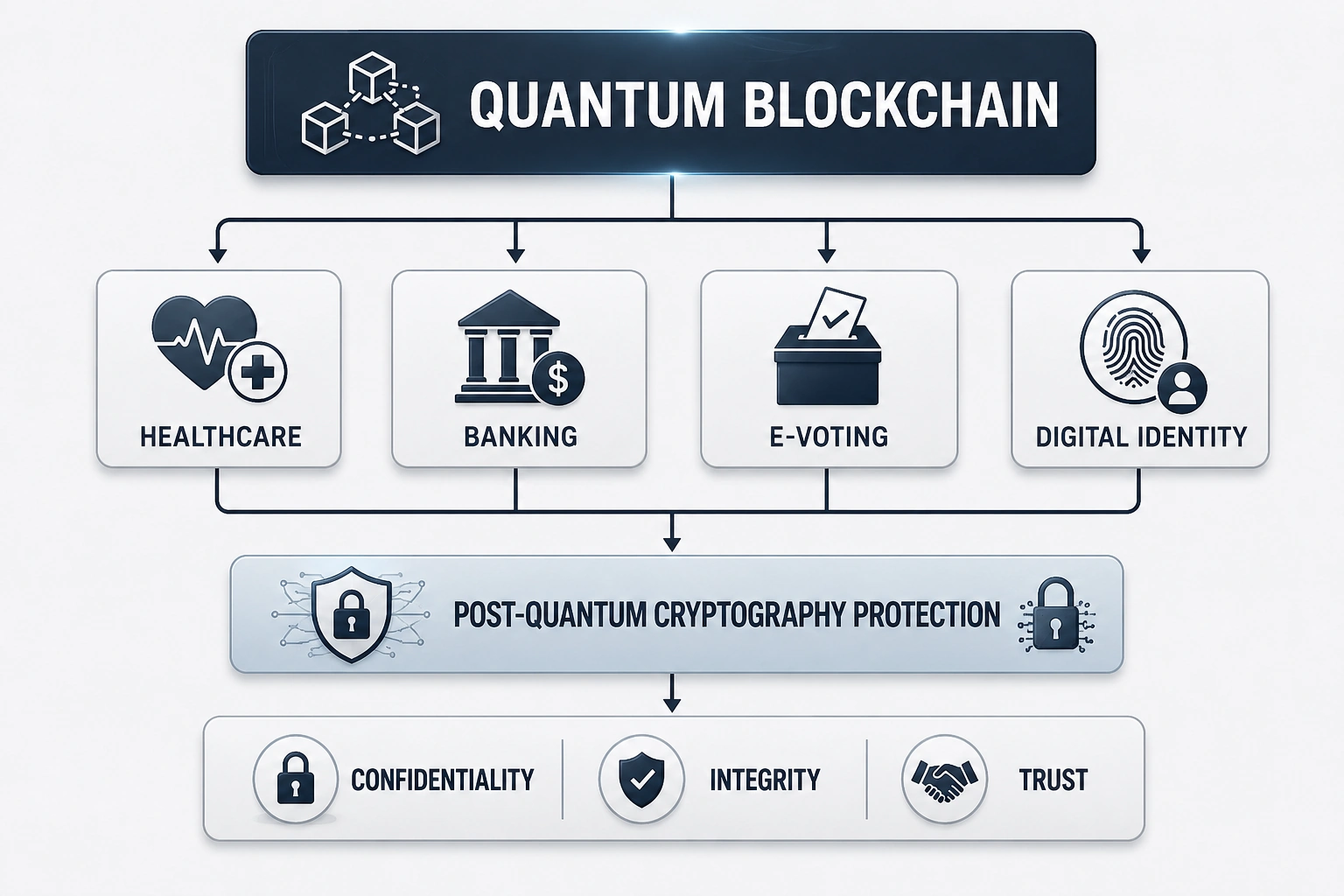
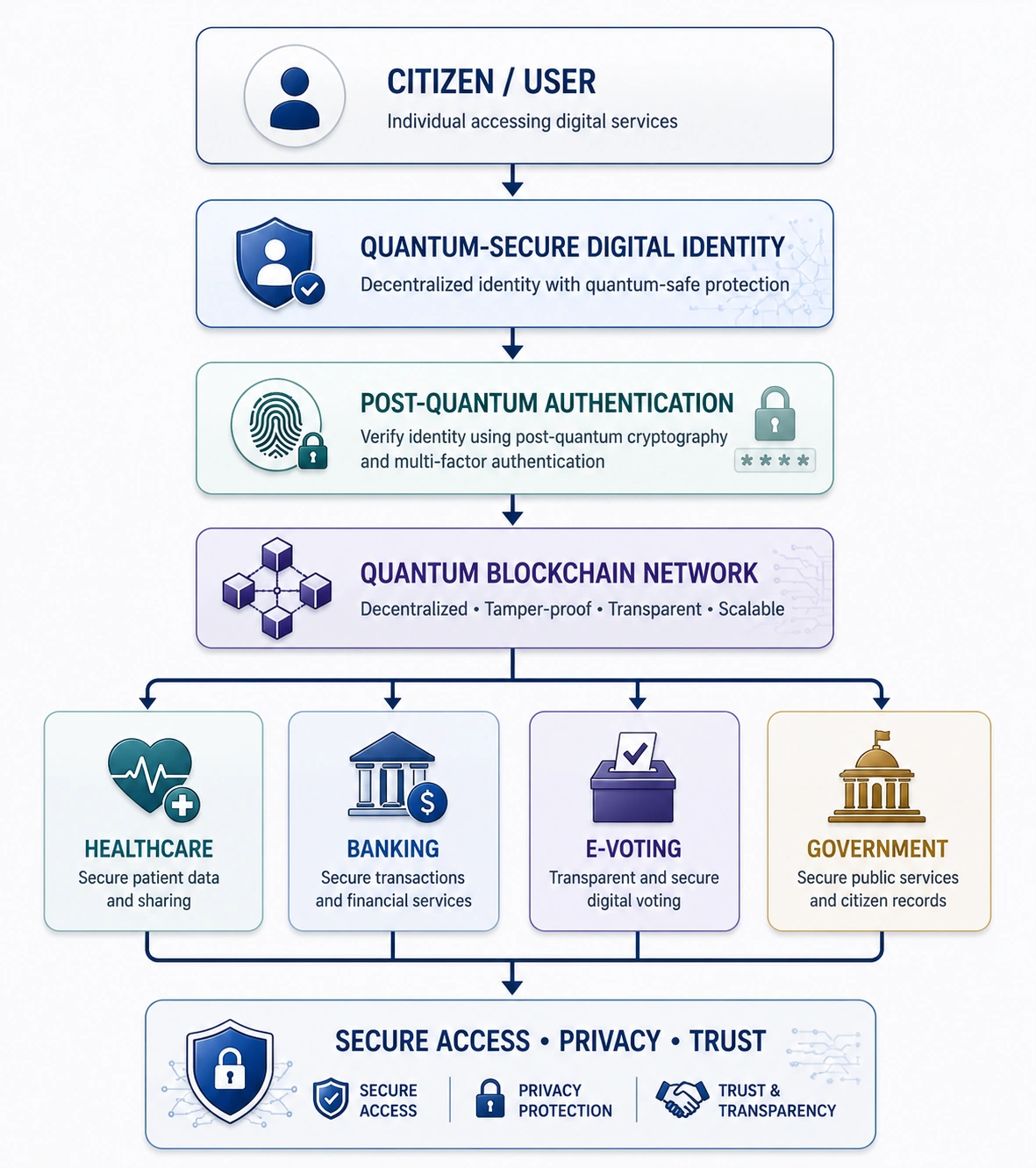
Figure 1. Conceptual overview of Quantum Blockchain protecting critical digital sectors using post-quantum cryptography.
I- Healthcare Records: Building a Quantum-Secure Healthcare Ecosystem
Healthcare is one of the most data-intensive sectors in the world. Every visit to a hospital generates valuable information, including patient demographics, medical history, laboratory reports, diagnostic images, prescriptions, insurance details, and treatment records. As healthcare services become increasingly digital, protecting this information has become just as important as providing medical care itself.
Today, most healthcare organizations rely on centralized databases or cloud-based systems to manage patient records. While these solutions have significantly improved accessibility and operational efficiency, they also introduce challenges such as data breaches, unauthorized access, ransomware attacks, and accidental data modification.
Blockchain technology was introduced as a promising solution to these challenges because it stores information in a decentralized and tamper-resistant ledger. Every authorized update is recorded chronologically, creating a transparent audit trail that helps maintain the integrity of medical records.
However, there is another challenge that healthcare systems must prepare for, the emergence of quantum computing.
Many blockchain platforms currently depend on cryptographic algorithms such as Elliptic Curve Cryptography (ECC) to authenticate users and validate digital signatures. Although these algorithms remain secure today, researchers believe that sufficiently powerful quantum computers could eventually weaken their security.
For healthcare, this is a serious concern because medical records are not short-lived data. A patient's medical history may need to remain confidential for several decades. If encrypted healthcare information is collected today and stored by attackers, it could potentially be decrypted in the future using advanced quantum computers. This long-term risk highlights the importance of transitioning toward quantum-resistant security before the threat becomes practical.
Quantum Blockchain addresses this challenge by combining blockchain technology with post-quantum cryptographic algorithms. Instead of relying solely on conventional encryption methods, future healthcare systems can adopt cryptographic techniques specifically designed to resist attacks from quantum computers. This approach ensures that patient records remain confidential, authentic, and tamper-resistant over the long term.
Another significant advantage of Quantum Blockchain is secure interoperability between healthcare institutions. Hospitals, diagnostic laboratories, pharmacies, and insurance providers often need to exchange patient information. Instead of repeatedly copying sensitive records across multiple databases, organizations can securely share verified information through a quantum-secure blockchain network while maintaining strict access control and complete traceability.
Imagine a patient receiving emergency treatment in another city. With appropriate authorization, doctors could securely access the patient's verified medical history through a Quantum Blockchain network without depending on multiple disconnected hospital databases. This could improve treatment decisions while reducing administrative delays and preserving patient privacy.
Although large-scale implementation of Quantum Blockchain in healthcare is still under active research, it represents a promising direction for building healthcare systems that remain secure not only against today's cyber threats but also against the computational capabilities of future quantum computers.
Key Advantages of Quantum Blockchain in Healthcare
Long-term protection of sensitive medical records.
Quantum-resistant authentication for healthcare professionals.
Secure sharing of patient information across hospitals and laboratories.
Tamper-resistant audit trails for clinical records.
Improved patient trust through stronger privacy protection.
Reduced dependence on centralized healthcare databases.
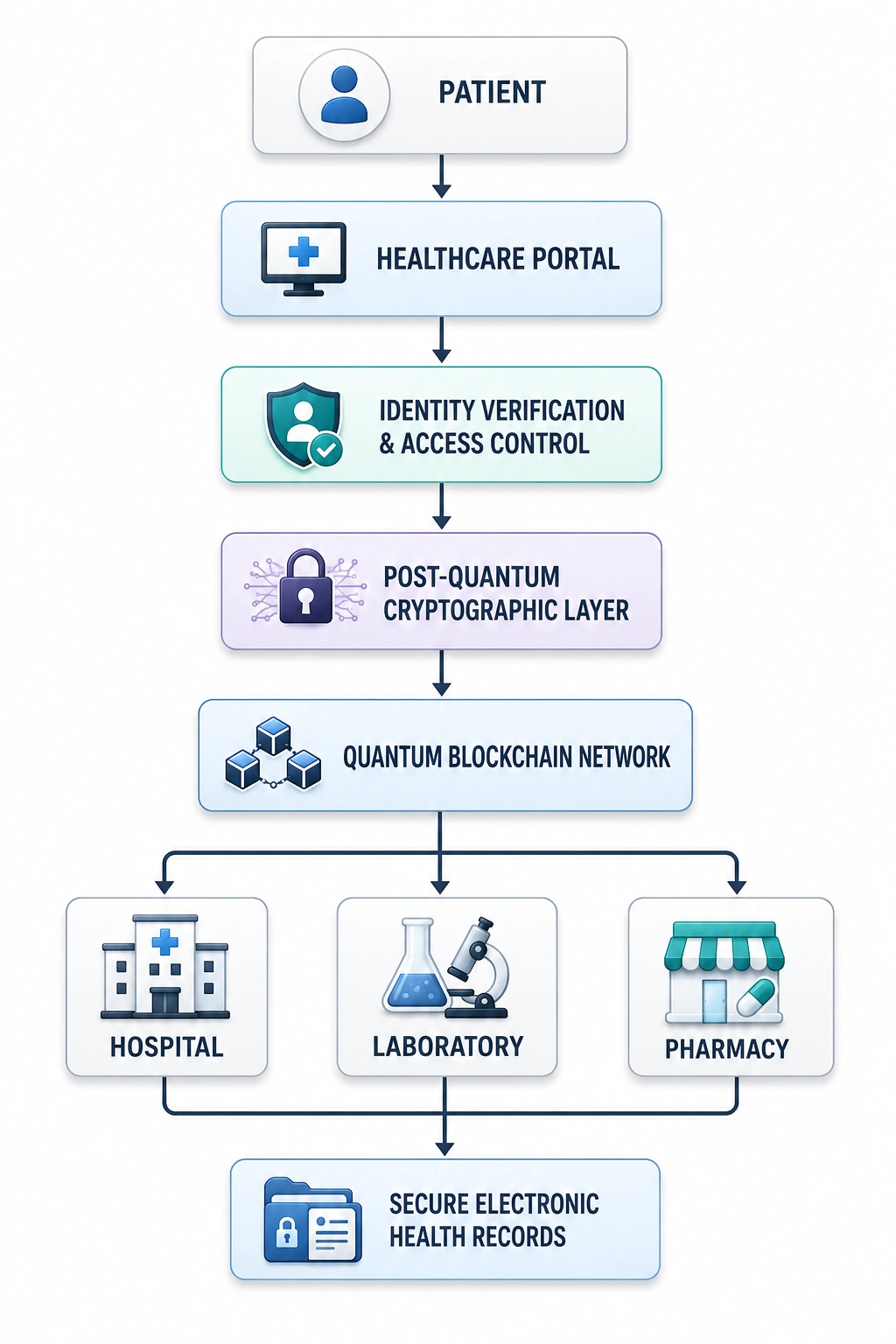
Figure 2. Illustrative architecture showing how healthcare organizations can securely exchange electronic health records using a quantum-resistant blockchain network.
Healthcare data often remains valuable throughout an individual's lifetime. As digital healthcare continues to expand through telemedicine, wearable devices, AI-assisted diagnosis, and cloud-based health services, the need for future-ready cybersecurity will become increasingly important. Quantum Blockchain has the potential to provide a resilient foundation that protects patient information for decades while supporting secure collaboration among healthcare providers.
Traditional Blockchain vs. Quantum Blockchain in Healthcare
| Feature | Traditional Blockchain | Quantum Blockchain |
|---|---|---|
| Cryptographic Security | Vulnerable to future quantum attacks | Protected using post-quantum cryptography |
| Patient Record Integrity | High | Very High |
| Long-Term Data Confidentiality | Limited in the quantum era | Designed for long-term protection |
| Hospital-to-Hospital Data Sharing | Secure | More secure with quantum-resistant authentication |
| Future Readiness | Moderate | High |
Table 1. Comparison of traditional blockchain and quantum blockchain for healthcare applications.
Unlike financial data, medical information may need to remain confidential for an individual's entire lifetime. This makes healthcare one of the strongest candidates for adopting Quantum Blockchain as organizations transition toward post-quantum cybersecurity.
II- Banking and Financial Services: Strengthening Trust in the Quantum Era
The banking and financial sector is one of the largest users of cryptographic technologies. Every day, millions of online transactions, ATM withdrawals, credit card payments, fund transfers, and digital banking sessions rely on encryption to protect customer information and financial assets.
Whenever a customer logs into an online banking application or authorizes a payment, cryptographic algorithms work behind the scenes to verify identities, secure communication channels, and ensure that transaction details cannot be altered during transmission. These security mechanisms have protected the global financial ecosystem for many years.
However, the emergence of quantum computing has introduced a new cybersecurity challenge.
Most existing financial systems depend on public-key cryptographic algorithms such as RSA and Elliptic Curve Cryptography (ECC). These algorithms are considered computationally secure against today's classical computers. In the future, however, sufficiently powerful quantum computers could solve the mathematical problems behind these algorithms much more efficiently, potentially weakening the security of digital signatures and encrypted communications.
It is important to note that this is not an immediate threat. Current banking systems remain secure, and practical quantum computers capable of breaking widely deployed encryption do not yet exist. Nevertheless, financial institutions deal with highly valuable and long-lived data, making early preparation essential rather than optional.
Quantum Blockchain provides a forward-looking approach by combining decentralized ledger technology with post-quantum cryptographic algorithms. Instead of relying only on traditional public-key encryption, future blockchain-based financial systems can authenticate users and validate transactions using cryptographic techniques specifically designed to resist quantum attacks.
This approach offers benefits beyond stronger encryption. Every transaction recorded on a blockchain is time-stamped, traceable, and resistant to unauthorized modification. When enhanced with post-quantum security, the integrity of financial records can be preserved even in a future where quantum computing becomes commercially practical.
Consider an international money transfer between two banks. Today, the transaction passes through multiple verification and settlement processes before reaching the recipient. In a Quantum Blockchain-enabled environment, the transaction could be authenticated using quantum-resistant digital signatures, validated through a decentralized blockchain network, and permanently recorded in a tamper-resistant ledger. This would improve transparency while reducing the long-term risks associated with evolving cryptographic attacks.
Another promising application is Central Bank Digital Currencies (CBDCs). Many countries are actively exploring or piloting digital currencies issued by their central banks. As these systems are expected to operate for decades, integrating post-quantum security from the beginning can help ensure that national digital payment infrastructures remain secure against future technological advancements.
Similarly, smart contracts used in decentralized finance (DeFi) and tokenized financial services could also benefit from quantum-resistant authentication, reducing the possibility of future signature forgery or unauthorized execution.
Although Quantum Blockchain is still an emerging research area, its integration into banking represents a proactive strategy. Rather than waiting for quantum computing to become a security problem, financial institutions can gradually modernize their cryptographic infrastructure and prepare for the next generation of secure digital banking.
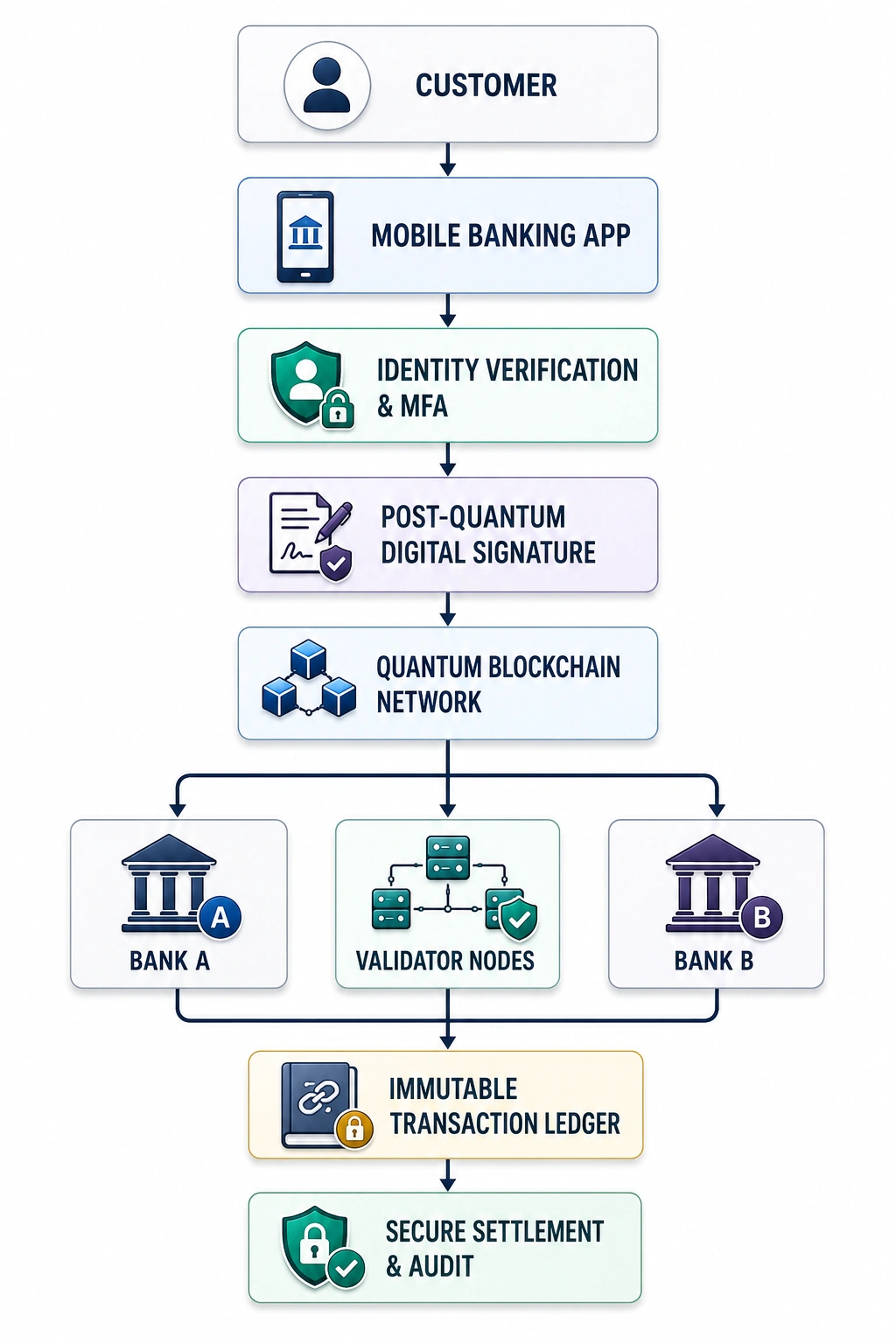
Figure 3. Illustrative workflow showing how Quantum Blockchain can secure financial transactions using post-quantum authentication and decentralized ledger verification.
Key Advantages of Quantum Blockchain in Banking
Quantum-resistant authentication for customers and financial institutions.
Enhanced protection for digital payments and online banking services.
Tamper-resistant financial transaction records.
Improved transparency in interbank settlements.
Stronger security for blockchain-based digital assets and smart contracts.
Long-term protection for emerging digital currency ecosystems.
Traditional Banking Security vs. Quantum Blockchain-Based Security
| Feature | Conventional Banking Security | Quantum Blockchain-Based Security |
|---|---|---|
| Authentication | RSA / ECC-based | Post-Quantum Cryptography |
| Transaction Records | Centralized databases | Distributed immutable ledger |
| Data Integrity | High | Very High |
| Resistance to Quantum Attacks | Limited | High |
| Long-Term Security | Requires future migration | Designed for quantum resilience |
| Transparency | Organization-controlled | Blockchain audit trail |
Join the conversation! Your thoughts help the community grow.