

Introduction
Kindly read my previous articles which explain in depth about getting started with ASP.NET Core Blazor.
- ASP.NET Core Blazor CRUD Using Entity Framework And Web API
- ASP.NET Core Blazor Filtering And Sorting Using Entity Framework And Web API
This article will explain,
- Creating sample database and Student Master and Detail Table in SQL Server to display in our web application.
- How to create an ASP.NET Core Blazor Web application.
- How to install the Package for using Entity Framework and creating DBContext class.
- How to get a result from Web API and bind result in Blazor client Razor view
- Creating Master/Detail with Sorting and Filtering features for the HTML table
- Creating Master/Detail table using Blazor Dynamic Content.
Blazor Dynamic Content
In Blazor, we can write our own component using the C# Code. We all know that in Blazor, we can write C# code in our client HTML function part, sometimes we need to create and bind the results dynamically to our HTML page. In this article using the Blazor Dynamic Content we create the detail table dynamically and display during the runtime as when the user clicks on the detail grid display icon in master grid.
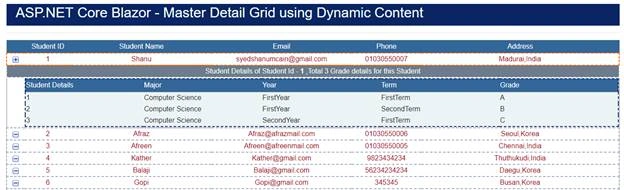
We can also call this a Master/Detail HTML Grid or Hierarchical Grid or Nested Grid.
Why we need Nested or Hierarchical Grid or Master/Detail Grid
In real time projects like Order Management, Production management, Students Management etc. we need to display the data in the hierarchical result.
For example, let’s take a Student Management project at a University. For student management, we need to create many relational tables like Student Master, Student Details and etc. In Student Master, we store student ID, Name, Email, Phone and Address. In Student Details, we store the students' final exam results for displaying Student Major, Studying Year with Term, and Grade details. Both these tables will be related with StudentID. We join these tables to display the complete student details.
Initially, we will be displaying all the students Master records in HTML table for the view. Users can click on expand icon on each student to view his complete details.
Here, in the below image, we can see that as we bind both the result of Student Master and Student detail in HTML table and we display the detail only when user clicks on the Student Master Icon which is near to the Student ID.when the user clicks on the Student ID “2”, then the next details Grid was being displayed to show student results in detail by Major,Year, Term, and Grade.
Here, we are displaying student details by each student Id.
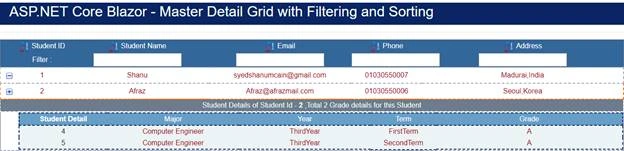
In our example, we also added the Filtering and Sorting functionality for our Master/Detail Grid.
Prerequisites
Make sure you have installed all the prerequisites in your computer. If not, then download and install all, one by one. Note that since Blazor is the new framework we must have installed the preview of Visual Studio 2017 (15.7) or above.
- Install the .NET Core 2.1 Preview 2 SDK. (You can find the all versions from this link
- Install the latest preview of Visual Studio 2017 (15.7).
- Install the NET Core Blazor Language Services for Blazor Extentions.
Step 1 - Create a database and a table
We will be using our SQL Server database for our WEB API and EF. First, we create a database named StudentsDB and a table as StudentMaster. Here is the SQL script to create a database table and sample record insert query in our table. Run the query given below in your local SQL Server to create a database and a table to be used in our project.
- USE MASTER
- GO
- --1) Check
- -- for the Database Exists.If the database is exist then drop and create new DB
- IF EXISTS(SELECT [name] FROM sys.databases WHERE[name] = 'StudentGradeDB')
- DROP DATABASE StudentGradeDB
- GO
- CREATE DATABASE StudentGradeDB
- GO
- USE StudentGradeDB
- GO
- --1) //////////// StudentMasters
- CREATE TABLE[dbo].[StudentMasters](
- [StdID] INT IDENTITY PRIMARY KEY,
- [StdName][varchar](100) NOT NULL,
- [Email][varchar](100) NOT NULL,
- [Phone][varchar](20) NOT NULL,
- [Address][varchar](200) NOT NULL
- )
- --insert sample data to Student Master table
- INSERT INTO [StudentMasters]([StdName], [Email], [Phone], [Address])
- VALUES('Shanu', '[email protected]', '01030550007', 'Madurai,India')
- INSERT INTO [StudentMasters]([StdName], [Email], [Phone], [Address])
- VALUES('Afraz', '[email protected]', '01030550006', 'Madurai,India')
- INSERT INTO [StudentMasters]([StdName], [Email], [Phone], [Address])
- VALUES('Afreen', '[email protected]', '01030550005', 'Madurai,India')
- select * from[StudentMasters]
- --1) //////////// StudentDetails
- CREATE TABLE[dbo].[StudentDetails](
- [StdDtlID] INT IDENTITY PRIMARY KEY, [StdID] INT,
- [Major][varchar](100) NOT NULL,
- [Year][varchar](30) NOT NULL,
- [Term][varchar](30) NOT NULL,
- [Grade][varchar](10) NOT NULL)
- INSERT INTO[StudentDetails]([StdID], [Major], [Year], [Term], [Grade])
- VALUES(1, 'Computer Science', 'FirstYear', 'FirstTerm', 'A')
- INSERT INTO[StudentDetails]([StdID], [Major], [Year], [Term], [Grade])
- VALUES(1, 'Computer Science', 'FirstYear', 'SecondTerm', 'B')
- INSERT INTO[StudentDetails]([StdID], [Major], [Year], [Term], [Grade])
- VALUES(1, 'Computer Science', 'SecondYear', 'FirstTerm', 'C')
- INSERT INTO[StudentDetails]([StdID], [Major], [Year], [Term], [Grade])
- VALUES(2, 'Computer Engineer', 'ThirdYear', 'FirstTerm', 'A')
- INSERT INTO[StudentDetails]([StdID], [Major], [Year], [Term], [Grade])
- VALUES(2, 'Computer Engineer', 'ThirdYear', 'SecondTerm', 'A')
- INSERT INTO[StudentDetails]([StdID], [Major], [Year], [Term], [Grade])
- VALUES(3, 'English', 'First Year', 'FirstTerm', 'C')
- INSERT INTO[StudentDetails]([StdID], [Major], [Year], [Term], [Grade])
- VALUES(3, 'Economics', 'First Year', 'FirstTerm', 'A')
- select * from StudentDetails
Step 2 - Create ASP.NET Core Blazor Application
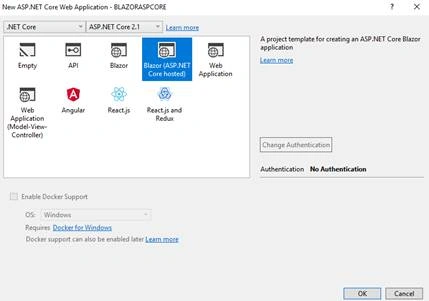
After installing all the prerequisites listed above and ASP.NET Core Blazor Language Services, click Start >> Programs >> Visual Studio 2017 >> Visual Studio 2017 on your desktop. Click New >> Project. Select Web >> ASP.NET Core Angular Web Application. Enter your project name and click OK.
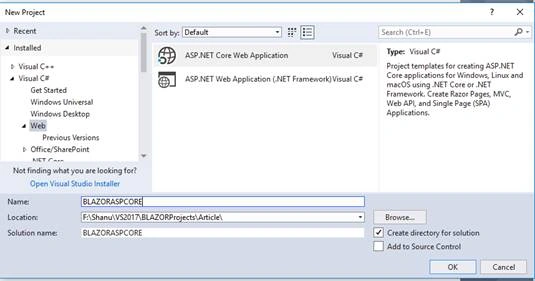
Select Blazor (ASP.NET Core hosted) and click OK.
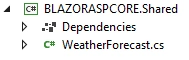
After creating ASP.NET Core Blazor Application, wait for a few seconds. You will see the below structure in Solution Explorer.
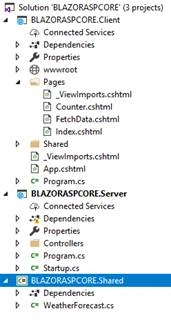
What is new in ASP.NET Core Blazor solution?
When we create our new ASP.NET Core Blazor application we can see 3 projects will be automatically created in the solution Explorer.
Client Project
The first project created is the Client project and it will be as our Solutionname.Client and here we can see our Solutionname is “BlazorASPCORE”. This project will be mainly focused for all the client-side view. Here we will be adding all our page views to be displayed in the client side in the browser.
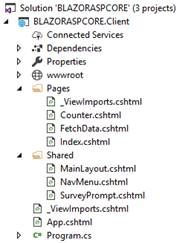
We can see a few sample page have been already added here and we can also see a shared folder like our MVC application where we will have the Sharedfolder and Layout page for the Master page. Here in Blazor we have the MainLayout which will work like the Master page and NavMenu for the left side menu display.
Server Project
As the name indicates this project will be used as a Server project. This project is mainly used to create all our Controllers and WEB API Controllers to perform all business logic and perform CRUD operation using WEB API’s. In our demo application we will be adding a Web API in this Server project and all the WEB API in our Client application. This Server project will work like get/set the data from Database and from our Client project we bind or send the result to this server to perform the CRUD operation in database.
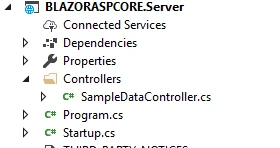
Shared Project
As the name indicates this project works like a shred project. This project works as a Model for our Server project and for the Client project. The Model declared in this Shared project will be used in both the Server and in the Client project. We also install all the packages needed for our project here, for example to use the Entity Framework we install all the packages in this Shared project.
Run to test the application
When we run the application, we can see that the left side has navigation and the right side contains the data. We can see the default sample pages and menus will be displayed in our Blazor web site. We can use the pages or remove it and start with our own page.
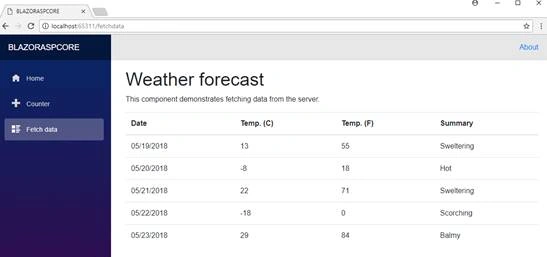
Now let’s see how to add new page to perform the CRUD operation for maintaining student details.
Using Entity Framework
To use the Entity Framework in our Blazor application we need to install the below packages
Install the Packages
Go to Tools and then select -> NuGet Package Manager -> Package Manager Console.
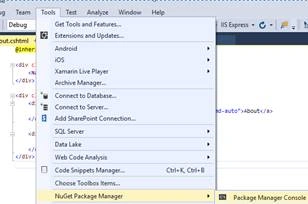
You can see the Console at the bottom of the VS 2017 IDE and in the right side of the combobox on the console select the Default project as your shared project” Select Shared”

- You can see the PM> and copy and paste the below line to install the Database Provider package. This package is used to set the database provider as SQL Servder
Install-Package Microsoft.EntityFrameworkCore.SqlServer
We can see the package is installed in our Shared folder
Install the Entity Framework

- You can see the PM> and copy and paste the below line to install the EF package.
Install-Package Microsoft.EntityFrameworkCore.Tools
To Create DB Context and set the DB Connection string

- You can see the PM> and copy and paste the below line set the Connection string and create DB Context. This is an important part as we give our SQL Server name, Database Name and SQL server UID and SQL Server Password to connect to our database to display our Master/Detail Grid. We also give our both SQL Table name “StudentMasters,StudentDetails” to create the Model class in our Shared project.
Scaffold-DbContext "Server= ServerName;Database=StudentGradeDB;user id=UserID;password=Password;Trusted_Connection=True;MultipleActiveResultSets=true" Microsoft.EntityFrameworkCore.SqlServer -OutputDir Models -Tables StudentMasters,StudentDetails
Press enter create connection string, Model Class and Database Context.
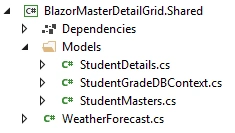
We can see StudentMasters and StudentDetails Model class and StudentGradeDBContext class has been created in our Shared project. We will be using this Model and DBContext in our Server project to create our Web API to perform the CRUD operations.
Creating Web API for Get Student details
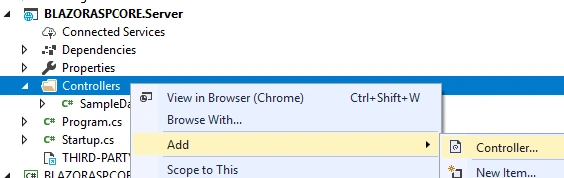
To create our WEB API Controller, right click Controllers folder. Click Add New Controller.
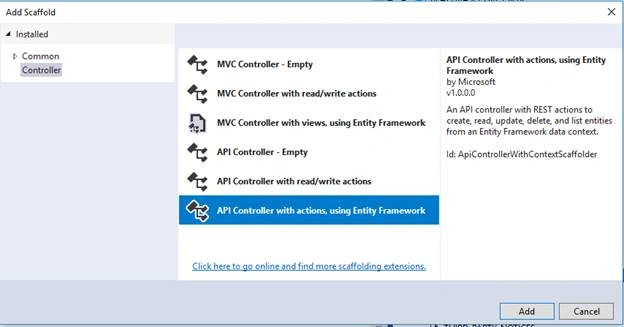
Here we will be using Scaffold method to create our WEB API. We select API Controller with actions, using Entity Framework.
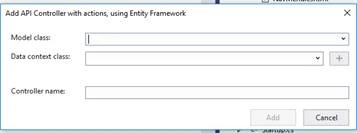
Select our Model and DatabaseContext from the Shared project.
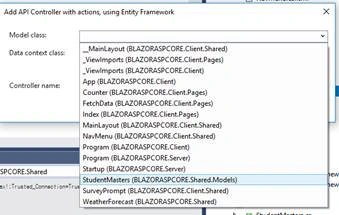
Select our StudentMasters Model from the Shared Project for performing the CRUD operation.
Select the Data Context Class as our StudentsDBContext from the Shared project. Our Controller name will be automatically added if you need you can change it and click the ADD.
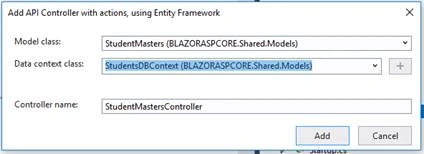
We will be using only the Get method from our Web API.
Same like this we also create a Web API for our StudentDetails
To test Get Method, we can run our project and copy the GET method API path. Here, we can see our API path to get api/StudentMasters/
Run the program and paste API path to test our output.
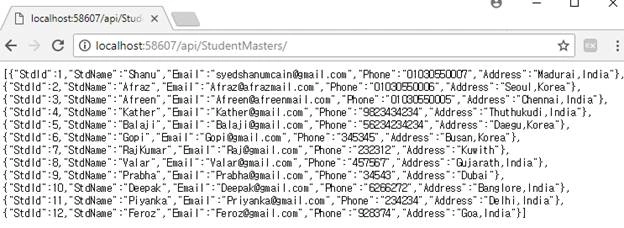
For StudentDetails we can pass the Student ID to get only one student details. Here we can see the result for student ID as “1” we call the Web API as /api/StudentDetails/1

Now we will bind all this WEB API Json result in our Razor View page from our Client project for display the Master/Detail HTML table.
Working with Client Project
Note
In this article we will create 2 Razor pages. In one Razor page we will create the Master Details HTML table with normal binding method and in another Razor page we bind the Detail table using Blazor Dynamic Content.
Razor Page with normal binding
First, we need to add the new Razor view page
Add Razor View
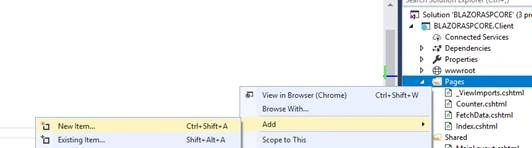
To add the Razor view page right click the Pages folder from the Client project. Click on Add >> New Item
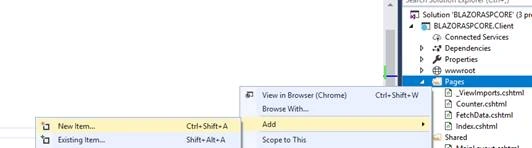
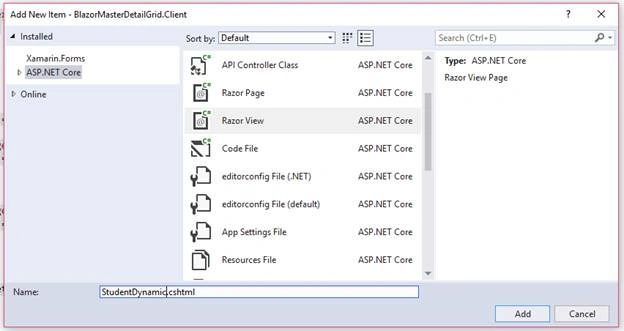
Select Razor View >> Enter your page name. Here we have given the name as Students.chtml
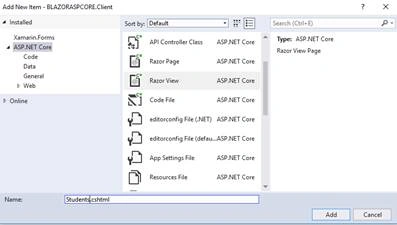
In Razor view Page we have 3 parts of code. The first one is the Import part where we import all the references and models for using in the view, HTML design and data bind part and finally we have the function part to call all the web API to bind in our HTML page and also to perform client-side business logic to be displayed in View page.
Import part
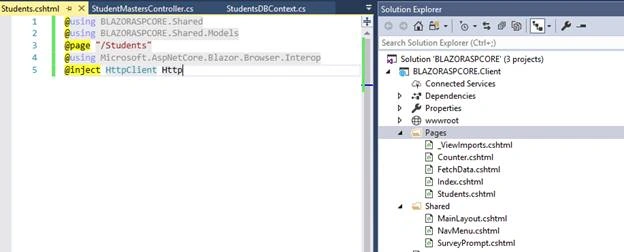
First, we import all the needed support files and references in our Razor View page. Here we have first imported our Model class to be used in our view and also imported HTTPClient for calling the Web API to perform the CRUD operations.
- @using BLAZORASPCORE.Shared
- @using BLAZORASPCORE.Shared.Models
- @page "/Students"
- @using Microsoft.AspNetCore.Blazor.Browser.Interop
- @inject HttpClient Http
Master HTML Grid data Bind part
Next, we design our Student page to bind the student Master and Student Detail results from the Web API to HTML table.
Binding Student Master Details
In the Init Method we get the Student Master details from Web API and bind the result in HTML table using foreach loop. Here we bind the result for Student Master Grid and in each row's first column we add the Toggle image and, in this Toggle we call the getStudentsDetails(studentsID) method to display the Detail HTML grid for the related Student. We pass the Student ID to the function and we get the related student details for the student and bind the result in detail grid and also we will show the detail grid only when the toggle image button is clicked and if the toggle button is clicked again we hide the detail grid.
- @foreach (var StudentMasters in stdMaster)
- {
- <tr style="border-style:dashed;border-width:2px;border-color: @(StudentMasters.StdId == studentIDs ? "#ff6a00": "#a2aabe")">
- <td align="center" style="border: solid1px#659EC7; padding: 5px;table-layout:fixed;">
- @if (@StudentMasters.StdId == studentIDs)
- {
- <img src="@Imagename" onclick="@(async () => await getStudentsDetails(@StudentMasters.StdId))" />
- }
- else
- {
- <img src="Images/toggle.png" onclick="@(async () => await getStudentsDetails(@StudentMasters.StdId))" />
- }
- </td>
- <td align="center">
- <span style="color:#9F000F">
- @StudentMasters.StdId
- </span>
- </td>
- <td align="center">
- <span style="color:#9F000F">
- @StudentMasters.StdName
- </span>
- </td>
- <td align="center">
- <span style="color:#9F000F">
- @StudentMasters.Email
- </span>
- </td>
- <td align="center">
- <span style="color:#9F000F">
- @StudentMasters.Phone
- </span>
- </td>
- <td align="center">
- <span style="color:#9F000F">
- @StudentMasters.Address
- </span>
- </td>
- </tr>
Adding Sorting features in Table Heading
Here we have added the Sorting and Filtering features only for the Master HTML table. If needed then we can implement this same feature for Detail grid as well.
In the Master Table heading part for each heading we add the Sorting Image. In Sorting Image Button Click event we call the Sorting function and pass each Sorting Column name to the click event. In Function code part we sort the Web API and display the result by ascending and in descending order by each column header soring image click.
joe bloggsPosted Dec 15, 2020, 4:35 AM
Excuse my typing....
joe bloggsPosted Dec 15, 2020, 4:34 AM
Is the toggle symbol (ie '-' and '+') set the wrong way round? to start with? In other words, should the unexpanded table start with a '+' symbol, so that the user knows to click this to expand the table to show the student details? Then, a '-' symbol should should to denote toggling back to an unexpanded state? If you know what I mean.
Naresh SinghalPosted Jun 11, 2018, 5:40 AM
Outstanding article & very well explained with great Example Sir Syed Shanu ...