

Introduction
In the realm of Generative AI, latency is the enemy of user experience, but reliability is the guardian of enterprise trust. When building Large Language Model (LLM) applications, developers often face a critical architectural decision: should request handling be synchronous (async/await) or offloaded to background workers? For simple queries, async endpoints provide immediate feedback. However, for complex, multi-step agentic workflows involving Retrieval-Augmented Generation (RAG), state management, and heavy computation, blocking the main thread can lead to timeouts and poor scalability.
This article explores a hybrid approach using FastAPI, demonstrating how to balance real-time responsiveness with robust background processing. We will build a Proof-of-Concept (PoC) for an "Enterprise Strategic Analyst" system. This system uses LangGraph to orchestrate multiple agents that research market trends, analyze internal data, and generate comprehensive reports. We will implement async endpoints for quick interactions and background workers for long-running report generation, ensuring the system remains responsive under load while maintaining strict state consistency and memory persistence.
Architectural Philosophy
The core principle of our design is responsiveness versus complexity.
- Async Endpoints are used for low-latency operations where the LLM inference time is predictable and short (e.g., < 5 seconds). These keep the connection open and stream responses directly to the client.
- Background Workers are employed for high-complexity tasks involving multiple agent iterations, extensive document retrieval, or large-scale data synthesis. These tasks return a
task_idimmediately, allowing the client to poll for status or receive updates via WebSockets, preventing HTTP timeouts and freeing up API workers for other requests.
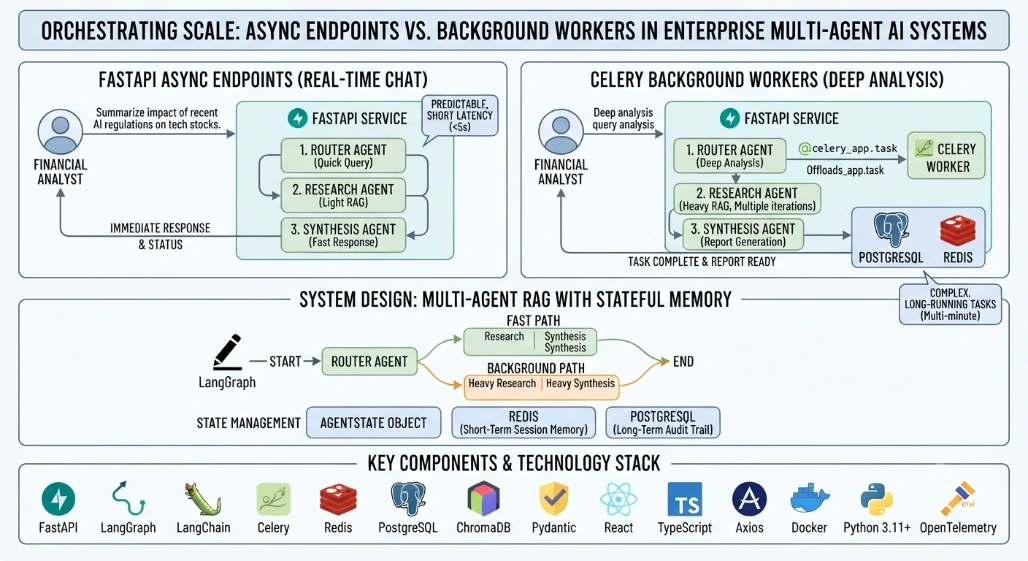
System Design: Multi-Agent RAG with Stateful Memory
Our system features three specialized agents orchestrated by LangGraph:
- Router Agent: Classifies intent (Quick Query vs. Deep Analysis).
- Research Agent: Performs RAG against vector databases (ChromaDB) and external APIs.
- Synthesis Agent: Compiles findings into a structured report.
State is managed via a AgentState object, persisted in Redis for short-term session memory and PostgreSQL for long-term audit trails.
Backend Implementation
1. Defining the State and Graph
from typing import TypedDict, Annotated, List
from langgraph.graph import StateGraph, END
from langchain_core.messages import BaseMessage

class AgentState(TypedDict):
    messages: Annotated[List[BaseMessage], add_messages]
    research_data: dict
    final_report: str
    status: str

def research_node(state: AgentState):
    # Simulate heavy RAG operation
    return {"research_data": {"sources": ["Market Report 2026"]}, "status": "researching"}

def synthesis_node(state: AgentState):
    # Simulate LLM synthesis
    return {"final_report": "Detailed analysis based on...", "status": "completed"}

workflow = StateGraph(AgentState)
workflow.add_node("research", research_node)
workflow.add_node("synthesize", synthesis_node)
workflow.set_entry_point("research")
workflow.add_edge("research", "synthesize")
workflow.add_edge("synthesize", END)
agent_executor = workflow.compile()
2. Async Endpoints for Quick Interactions
For simple queries, we use FastAPI’s native async capabilities. This allows the server to handle other requests while waiting for the LLM.
from fastapi import FastAPI, BackgroundTasks
from pydantic import BaseModel

app = FastAPI()

class QueryRequest(BaseModel):
    query: str
    session_id: str

@app.post("/api/chat")
async def handle_chat(request: QueryRequest):
    # Direct async execution for low-latency needs
    initial_state = {"messages": [{"role": "user", "content": request.query}], "status": "processing"}
    result = await agent_executor.ainvoke(initial_state)
    return {"response": result['messages'][-1].content, "status": "complete"}
3. Background Workers for Complex Analysis
For deep analysis, we offload to Celery. This prevents the API from hanging during multi-minute computations.
from celery import Celery

celery_app = Celery('tasks', broker='redis://localhost:6379/0')

@celery_app.task(bind=True)
def generate_deep_report(self, query: str, session_id: str):
    # Long-running process
    initial_state = {"messages": [{"role": "user", "content": query}], "status": "queued"}
    result = agent_executor.invoke(initial_state)

    # Save to PostgreSQL for persistence
    save_to_database(session_id, result)
    return {"report": result['final_report'], "status": "completed"}

@app.post("/api/analyze")
async def start_analysis(request: QueryRequest):
    task = generate_deep_report.delay(request.query, request.session_id)
    return {"task_id": task.id, "status": "accepted"}
Frontend Implementation
The React frontend handles both interaction modes. For background tasks, it implements a polling mechanism to check task status.
const startAnalysis = async (query: string) => {
  const response = await axios.post('/api/analyze', { query, session_id });
  const taskId = response.data.task_id;

  // Poll for completion
  const interval = setInterval(async () => {
    const statusRes = await axios.get(`/api/task/${taskId}`);
    if (statusRes.data.status === 'completed') {
      setReport(statusRes.data.report);
      clearInterval(interval);
    }
  }, 2000);
};
Real-Time Use Case: Financial Market Analysis
Imagine a financial analyst asking, "Summarize the impact of recent AI regulations on tech stocks."
- Router: Identifies this as a "Deep Analysis" request.
- API: Returns a
task_idimmediately. - Worker: The Research Agent scrapes regulatory documents and stock data (RAG). The Synthesis Agent generates a 10-page report.
- Frontend: Shows a progress bar. Once complete, displays the report with citations. This ensures the analyst can continue working without staring at a loading spinner for five minutes.
Conclusion
Balancing async endpoints and background workers is essential for scalable enterprise AI. Async endpoints provide the snappy feel users expect for simple interactions, while background workers ensure that complex, multi-agent RAG workflows do not cripple system performance. By leveraging FastAPI for the interface, LangGraph for orchestration, and Celery for heavy lifting, we create a resilient architecture that scales with demand. This hybrid approach not only improves user experience but also enhances system observability and reliability, key requirements for any enterprise-grade AI deployment.
Join the conversation! Your thoughts help the community grow.