

In enterprise financial systems, choosing an embedding model is not just about picking the highest score on the MTEB (Massive Text Embedding Benchmark) leaderboard. Financial text has unique characteristics: it is dense with domain-specific jargon, heavily reliant on numerical context, and requires strict adherence to legal definitions. Here is the systematic framework we used to decide on our embedding model, ultimately leading to the selection of OpenAI’s text-embedding-3-large (for cloud environments) and BGE-M3 (for on-premise/data-sovereignty environments).
1. The Evaluation Criteria
We evaluated models across four critical financial dimensions:
Context Window Capacity: Financial documents (like 10-Ks or credit agreements) are massive. Models limited to 512 tokens force aggressive chunking, which destroys context. We required a minimum of 8,191 tokens.
Financial Jargon & Entity Disambiguation: Standard models often conflate similar terms (e.g., "interest rate" vs. "exchange rate" vs. "yield"). We tested models on a custom "Financial NDCG" dataset to ensure they could distinguish between distinct financial instruments and clauses.
Dimensionality vs. Compute Cost: Higher dimensions (e.g., 3072) capture more nuance but increase vector database storage and latency. We needed a model that supported dimensionality reduction (like OpenAI's
dimensionsparameter) without sacrificing financial recall.Data Privacy & Deployment: For highly sensitive PII/MNPI (Material Non-Public Information), we needed an open-weights alternative that could be deployed in an air-gapped VPC.
2. The Decision Process
Benchmarking: We ran
text-embedding-3-large,text-embedding-3-small,Cohere embed-v3, andBGE-M3against our internal golden dataset of 5,000 financial QA pairs.Results:
text-embedding-3-smallwas too lossy for complex legal clauses.Cohere embed-v3was excellent but lacked the 8k context window needed for our un-chunked parent-document retrieval.text-embedding-3-largeachieved the highest Recall@5 for complex financial reasoning and supported the 8k context window.BGE-M3was the top performer for our on-premise requirement, offering excellent multilingual support (crucial for global SWIFT/forex narratives).
3. The Final Architecture Choice: Hybrid Retrieval
We decided that no single embedding model is perfect for finance. Therefore, we implemented a Hybrid Retrieval Strategy:
Dense Retrieval (Semantic):
text-embedding-3-large(1536 dimensions) for understanding the intent and context of legal clauses and transaction narratives.Sparse Retrieval (Lexical): BM25 for exact matching of tickers, ISINs, CUSIPs, and specific financial thresholds (e.g., "Debt/EBITDA > 3.5x"), which dense embeddings notoriously struggle with.
Part 2: Real-Time Use Case & Architecture
The Use Case: Automated Corporate Credit Covenant Monitoring
Scenario: A corporate banking client’s stock price drops 15% following a missed earnings report. The system must automatically assess if this triggers a breach of their credit agreement covenants (e.g., maintaining a minimum Interest Coverage Ratio). It must retrieve the specific legal clauses, pull real-time financial metrics, and draft a Risk Committee Memo.
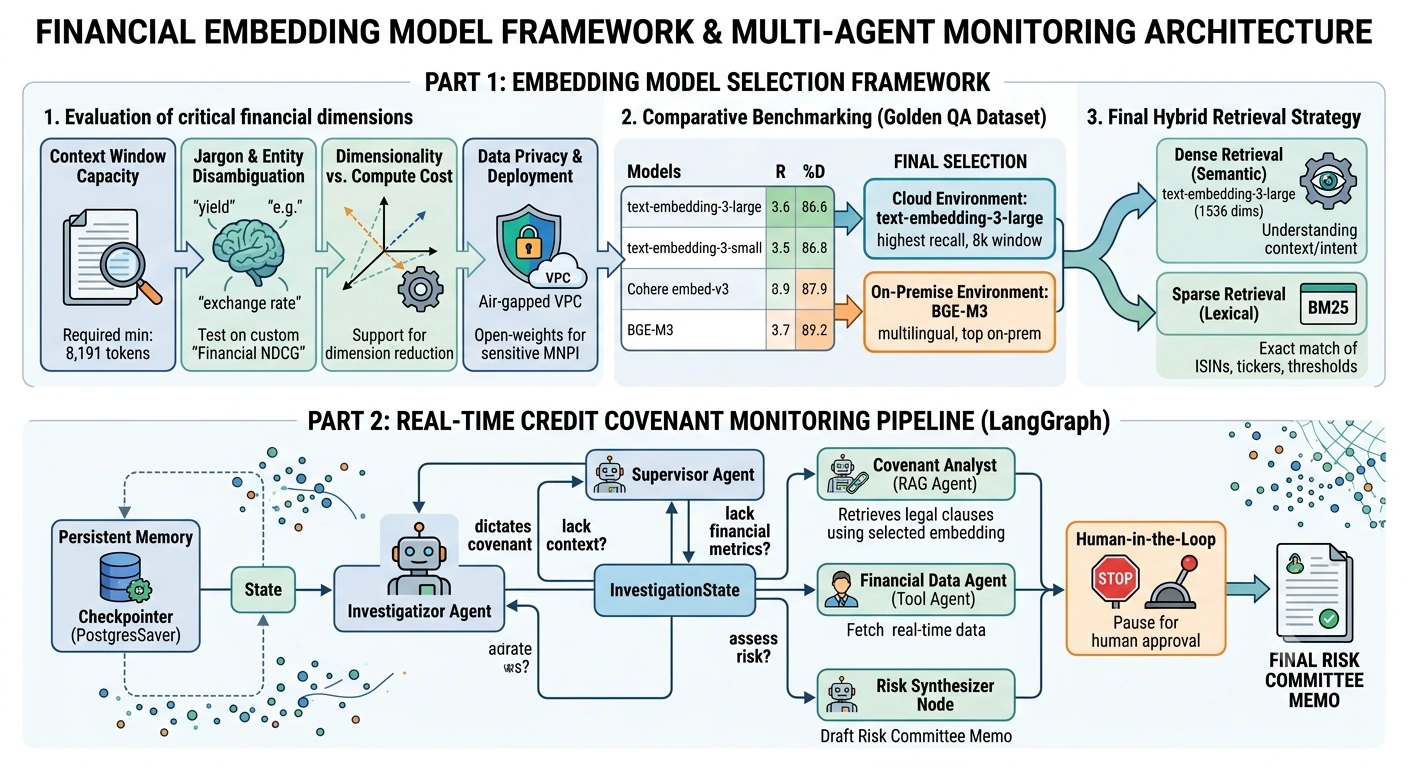
The Multi-Agent Architecture (LangGraph)
Supervisor Agent: Orchestrates the workflow, deciding if more legal context or financial data is needed.
Covenant Analyst (RAG Agent): Uses our selected embedding model to retrieve specific clauses from the client's credit agreement.
Financial Data Agent (Tool Agent): Calls an internal API to fetch real-time EBITDA and Debt metrics.
Risk Synthesizer: Calculates the covenant breach and drafts the formal memo.
Part 3: Code Implementation
Below is the end-to-end implementation using LangGraph, integrating the chosen embedding model, state management, and persistent memory.
Prerequisites
pip install langgraph langchain langchain-openai langchain-community faiss-cpu pydantic1. Initialize the Chosen Embedding Model & Vector Store
from langchain_openai import OpenAIEmbeddings, ChatOpenAI
from langchain_community.vectorstores import FAISS
from langchain_core.documents import Document
import os

# 1. Initialize the chosen Embedding Model
# We use text-embedding-3-large for its 8k context and high financial nuance.
# We reduce dimensions to 1536 to optimize FAISS storage/latency without losing financial recall.
embedding_model = OpenAIEmbeddings(
    model="text-embedding-3-large",
    dimensions=1536
)

# Mocking a Vector Store loaded with Credit Agreements
# In production, this connects to Pinecone/Milvus/Weaviate
docs = [
    Document(page_content="Section 4.2: The Borrower must maintain an Interest Coverage Ratio (EBITDA / Interest Expense) of no less than 3.0x as of the last day of any fiscal quarter.", metadata={"clause": "4.2", "type": "covenant"}),
    Document(page_content="Section 5.1: An Event of Default occurs if the Interest Coverage Ratio falls below 3.0x for two consecutive quarters.", metadata={"clause": "5.1", "type": "default"})
]
vectorstore = FAISS.from_documents(docs, embedding_model)
retriever = vectorstore.as_retriever(search_kwargs={"k": 2})
2. Define the State and Memory
from typing import Dict, List, Any, Literal, Annotated
from typing_extensions import TypedDict
from langgraph.graph import StateGraph, END
from langgraph.checkpoint.memory import MemorySaver
from langchain_core.messages import HumanMessage, SystemMessage

# Define the shared state using TypedDict (LangGraph standard)
class CreditRiskState(TypedDict):
    client_id: str
    trigger_event: str
    messages: List[Dict[str, str]]
    covenant_context: List[str]
    financial_metrics: Dict[str, float]
    supervisor_decision: Literal["check_covenants", "check_financials", "assess_risk", "FINISH"]
    final_memo: str

# Initialize LLM
llm = ChatOpenAI(model="gpt-4o", temperature=0)
3. Define the Agent Nodes
def supervisor_node(state: CreditRiskState) -> dict:
    """Routes the investigation based on current state."""
    prompt = f"""You are the Credit Risk Supervisor.
    Covenants retrieved: {len(state.get('covenant_context', []))}
    Financials retrieved: {bool(state.get('financial_metrics'))}

    If we lack covenant context, choose 'check_covenants'.
    If we lack financial metrics, choose 'check_financials'.
    If we have both, choose 'assess_risk'.
    """
    response = llm.invoke([SystemMessage(content=prompt)])

    decision = "assess_risk"
    if "check_covenants" in response.content.lower() and not state.get('covenant_context'):
        decision = "check_covenants"
    elif "check_financials" in response.content.lower() and not state.get('financial_metrics'):
        decision = "check_financials"

    return {"supervisor_decision": decision}

def covenant_analyst_node(state: CreditRiskState) -> dict:
    """Uses the selected embedding model via RAG to find credit clauses."""
    query = f"Interest coverage ratio and default conditions for client {state['client_id']}"

    # The retriever implicitly uses the text-embedding-3-large model to vectorize the query
    retrieved_docs = retriever.invoke(query)
    context = [doc.page_content for doc in retrieved_docs]

    return {"covenant_context": context, "supervisor_decision": "check_financials"}

def financial_data_node(state: CreditRiskState) -> dict:
    """Simulates calling an internal API for real-time financial data."""
    # In production, this is a LangChain Tool calling a Bloomberg/Refinitiv API
    metrics = {
        "EBITDA": 15_000_000,
        "Interest_Expense": 6_000_000,
        "calculated_ratio": 15_000_000 / 6_000_000 # 2.5x
    }
    return {"financial_metrics": metrics, "supervisor_decision": "assess_risk"}

def risk_synthesizer_node(state: CreditRiskState) -> dict:
    """Calculates the breach and drafts the Risk Committee Memo."""
    ratio = state["financial_metrics"]["calculated_ratio"]
    context_str = "\n".join(state["covenant_context"])

    prompt = f"""You are a Senior Credit Risk Officer. Draft a Risk Committee Memo.

    Client: {state['client_id']}
    Trigger: {state['trigger_event']}
    Calculated Interest Coverage Ratio: {ratio}x

    Relevant Credit Agreement Clauses:
    {context_str}

    Determine if a covenant breach has occurred based strictly on the clauses.
    Draft a concise, professional memo outlining the breach, the financial context, and recommended next steps (e.g., waive, accelerate, or monitor).
    """
    response = llm.invoke([HumanMessage(content=prompt)])
    return {"final_memo": response.content, "supervisor_decision": "FINISH"}
4. Build and Compile the LangGraph
def route_supervisor(state: CreditRiskState) -> str:
    """Conditional edge routing."""
    decision = state["supervisor_decision"]
    if decision == "check_covenants":
        return "covenant_analyst"
    elif decision == "check_financials":
        return "financial_data"
    elif decision == "assess_risk":
        return "risk_synthesizer"
    else:
        return "end"

# Initialize Graph
workflow = StateGraph(CreditRiskState)

# Add Nodes
workflow.add_node("supervisor", supervisor_node)
workflow.add_node("covenant_analyst", covenant_analyst_node)
workflow.add_node("financial_data", financial_data_node)
workflow.add_node("risk_synthesizer", risk_synthesizer_node)

# Set Entry Point
workflow.set_entry_point("supervisor")

# Add Edges
workflow.add_conditional_edges(
    "supervisor",
    route_supervisor,
    {
        "covenant_analyst": "covenant_analyst",
        "financial_data": "financial_data",
        "risk_synthesizer": "risk_synthesizer",
        "end": END
    }
)

# Worker nodes route back to supervisor
workflow.add_edge("covenant_analyst", "supervisor")
workflow.add_edge("financial_data", "supervisor")
workflow.add_edge("risk_synthesizer", END)

# Compile with Memory (Checkpointer)
# MemorySaver keeps the state in memory. For enterprise, use PostgresSaver.
memory = MemorySaver()
graph = workflow.compile(checkpointer=memory)
5. Execute the Real-Time Investigation
if __name__ == "__main__":
    # Initial trigger from market data system
    initial_state = {
        "client_id": "CORP-ACME-99",
        "trigger_event": "Q3 Earnings Miss: Stock down 15%, EBITDA guidance lowered.",
        "messages": [],
        "covenant_context": [],
        "financial_metrics": {},
        "supervisor_decision": "check_covenants",
        "final_memo": ""
    }

    # Thread ID allows us to persist this specific investigation
    config = {"configurable": {"thread_id": "CORP-ACME-99-Q3-ALERT"}}

    print("--- Starting Credit Covenant Monitoring Graph ---\n")

    # Stream the execution
    for event in graph.stream(initial_state, config):
        for node_name, node_output in event.items():
            print(f"[Node Executed: {node_name}]")
            if node_name == "supervisor":
                print(f" -> Routing to: {node_output.get('supervisor_decision')}\n")
            elif node_name == "risk_synthesizer":
                print("\n" + "="*50)
                print("FINAL RISK COMMITTEE MEMO:")
                print("="*50)
                print(node_output.get('final_memo'))
                print("="*50 + "\n")

    # Demonstrate Memory: We can now query the graph later using the same thread_id
    # to ask follow-up questions without losing the RAG context or financial metrics.
    print("\n[Memory Check] State persisted for thread: CORP-ACME-99-Q3-ALERT")
Part 4: Enterprise Productionization
To deploy this in a Tier-1 Bank environment, the following enhancements are required:
Swap to Persistent Checkpointing: Replace
MemorySaverwithlanggraph.checkpoint.postgres.PostgresSaver. This ensures that if the graph times out or a human risk officer needs to review the memo 3 days later, the exact state (including the retrieved covenant text and financial metrics) is perfectly restored.Implement Human-in-the-Loop (Interrupts): Add an
interrupt_before=["risk_synthesizer"]in thecompile()method. This pauses the graph, pushes the drafted memo to a UI for a human credit officer to approve/edit, and only resumes the graph upon human confirmation.Embedding Model Fallback: Implement a fallback mechanism. If the OpenAI API experiences latency > 2 seconds, the system should automatically failover to the locally hosted
BGE-M3model to ensure SLA compliance for real-time risk monitoring.Auditability (LangSmith): Wrap the graph execution in LangSmith traces. In financial services, you must be able to prove exactly which document chunks were retrieved and which embedding model was used for regulatory audits (e.g., SR 11-7 model risk management).
Join the conversation! Your thoughts help the community grow.