

Introduction
Manufacturers across industries are constantly looking for ways to enhance quality control and reduce production errors. Azure AI and Computer Vision provide a scalable solution to automate defect detection, ensuring higher precision, reduced waste, and improved efficiency in manufacturing processes.
In this article, we’ll explore how Azure AI enables real-time defect detection using computer vision, the benefits of this approach, and a step-by-step guide to implementing it.
Why Use Azure AI for Defect Detection?
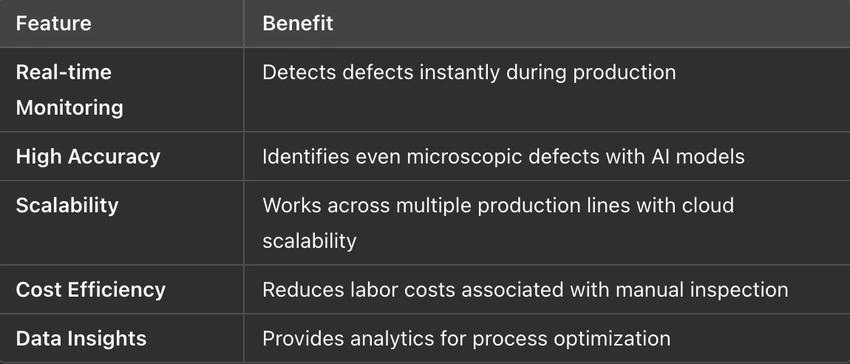
Key Components of Azure AI for Defect Detection
Azure offers several AI-powered tools to support defect detection in manufacturing.
- Azure Custom Vision: Allows model training with labeled defect images.
- Azure Machine Learning: Optimizes AI models with continuous learning.
- Azure IoT Edge: Enables real-time defect detection on factory floor devices.
- Azure Cognitive Services: Enhances vision capabilities with pre-trained models.
- Azure Synapse Analytics: Provides insights for process improvements.
Implementation Steps
1. Prepare Your Dataset
To train an AI model, you need a labeled dataset containing images of defective and non-defective products. You can use tools like Azure Blob Storage to store images securely.
2. Train a Custom Vision Model

Step 1. Create an Azure Custom Vision Resource.
- Navigate to Azure Portal → Create a new Custom Vision resource.
- Select Training and Prediction as the resource type.
- Once created, get the API Key and Endpoint for integration.
Step 2. Train the Model.
Use Python to upload images and train a defect detection model.

3. Deploy the Model to Production
Once the model is trained, deploy it to Azure IoT Edge for real-time defect detection on the factory floor.
from azure.cognitiveservices.vision.customvision.prediction import CustomVisionPredictionClient

PREDICTION_KEY = "your-prediction-key"

predictor = CustomVisionPredictionClient(PREDICTION_KEY, endpoint=ENDPOINT)

# Run prediction on a test image
with open("test_product.jpg", "rb") as test_image:
    result = predictor.classify_image(project.id, "Iteration1", test_image.read())

for prediction in result.predictions:
    print(f"{prediction.tag_name}: {prediction.probability * 100:.2f}% confidence")
4. Integrate with Azure IoT Edge for Real-time Detection
Deploying the model to IoT Edge devices enables real-time defect detection, reducing downtime and improving production efficiency.
5. Analyze and Optimize Defect Detection
Use Azure Synapse Analytics to analyze detection patterns and improve production quality over time.
Real-World Applications
- Automotive Industry: Detecting surface scratches on car parts and identifying defective welding joints in chassis assembly lines. This helps reduce warranty claims and enhances vehicle safety.
- Electronics Manufacturing: Identifying circuit board defects such as missing components, soldering errors, and microcracks. AI-powered vision systems help detect these minute flaws before the products reach final assembly.
- Food Processing: Ensuring product quality by detecting contamination, improper packaging, or incorrect labeling. AI-driven visual inspection can flag inconsistencies in food packaging to comply with safety regulations.
- Pharmaceuticals: Detecting packaging defects in medicine bottles, verifying labels, and ensuring batch integrity. AI solutions reduce human error in quality control and enhance compliance with stringent regulatory standards.
- Textile Industry: Identifying fabric defects such as irregular patterns, tears, or inconsistencies in dyeing. AI vision systems improve efficiency in textile manufacturing by automating the quality assessment process.
Conclusion
Azure AI and Computer Vision revolutionize quality control in manufacturing by providing real-time, scalable, and highly accurate defect detection. By integrating Custom Vision, Machine Learning, and IoT Edge, manufacturers can significantly enhance efficiency, reduce defects, and cut costs.
Are you ready to implement AI-powered defect detection in your manufacturing workflow? Start today with Azure AI!
Next Steps
Join the conversation! Your thoughts help the community grow.