Building an AI agent that can interact with business data using natural language is becoming increasingly popular. With Databricks Genie, organisations can create conversational experiences that allow business users to ask questions and retrieve insights without having to write SQL themselves.
However, getting an agent to generate responses is only one part of the implementation. How do you know whether the answers it generates are actually correct?
This is where Databricks Genie Benchmark becomes important.
In this article, I'll explore how benchmarking works in Databricks Genie, why ground-truth SQL answers matter, and how I'm applying it to a healthcare AI solution.
1. Understanding Databricks Genie Benchmark
Databricks Genie allows users to interact with their data using natural language. Instead of writing SQL queries, users can ask questions in plain English and receive answers generated from their underlying datasets.
For example, in a healthcare analytics environment, a clinician or analyst might ask:
Which patients have critical lab values?
What is the claim denial rate by payer?
What is the average length of stay by diagnosis?
How many patients per primary diagnosis?
Genie interprets these questions, generates SQL queries, executes them against the relevant data, and presents the results.
But how do we validate that the generated SQL and resulting answers meet expectations?
Genie Benchmark provides a way to evaluate the agent using predefined questions and expected SQL answers.
Rather than relying on a few manual tests, you can establish a collection of benchmark questions that represent the types of queries business users are likely to ask.
2. Creating Benchmark Questions for a Healthcare Genie Agent
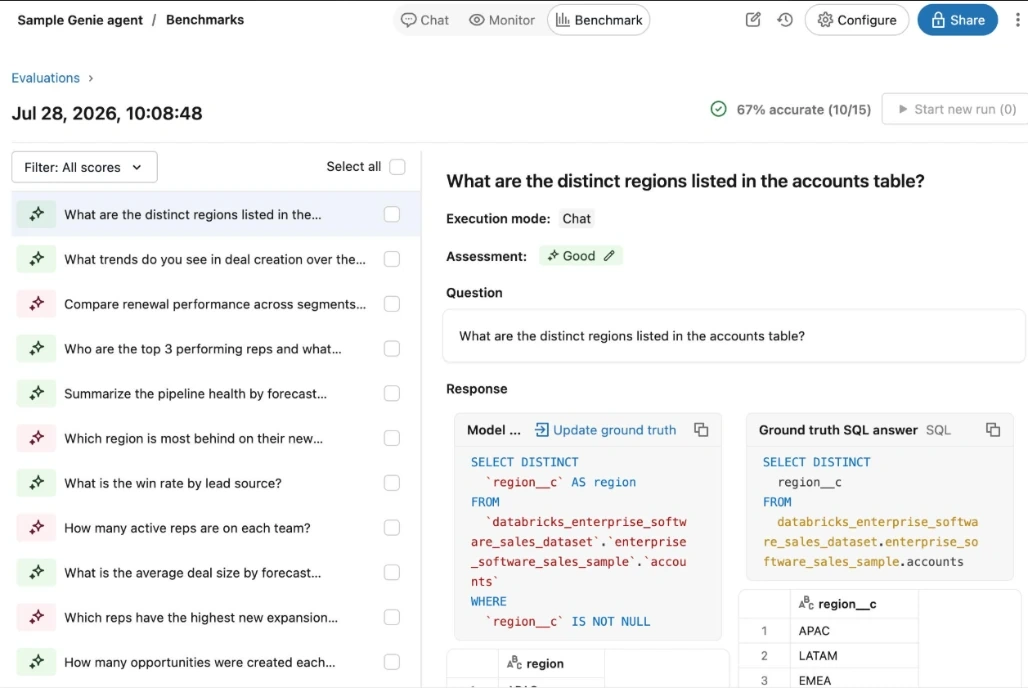
docs.databricks.com
In my healthcare AI solution, I've created benchmark questions based on common healthcare reporting and analytical requirements.
The objective is to test whether the Genie Agent can correctly interpret questions and retrieve the expected information from the underlying healthcare datasets.
Here are some examples.
Question 1: Which patients have critical lab values?
This evaluates whether Genie can identify patients whose laboratory results meet the defined critical-value criteria.
Question 2: What is the claim denial rate by payer?
This tests the agent's ability to calculate claim denial rates and group the results by payer.
Question 3: What is the average length of stay by diagnosis for inpatient encounters?
This evaluates whether Genie can calculate average hospital stays and group the results using the appropriate diagnosis field.
Question 4: How many patients per primary diagnosis?
This checks whether the agent can correctly aggregate patient counts by primary diagnosis.
These questions provide a practical way to test the agent against real business requirements rather than relying on generic questions.
3. Understanding Ground Truth SQL Answers
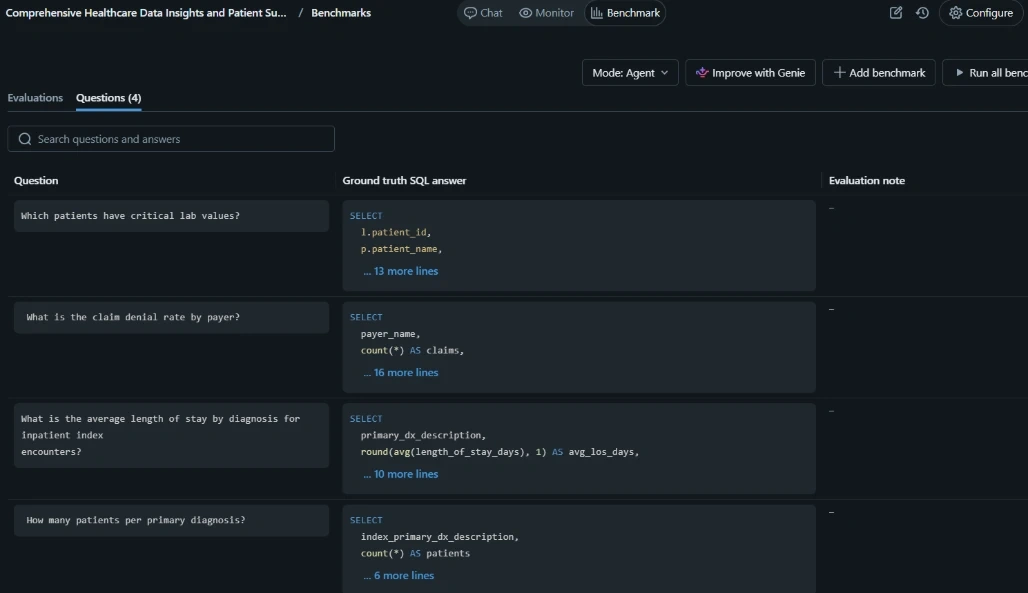
One of the most important parts of the benchmarking process is providing the Ground Truth SQL Answer for each benchmark question.
What does this mean?
A benchmark question represents what a business user would ask the Genie Agent in natural language.
The ground-truth SQL answer represents the expected SQL query used as a reference for evaluating the agent's generated SQL.
For example, consider the following question:
What is the claim denial rate by payer?
A corresponding reference SQL query might look like this:
SELECT
    payer_name,
    COUNT(*) AS total_claims,
    SUM(
        CASE
            WHEN claim_status = 'Denied' THEN 1
            ELSE 0
        END
    ) AS denied_claims,
    ROUND(
        100.0 * SUM(
            CASE
                WHEN claim_status = 'Denied' THEN 1
                ELSE 0
            END
        ) / NULLIF(COUNT(*), 0),
        2
    ) AS denial_rate
FROM healthcare_ai.gold.claims
GROUP BY payer_name
ORDER BY denial_rate DESC;
Note: This is an illustrative example; the actual table and column names should match your healthcare data model.
When the benchmark runs, Genie generates its own SQL based on the natural-language question.
The evaluation can then compare the generated query's results against the expected reference results.
This helps determine whether the agent understands the question and retrieves the expected information.
An important distinction: Ground-truth SQL is an evaluation reference. It is not additional context automatically supplied to the Genie Agent when ordinary users submit questions.
4. Why Benchmarking Is Important for Databricks Genie Agents
Benchmarking is not just about checking whether an agent can execute SQL successfully. It is about evaluating whether the agent produces the expected answers to business questions.
Here are some important benefits.
A. Validating SQL accuracy
An agent may generate syntactically correct SQL but still return incorrect results.
For example, it might use the wrong date column, calculate an incorrect percentage, or group data using an inappropriate field.
Benchmarking helps identify these issues.
B. Identifying gaps in the agent's understanding
Sometimes, Genie may misunderstand a business term or interpret a question differently from what the organisation expects.
For example, the term patient count could refer to unique patients or total encounters.
A benchmark helps reveal these differences so that you can improve your Genie configuration.
C. Improving Genie instructions
When benchmarking identifies recurring problems, you can revisit the agent's instructions.
You may need to provide additional guidance about:
Business terminology.
Table relationships.
SQL calculation logic.
Default filtering conditions.
Date and time interpretation.
How specific metrics should be calculated.
This makes benchmarking useful beyond simply measuring performance.
D. Improving example queries
Genie allows you to provide example SQL queries to demonstrate how certain questions should be answered.
When benchmark results reveal gaps, you can review your example queries and add relevant examples to improve the agent's understanding of common business questions.
E. Building confidence before production deployment
For organisations building AI-powered analytical solutions, reliability matters.
You don't want to make an agent available to hundreds or thousands of business users without first evaluating how it performs against realistic questions.
Benchmarking provides a repeatable way to assess performance and identify areas that need improvement before wider adoption.
5. How Benchmarking Fits into the Agent Development Lifecycle
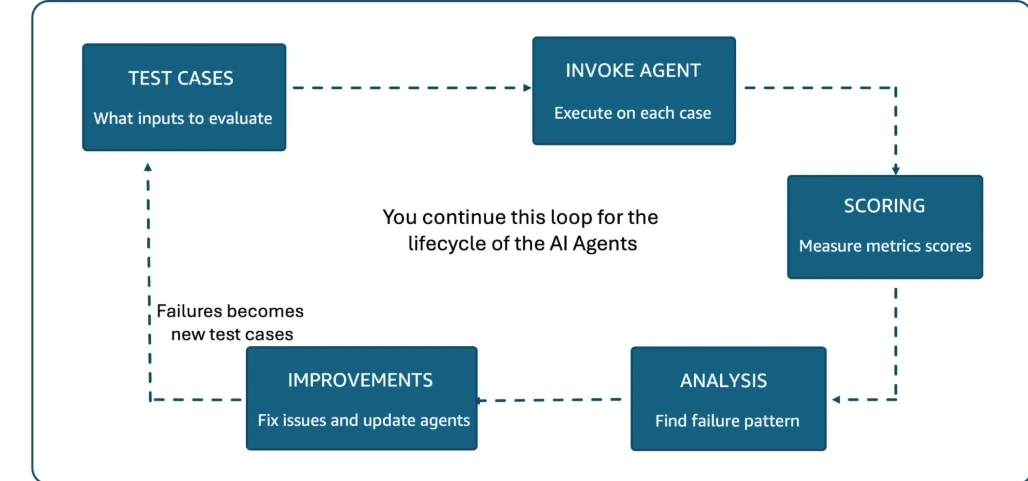
I see benchmarking as an important part of the overall Genie Agent development lifecycle.
A practical workflow looks like this:
Prepare your data: Make sure the underlying datasets are properly structured and accessible to Genie.
Configure Genie: Define the relevant tables, relationships, instructions, and business terminology.
Add example queries: Provide SQL examples that demonstrate how common business questions should be interpreted.
Create benchmark questions: Add realistic natural-language questions based on actual business requirements.
Provide ground-truth SQL: Define the expected SQL query for each benchmark question.
Run benchmarks: Execute the evaluation to assess the agent's generated SQL and results.
Review the results: Identify failed evaluations and investigate the underlying issues.
Improve and repeat: Refine instructions, example queries, and data configurations before running the benchmarks again.
This creates an iterative improvement process rather than treating agent development as a one-time configuration exercise.
6. Conclusion
Databricks Genie makes it easier for business users to interact with data using natural language. However, making an agent available to users is not the same as making it reliable.
Benchmarking helps bridge that gap.
By defining realistic questions and providing corresponding ground-truth SQL answers, you can systematically evaluate how your Genie Agent interprets business requirements and retrieves information.
In my healthcare AI implementation, I'm using questions around critical laboratory results, claim denial rates, hospital length of stay, and patient diagnosis counts to evaluate the agent.
My recommendation is simple: Don't just build an AI agent and assume it works. Test it, benchmark it, evaluate the results, and continuously improve it.
That's how you move from an interesting AI demonstration to a more reliable, production-ready Agentic AI solution.
Technologies covered: Databricks Genie | Genie Benchmark | Azure Databricks | SQL | Healthcare AI | Agentic AI | Generative AI
#Databricks #GenieAgent #Benchmarking #AgenticAI #HealthcareAI #DataEngineering #GenerativeAI #AzureDatabricks #ArtificialIntelligence #DataAnalytics


Join the conversation! Your thoughts help the community grow.