

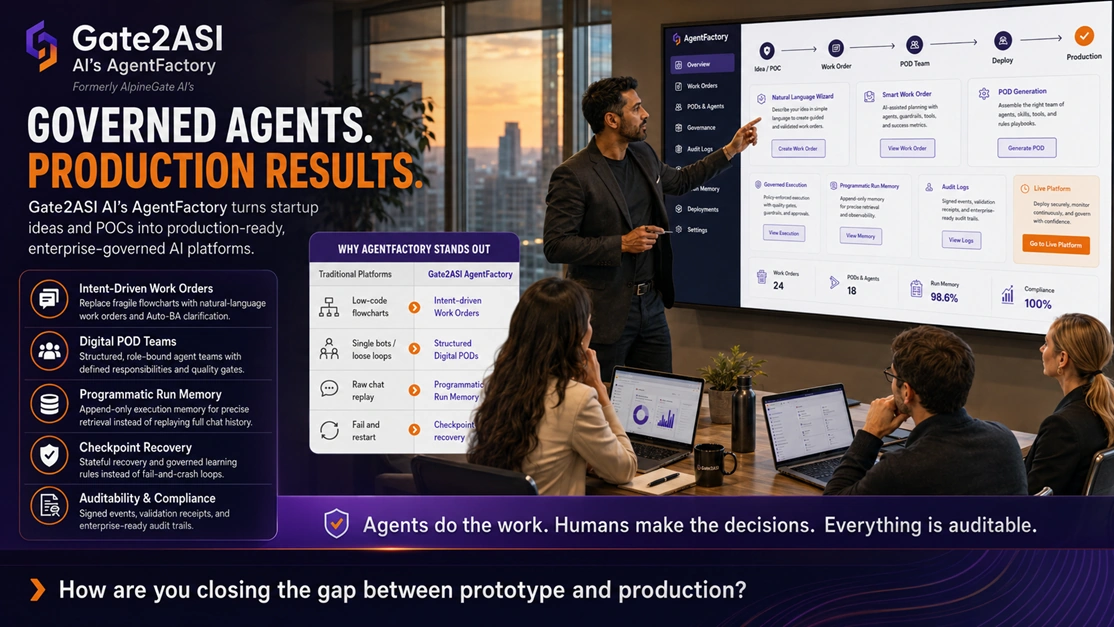
Enterprise AI is entering a decisive new phase.
The competitive question is no longer simply which company has the largest model, the broadest cloud platform, or the most sophisticated chatbot. The real challenge is turning Digital Intelligence into dependable business execution—across complex processes, specialized teams, regulated data, legacy systems, and accountable human decision-making.
Many large technology platforms approach agentic automation as an extension of existing products. They add copilots, visual workflow designers, prompt builders, connectors, and autonomous agent loops to ecosystems originally designed for applications, CRM systems, cloud infrastructure, or conversational assistance.
Gate2ASI AI Technologies Inc.’s AgentFactory (Formerly AlpineGate AI's) takes a fundamentally different approach.
AgentFactory is designed around the premise that enterprise agents should operate less like independent chatbots and more like a disciplined corporate workforce. Agents receive defined roles, controlled tools, explicit responsibilities, governed dependencies, persistent operational memory, validation requirements, and human approval boundaries.
This is not merely multi-agent automation. It is a governed operating architecture for Digital Intelligence.
The Architectural Difference
| Conventional Enterprise AI Platforms | Gate2ASI AI AgentFactory (Formerly AlpineGate AI's) |
|---|---|
| Manually assembled drag-and-drop workflows | Intent-driven Work Orders |
| Generic assistants and loosely coordinated agents | Mission-specific Digital PODs |
| Prompt history repeatedly sent to models | Programmatic Run Memory |
| Broad agents performing multiple conflicting duties | Role-bound agents with bounded authority |
| Execution frequently restarts after failure | Stateful, checkpoint-based recovery |
| Outputs accepted based primarily on generated content | Evidence-driven validation and quality gates |
| Learning through prompt changes or model modification | Governed metacognitive operating rules |
| Human intervention added around the workflow | Human decision authority built into the runtime |
| Logs designed primarily for troubleshooting | Append-only execution evidence and auditability |
The difference is structural. AgentFactory does not begin with a chatbot, a model, or a workflow canvas. It begins with a business objective and constructs a governed execution system around it.
1. Business Intent Instead of Fragile Flowcharts
Traditional automation platforms frequently require technical teams to translate a business process into a visual network of triggers, branches, API calls, conditions, and exception paths.
These systems can work well for predictable processes. However, they become increasingly difficult to maintain when the work involves ambiguity, changing requirements, specialist judgment, incomplete documentation, or dependencies that cannot be modeled in advance.
A minor business change can require engineers to redesign multiple branches of the workflow. As complexity increases, the visual flow becomes another application that must be developed, tested, secured, and maintained.
AgentFactory replaces this workflow-first model with intent-driven Work Orders.
A Work Order defines the desired business outcome, operating constraints, expected deliverables, data requirements, governance policies, success criteria, and approval boundaries. It describes what the enterprise needs accomplished—not every technical step required to accomplish it.
Before execution begins, an autonomous Business Analyst agent can inspect the request, identify missing information, clarify ambiguous requirements, detect contradictions, and convert the original request into a structured execution contract.
This creates a critical separation:
Business leaders define the objective.
The platform determines the required capabilities and execution plan.
Specialized agents perform the work.
Validators confirm that the outcome satisfies the contract.
Humans retain authority over consequential decisions.
The result is a system that can adapt its execution plan without losing control of the original business intent.
2. Digital PODs Instead of Uncontrolled Agent Swarms
Many multi-agent systems focus on increasing the number of agents or allowing agents to communicate freely until a result emerges.
That approach may be useful for experimentation, but it introduces serious enterprise risks. Agents can duplicate work, overwrite one another’s outputs, bypass dependencies, use tools outside their intended scope, or reinforce incorrect assumptions across the team.
AgentFactory organizes agents into Digital PODs: structured, mission-aligned teams modeled after professional enterprise delivery organizations.
A Digital POD may include roles such as:
Business Analyst
Project Manager
Domain Specialist
Solution or Data Architect
Database Developer
Backend Developer
Frontend Developer
Security or Compliance Specialist
Quality Engineer
Independent Validator
Orchestration Lead
Each agent operates as a bounded digital professional. Its responsibilities, permitted tools, skills, resource access, quality gates, dependencies, and escalation rules are defined before execution.
A Database Developer, for example, should not quietly redesign the business requirements. A Backend Developer should not invent database tables that were never created. A Builder should not validate its own work without independent evidence. A Validator should not modify the artifact it is responsible for evaluating.
This separation of duties brings familiar enterprise governance principles into agentic execution:
Role clarity
Least-privilege access
Dependency management
Independent validation
Controlled handoffs
Human escalation
Traceable accountability
AgentFactory therefore replaces the idea of an autonomous swarm with a more enterprise-ready concept: a governed digital workforce.
3. Programmatic Run Memory Instead of Replayed Chat History
Basic agent memory is often implemented by placing previous messages, summaries, or retrieved documents back into the model’s context window.
This method can become expensive and unreliable. As execution histories grow, the system must repeatedly process large amounts of text. Important instructions may be buried inside irrelevant conversation. Summaries can lose technical precision. Different agents may receive inconsistent versions of prior events.
AgentFactory introduces Programmatic Run Memory, built around an append-only execution ledger.
Rather than asking every agent to reread an entire conversation, the platform records structured operational events such as:
Requirements decisions
Agent assignments
Dependency states
Tool invocations
Database schemas
Build results
Validation receipts
Runtime exceptions
Retry classifications
Human approvals
Checkpoint locations
Published artifacts
Agents retrieve only the evidence required for their current responsibility.
A Backend Developer can query the verified database contract rather than infer table names from a long transcript. A Validator can inspect build receipts, startup results, live API responses, and database row counts. A recovering agent can determine which phases succeeded and which artifact delta remains incomplete.
This transforms memory from passive conversational history into governed operational intelligence.
The platform does not merely remember what agents said. It remembers what was attempted, what actually happened, what was verified, and what remains unresolved.
4. Stateful Recovery Instead of “Fail and Restart”
Long-running enterprise work rarely succeeds as one uninterrupted model response.
Software generation, database construction, document analysis, compliance review, and cross-system integration can involve many phases. Providers may become unavailable. A tool may time out. A generated artifact may compile but fail during startup. A database may exist but contain incorrect seed data.
In many agent systems, a failed attempt leads to one of two outcomes:
The entire process stops.
The system restarts the task from the beginning.
Both are costly. Restarting discards valid work, repeats model calls, increases inconsistency, and may introduce new errors into previously completed phases.
AgentFactory uses stateful, checkpoint-based recovery.
Successful phases are preserved. Verified artifacts remain available. The platform classifies the failure, identifies the incomplete delta, selects an appropriate recovery route, and resumes from the last valid checkpoint.
For example, when an application package has been generated but live startup verification fails, the platform should not regenerate the business requirements, database design, and entire application. It should preserve those outputs and repair only the missing or invalid software delta.
This recovery model is closer to a resilient distributed system than a conventional chatbot retry loop.
It provides:
Phase-level persistence
Bounded retries
Failure classification
Provider-route recovery
Workspace preservation
Delta-based repair
Evidence-based continuation
Controlled escalation when automatic recovery is exhausted
The objective is not to pretend that agents never fail. The objective is to ensure that failures are contained, understood, recoverable, and auditable.
5. Metacognitive Governance Instead of Uncontrolled Self-Modification
Enterprises want agent systems to improve over time, but unconstrained self-learning creates a difficult governance problem.
An agent that freely modifies its own instructions, tools, or decision policies may become less predictable. A correction that works for one edge case may degrade performance elsewhere. Over time, it becomes difficult to explain which behavior changed, why it changed, and who authorized the change.
AgentFactory separates operational learning from uncontrolled model modification.
When an execution failure occurs, the platform can analyze the evidence and derive a conditional operating rule.
Suppose an agent generates code against claims.Claim while the verified database contains claims.Claims. The system should not simply append a vague instruction such as “be more careful with table names.” It should derive a precise rule:
Before generating database-dependent code, retrieve the current schema-qualified database contract and use only verified objects. Do not infer singular or plural table-name variants.
That rule can be:
Associated with the relevant agent role
Limited to a specific capability or context
Versioned
Tested
Reviewed
Approved
Rolled back
Audited
The underlying model remains unchanged. What improves is the governed operating architecture around it.
This approach creates metacognitive learning without unpredictable behavioral drift.
6. Verified Outcomes Instead of Plausible Outputs
Generative models are optimized to produce plausible content. Enterprises, however, require proof.
A generated application is not complete because source files exist. It must compile, start, connect to the required systems, execute expected operations, and return valid results.
A generated database is not complete because a SQL script was produced. The database must exist, required tables must be present, constraints must succeed, seed data must load, and expected records must be verifiable.
A compliance report is not complete because it appears professional. Its conclusions must trace back to approved evidence.
AgentFactory addresses this through validation receipts and evidence-driven acceptance.
Depending on the Work Order, completion evidence may include:
Successful compilation
Automated test results
Application startup verification
Live endpoint responses
Database connectivity
Schema-qualified object verification
Row counts
Data-quality measurements
Security checks
Policy evaluations
Signed approval events
Artifact hashes
Deployment results
This creates a clear distinction between generation and completion:
The Builder proposes the result. The Validator proves the result.
No artifact should be accepted solely because the same agent that created it claims it is complete.
7. Governance as Runtime Architecture
In many platforms, governance is implemented outside the agent system through policies, dashboards, approval forms, or post-execution monitoring.
AgentFactory places governance inside the execution runtime.
Every Work Order can define:
Which agents may participate
Which systems they may access
Which tools they may use
Which data they may retrieve
Which actions require approval
Which validations must pass
Which artifacts must be produced
Which events must be recorded
Which failures may be retried automatically
Which conditions require human intervention
The append-only ledger connects agent decisions to system events, tool activity, validation evidence, and human approvals.
This makes it possible to answer questions that conventional AI logs often cannot answer reliably:
Which agent made this decision?
Which version of its operating policy was active?
What evidence did it use?
Which tools and records did it access?
Did it operate within its authorized scope?
Which validation gates passed?
Which human approved the final action?
Can the complete subject-related record be exported?
Can the result be reproduced or independently reviewed?
Governance is therefore not an administrative layer added after execution. It is part of the machinery that determines whether execution is permitted to continue.
8. Human Authority Without Human Micromanagement
The purpose of AgentFactory is not to remove humans from enterprise operations.
It is to remove unnecessary administrative effort while preserving human authority.
Agents can perform research, analysis, planning, coding, testing, documentation, reconciliation, and validation. Humans remain responsible for strategic direction, policy decisions, material exceptions, risk acceptance, and final approval where required.
This philosophy can be summarized simply:
Agents do the work. Humans make the decisions. Everything is auditable.
That is a different operating model from both traditional workflow automation and unconstrained autonomous AI.
It gives organizations the leverage of a digital workforce without surrendering accountability.
Where AgentFactory Creates the Greatest Value
The architecture is particularly relevant for work that is too complex for fixed automation but too consequential for uncontrolled agent autonomy.
Potential use cases include:
Legacy application modernization
Governed software generation
Database engineering and migration
Regulatory compliance auditing
Insurance claims analysis
Healthcare fraud detection
Financial reconciliation
Enterprise architecture assessments
Cybersecurity investigations
Data-quality remediation
Infrastructure planning
Procurement and vendor analysis
Policy implementation
Operational risk management
Document-to-execution transformation
In each case, the value comes not merely from generating a response, but from coordinating specialized digital professionals through a controlled, recoverable, and evidence-based execution lifecycle.
A New Competitive Category
AgentFactory should not be evaluated only as another agent builder, chatbot platform, or visual automation product.
Its more important contribution is the creation of a new enterprise category:
Governed Digital Workforce Orchestration.
Large technology ecosystems will continue to deliver powerful models, infrastructure, productivity assistants, and integration platforms. Those capabilities remain valuable.
AgentFactory addresses a different architectural problem: how to transform those capabilities into a dependable enterprise workforce that can understand intent, divide responsibilities, execute across multiple disciplines, recover from failure, validate real outcomes, learn under governance, and remain accountable to human leadership.
The future of enterprise Digital Intelligence will not be determined solely by which model produces the most impressive answer.
It will be determined by which operating architecture can repeatedly convert business intent into verified, compliant, and auditable results.
That is the problem Gate2ASI AI’s AgentFactory (Formerly AlpineGate AI's) is built to solve.
Sources and Further Reading
Phillip Swan, “Agent Factory vs. Solution,” LinkedIn.
“Gate2ASI AI’s AgentFactory: From Agent Memory to Governed Operational Intelligence,” daily.dev.
Co-Created, industry insights on enterprise AI and operating-model transformation.
“Gate2ASI AI’s AgentFactory: From Agent Memory to Governed Operational Intelligence,” C# Corner.
Arahi AI, research and commentary on AI-agent platforms.
ChatBot.com, overview of AI-agent platforms and automation tools.
Gate2ASI AI AgentFactory architecture and operating-model materials.
Supporting research concerning agent memory, context limitations, and governed learning.
Gate2ASI AI Technologies Inc., AgentFactory product information.
Gate2ASI AI Technologies Inc., corporate and platform information.
Competitive comparisons in this article describe architectural approaches and operating models. They should not be interpreted as a claim that every product from every referenced company implements the same architecture or has the same limitations.
Join the conversation! Your thoughts help the community grow.