

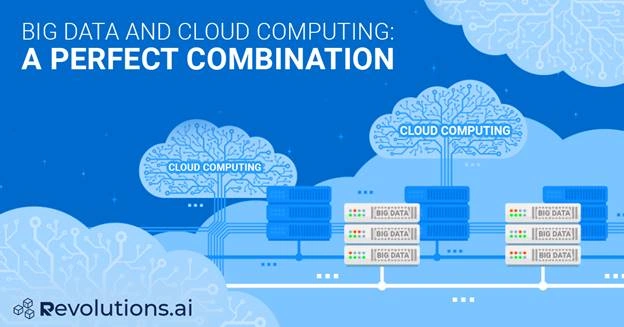
While Big Data is responsible for data storage and processing, the cloud provides a reliable, accessible, and scalable environment for Big Data systems to function. Big Data is defined as the quantity of digital data produced from different sources of technology, for example, sensors, digitizers, scanners, numerical modeling, mobile phones, Internet, videos, social networks. Cloud Computing and Big Data are complementary to each other. Rapid growth in Big Data is regarded as a problem. Clouds are evolving and providing solutions for the appropriate environment of Big Data while traditional storage cannot meet the requirements for dealing with Big Data, in addition to the need for data exchange between various distributed storage locations. Cloud Computing provides solutions and addresses problems with Big Data.
The Cloud Computing environment is expanding to be able to absorb big amounts of data as it follows the policy of data splitting, that is, to store data in more than one location or availability area. Cloud Computing environments are built for general-purpose workloads and resource pooling is used to provide flexibility on demand. Therefore, the Cloud Computing environment seems to be well suited for Big Data.
Big Data processing and storage require expansion as the cloud provides expansion through virtual machines and helps Big Data evolve. This is a consistent relationship between them. In order for the cloud environment to fit with Big Data, the Cloud Computing environment must be modified to suit data and cloud work together. Many changes are required to be made on the cloud: CPUs to handle Big Data and others.
Big Data and Cloud Computing are among the most important stages of IT development. Information privacy and security are one of the most important issues for the cloud because of its open environment with very limited user control. Security and privacy influence Big Data storage and processing because there is a vast use of third party services and the infrastructure used to host important data or to perform operations as growing data and application growth bring challenges.
There are multiple benefits of Big Data analytics in Cloud:
- Improved analysis
With the advancement of Cloud technology, Big Data analysis has been upgraded causing better results. Hence, companies prefer to perform Big Data analysis in the Cloud. Moreover, Cloud helps to integrate data from numerous sources. - Simplified Infrastructure
Big Data analysis is a tremendous strenuous job on infrastructure as the data comes in large volumes with varying speeds, and types which traditional infrastructures usually cannot keep up with. As Cloud Computing provides flexible infrastructure, which we can scale according to the needs at the time, it is easy to manage workloads. - Lowering the cost
Both Big Data and Cloud technology delivers value to organizations by reducing ownership. Cloud allows customers for Big Data processing without large-scale Big Data resources. Hence, both Big Data and Cloud technology are driving the price down for enterprise purposes and bringing value to the enterprise. - Security and Privacy
Data security and privacy are two major concerns when dealing with enterprise data. Moreover, when your application is hosted on a Cloud platform due to its open environment and limited user control security becomes a primary concern. Hence, nowadays the system integrators bring in Private Cloud Solution that is Elastic and Scalable. Furthermore, it also leverages Scalable Distributed Processing.
Big Data and Cloud Computing constitute an integrated model in the world of distributed network technology. The development of Big Data and their requirements is a factor that motivates service providers in the cloud for continuous development because the relationship between them is based on the product, the storage, and processing as a common factor. Big Data represents the product and the cloud represents the container. Cloud computing represents an environment of flexible distributed resources that use high techniques in the processing and management of data and yet reduces the cost. All these characteristics show that cloud computing has an integrated relationship with big data. Both are moving towards rapid progress to keep pace with progress in technology requirements and users.
Join the conversation! Your thoughts help the community grow.