

Introduction
In enterprise machine learning architectures, feature engineering is rarely a monolithic process. It is bifurcated into two distinct modes: Offline Computation for model training and historical analysis, and Online Serving for real-time inference. While offline features provide depth and historical context, online features offer immediacy and relevance. The critical challenge lies in ensuring that these two modes remain consistent—a problem known as "training-serving skew." If the features used to train a model differ significantly from those served during prediction, model performance degrades rapidly.
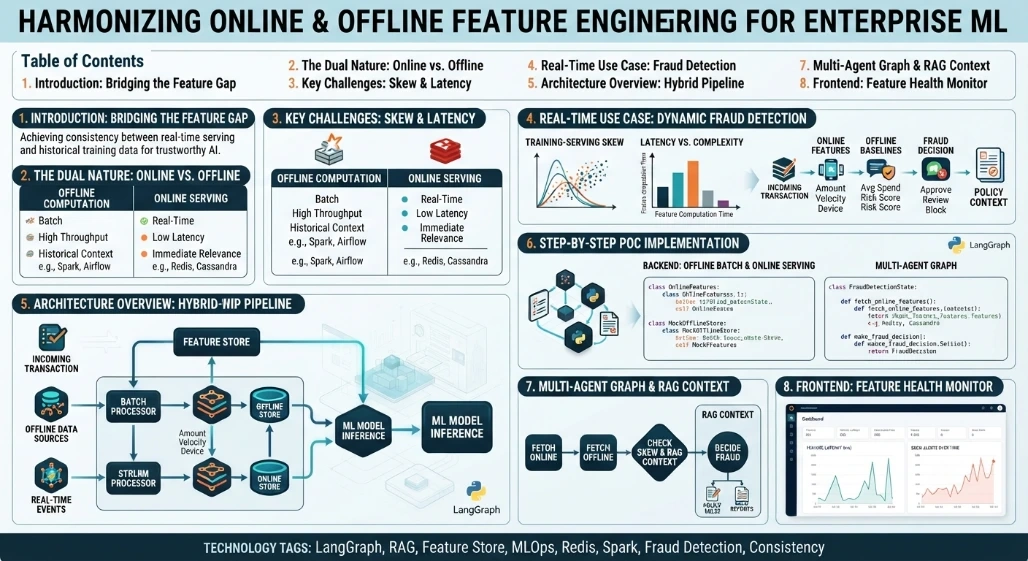
This article explores how to harmonize online and offline feature pipelines using an enterprise-grade Multi-Agent Retrieval-Augmented Generation (RAG) system built on LangGraph. By treating feature consistency as a stateful, multi-agent problem, we can create systems that not only serve low-latency predictions but also continuously validate their data integrity against historical baselines. This approach ensures that real-time decisions are both fast and trustworthy.
The Dual Nature of Feature Engineering: Online vs. Offline
Offline Feature Computation: This involves processing large volumes of historical data in batch jobs (e.g., using Spark or Airflow). Features here are often complex, involving windowed aggregations (e.g., "average transaction amount over the last 90 days"). They are stored in data lakes or warehouses and are optimized for throughput, not latency.
Online Feature Serving: This requires sub-millisecond access to features during live user interactions. These features are typically pre-computed and stored in low-latency stores like Redis or Cassandra. They must be updated incrementally as new events arrive.
The Bridge: A robust feature store acts as the bridge, ensuring that the logic used to compute offline features is identical to the logic used to update online features.
Key Challenges: Training-Serving Skew and Latency Constraints
Training-Serving Skew: This occurs when the definition of a feature changes between the training phase (offline) and the serving phase (online). For example, if offline logic handles null values differently than online logic, the model encounters unfamiliar data patterns in production.
Latency vs. Complexity: Complex features requiring multiple joins are easy to compute offline but difficult to serve online within strict latency budgets. Engineers often have to simplify online features, leading to a loss of predictive power.
Point-in-Time Correctness: Offline training requires "point-in-time" correctness to avoid data leakage (using future data to predict the past). Online serving does not have this constraint but must ensure data freshness.
Real-Time Use Case: Dynamic Fraud Detection in Fintech
Scenario: "PaySecure," a digital payment processor, needs to detect fraudulent transactions in real-time. The model relies on:
Offline Features: User’s historical average spend, typical merchant categories, and long-term risk score (computed daily).
Online Features: Current transaction amount, location velocity (distance from last transaction), and device fingerprint (computed in milliseconds).
Problem: During a high-volume sales event, the online serving layer experiences latency spikes, causing some features to time out. The system must decide whether to use stale cached values, default values, or block the transaction entirely, all while maintaining consistency with the offline-trained model’s expectations.
Objective: Build a Multi-Agent LangGraph system that:
Retrieves online features from a low-latency store.
Fetches offline baseline features for context.
Uses RAG to retrieve fraud policy rules and historical skew reports.
Makes a reasoned decision on how to handle missing or stale online features.
Maintains state to track the decision lineage for audit purposes.
Architecture Overview: Hybrid Feature Pipeline with Multi-Agent Orchestration
We use LangGraph to orchestrate the interaction between online and offline data sources. The workflow includes:
Online Fetcher Agent: Retrieves real-time features from Redis.
Offline Baseline Agent: Fetches historical averages from a SQL database.
Consistency Checker Agent: Compares online values against offline baselines to detect anomalies or skew.
Decision Agent: Uses RAG-retrieved policies to determine the final action (Approve, Review, Block).
State Management: LangGraph’s
StateGraphmaintains the feature snapshot and decision trace.
Step-by-Step POC Implementation
Backend: Offline Batch Processor and Online Serving Layer
We simulate offline and online stores using Python dictionaries. In production, these would be PostgreSQL and Redis respectively.
# backend/feature_store.py
from pydantic import BaseModel
from typing import Dict, Optional
import time

class OnlineFeatures(BaseModel):
    transaction_amount: float
    location_velocity_km_h: float
    device_trust_score: float

class OfflineFeatures(BaseModel):
    avg_spend_90d: float
    typical_merchant_category: str
    long_term_risk_score: float

class MockOnlineStore:
    def __init__(self):
        self.store = {}

    def set_features(self, user_id: str, features: OnlineFeatures):
        self.store[user_id] = {"data": features.dict(), "ts": time.time()}

    def get_features(self, user_id: str) -> Optional[Dict]:
        return self.store.get(user_id)

class MockOfflineStore:
    def __init__(self):
        self.store = {
            "USER_001": OfflineFeatures(
                avg_spend_90d=150.0,
                typical_merchant_category="electronics",
                long_term_risk_score=0.2
            )
        }

    def get_features(self, user_id: str) -> Optional[OfflineFeatures]:
        return self.store.get(user_id)

online_store = MockOnlineStore()
offline_store = MockOfflineStore()

# Seed online data
online_store.set_features("USER_001", OnlineFeatures(
    transaction_amount=1200.0,
    location_velocity_km_h=800.0,
    device_trust_score=0.9
))
Multi-Agent Graph: Stateful Reconciliation and RAG Context
The graph orchestrates the retrieval and decision-making process.
# backend/graph.py
from typing import TypedDict, Annotated, List, Optional
from langgraph.graph import StateGraph, END
from langchain_core.messages import HumanMessage, AIMessage
import operator
from .feature_store import online_store, offline_store

class FraudDetectionState(TypedDict):
    user_id: str
    online_features: Optional[dict]
    offline_features: Optional[dict]
    skew_detected: bool
    policy_context: List[str]
    decision: str
    messages: Annotated[List, operator.add]

def fetch_online_features(state: FraudDetectionState):
    """Agent 1: Fetches real-time features"""
    raw = online_store.get_features(state["user_id"])
    if not raw:
        return {"online_features": None, "messages": [AIMessage(content="Online features missing")]}
    # Check for staleness (e.g., older than 5 seconds)
    if time.time() - raw["ts"] > 5:
        return {"online_features": None, "messages": [AIMessage(content="Online features stale")]}
    return {"online_features": raw["data"], "messages": [AIMessage(content="Online features retrieved")]}

def fetch_offline_baseline(state: FraudDetectionState):
    """Agent 2: Fetches historical baseline"""
    offline = offline_store.get_features(state["user_id"])
    if not offline:
        return {"offline_features": None, "messages": [AIMessage(content="Offline baseline missing")]}
    return {"offline_features": offline.dict(), "messages": [AIMessage(content="Offline baseline retrieved")]}

def check_skew_and_retrieve_policy(state: FraudDetectionState):
    """Agent 3: Detects skew and retrieves RAG context"""
    online = state["online_features"]
    offline = state["offline_features"]

    skew = False
    if online and offline:
        # Simple skew check: if current amount is > 5x average
        if online["transaction_amount"] > (offline["avg_spend_90d"] * 5):
            skew = True

    # Mock RAG retrieval for policies
    policies = ["Policy A: High velocity + High amount = Manual Review", "Policy B: Stale features = Block"]

    return {"skew_detected": skew, "policy_context": policies, "messages": [AIMessage(content=f"Skew detected: {skew}")] }

def make_fraud_decision(state: FraudDetectionState):
    """Agent 4: Final decision based on state"""
    if not state["online_features"]:
        decision = "BLOCK: Missing/Stale Online Data"
    elif state["skew_detected"]:
        decision = "REVIEW: High Value Anomaly Detected"
    else:
        decision = "APPROVE: Normal Pattern"

    return {"decision": decision, "messages": [AIMessage(content=decision)]}

# Build Graph
workflow = StateGraph(FraudDetectionState)
workflow.add_node("fetch_online", fetch_online_features)
workflow.add_node("fetch_offline", fetch_offline_baseline)
workflow.add_node("check_skew", check_skew_and_retrieve_policy)
workflow.add_node("decide", make_fraud_decision)

workflow.set_entry_point("fetch_online")
workflow.add_edge("fetch_online", "fetch_offline")
workflow.add_edge("fetch_offline", "check_skew")
workflow.add_edge("check_skew", "decide")
workflow.add_edge("decide", END)

app = workflow.compile()
Frontend: Feature Health and Latency Monitor
A React dashboard displays the feature values, skew status, and final decision.
// frontend/src/components/FraudMonitor.jsx
import { useState } from 'react';

export default function FraudMonitor() {
  const [userId, setUserId] = useState('USER_001');
  const [result, setResult] = useState(null);

  const handleCheck = async () => {
    const response = await fetch(`/api/fraud-check?user_id=${userId}`);
    const data = await response.json();
    setResult(data);
  };

  return (
    <div className="p-6 max-w-3xl mx-auto">
      <h2 className="text-2xl font-bold mb-4">Fraud Detection Feature Monitor</h2>
      <input
        type="text"
        value={userId}
        onChange={(e) => setUserId(e.target.value)}
        className="border p-2 mr-2"
      />
      <button onClick={handleCheck} className="bg-red-600 text-white p-2 rounded">
        Run Fraud Check
      </button>

      {result && (
        <div className="mt-6 space-y-4">
          <div className="grid grid-cols-2 gap-4">
            <div className="bg-blue-50 p-4 rounded">
              <h3 className="font-semibold">Online Features</h3>
              <pre>{JSON.stringify(result.online_features, null, 2)}</pre>
            </div>
            <div className="bg-gray-50 p-4 rounded">
              <h3 className="font-semibold">Offline Baseline</h3>
              <pre>{JSON.stringify(result.offline_features, null, 2)}</pre>
            </div>
          </div>

          <div className={`p-4 rounded border-l-4 ${result.decision.includes('BLOCK') ? 'bg-red-100 border-red-500' : result.decision.includes('REVIEW') ? 'bg-yellow-100 border-yellow-500' : 'bg-green-100 border-green-500'}`}>
            <h3 className="font-semibold">Final Decision</h3>
            <p className="text-lg">{result.decision}</p>
          </div>

          <details className="bg-white p-4 rounded shadow">
            <summary className="cursor-pointer font-medium">View Agent Trace</summary>
            <ul className="mt-2 list-disc pl-5">
              {result.messages.map((m, i) => (
                <li key={i} className="text-sm text-gray-700">{m.content}</li>
              ))}
            </ul>
          </details>
        </div>
      )}
    </div>
  );
}
Conclusion
Handling the dichotomy between online serving and offline computation is one of the most significant hurdles in enterprise MLOps. While offline features provide the statistical depth required for robust model training, online features provide the temporal relevance needed for real-time action. By implementing a Multi-Agent LangGraph architecture, organizations can bridge this gap effectively. This system not only serves features but also actively monitors for training-serving skew and applies contextual policies to manage data inconsistencies. As AI systems become more autonomous, the ability to maintain this balance will be crucial for ensuring both performance and reliability in production environments.
Join the conversation! Your thoughts help the community grow.