

In the high-stakes world of Accounting & Financial Management, deploying AI models without rigorous evaluation is akin to navigating a minefield blindfolded. A critical challenge for AI engineers in fintech is determining how to validate recommendation systems such as those suggesting tax codes, ledger entries, or compliance actions before they impact real financial data. This requires a dual-strategy approach: Offline Evaluation for historical accuracy and safety, and Online Evaluation for real-world adaptability and user engagement. This article details a robust strategy for balancing these two evaluation modes within an Enterprise Multi-Agent System built on LangGraph. By integrating Retrieval-Augmented Generation (RAG), Long-Term Memory, and State Management, we create a system that adheres to strict Bank Policies while continuously improving through real-time feedback. We will focus on three core domains: Financial Reporting, Tax Management, and General Ledger integrity.
The Dilemma: Why Offline Isn’t Enough and Online Is Too Risky
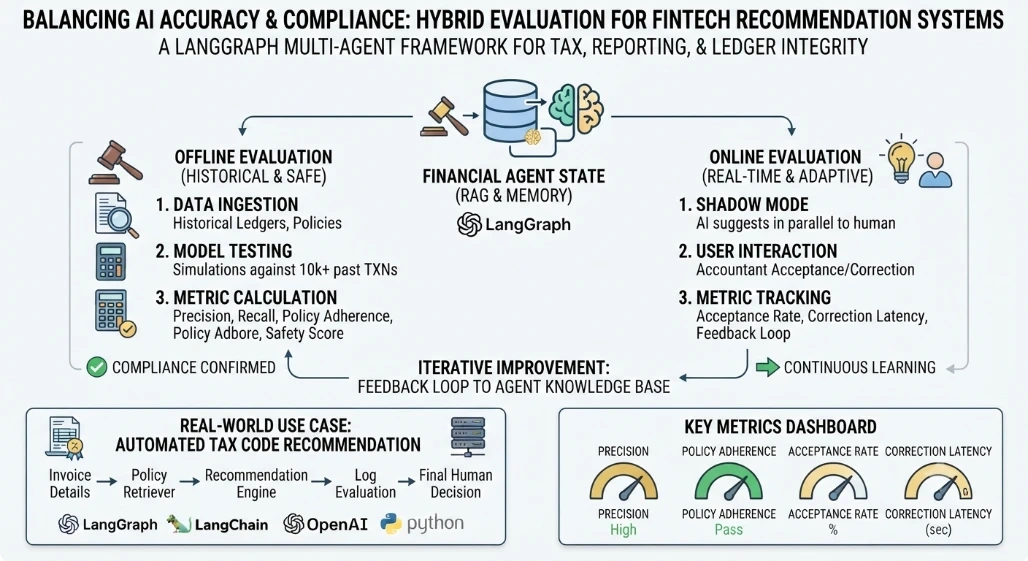
Offline Evaluation involves testing models against historical datasets. It is safe and reproducible but suffers from "data drift"—past behavior may not predict future regulatory changes. Online Evaluation tests models in production with real users. It provides true performance data but carries the risk of non-compliance or financial error. In banking, where Tax Management and Financial Reporting are legally binding, we cannot afford pure online experimentation.
Strategy Overview: The Hybrid Evaluation Loop
Our strategy employs a "Shadow Mode" for online evaluation. The AI agent generates recommendations in parallel with human experts. These recommendations are logged but not executed until validated.
Offline Phase: We use historical ledgers to train the RAG retriever and validate that the agent’s logic aligns with past approved decisions.
Online Phase: We deploy the agent in "Advisor Mode." It suggests tax codes or ledger classifications. We measure User Acceptance Rate (how often the accountant accepts the suggestion) and Correction Latency (how quickly they correct it). This feedback loop updates the agent’s memory, refining future recommendations.
Real-Time Use Case: Automated Tax Code Recommendation & Validation
Consider a multinational bank processing thousands of cross-border transactions. Each transaction requires a specific tax code based on jurisdiction, entity type, and service category. A new accountant (a cold-start user) faces a complex invoice from a vendor in Germany.
The system must:
Retrieve the latest Bank Policy on EU VAT regulations.
Analyze the invoice details.
Recommend a tax code.
Log the interaction for offline analysis and online feedback.
Architecture: Multi-Agent LangGraph with RAG and State
We utilize a LangGraph workflow with three key nodes:
Policy Retriever (RAG): Fetches relevant tax laws and internal bank policies from a vector store.
Recommendation Engine: Generates the tax code suggestion based on retrieved context.
Evaluation Logger: Records the suggestion, the final human decision, and the time taken, updating the system’s state for future learning.
Code Implementation: Building the Evaluation-Aware Agent
Below is a simplified implementation demonstrating how state and memory are used to track evaluation metrics.
from typing import TypedDict, List, Annotated
from langgraph.graph import StateGraph, END
import operator
import time

# Define the State with Evaluation Metrics
class FinancialAgentState(TypedDict):
    transaction_id: str
    invoice_details: dict
    retrieved_policy: str
    recommended_tax_code: str
    human_decision: str
    acceptance_status: str # 'ACCEPTED', 'REJECTED'
    timestamp: float
    evaluation_log: Annotated[List[dict], operator.add]

# Mock RAG Retrieval for Bank Policy
def retrieve_tax_policy(state: FinancialAgentState) -> FinancialAgentState:
    # Simulate fetching policy based on jurisdiction
    jurisdiction = state['invoice_details'].get('jurisdiction', 'US')
    if jurisdiction == 'DE':
        state['retrieved_policy'] = "EU VAT Directive 2006/112/EC: Standard rate 19% for digital services."
    else:
        state['retrieved_policy'] = "US IRS Guidelines: Standard sales tax applies."
    return state

# Recommendation Engine
def recommend_tax_code(state: FinancialAgentState) -> FinancialAgentState:
    policy = state['retrieved_policy']
    if "EU VAT" in policy:
        state['recommended_tax_code'] = "DE-VAT-19"
    else:
        state['recommended_tax_code'] = "US-SALES-TAX"
    state['timestamp'] = time.time()
    return state

# Evaluation Logger (Simulates Online Feedback)
def log_evaluation(state: FinancialAgentState) -> FinancialAgentState:
    # In a real app, this would wait for user input via UI
    # For demo, we simulate a human accepting the recommendation
    state['human_decision'] = state['recommended_tax_code']
    state['acceptance_status'] = 'ACCEPTED'

    log_entry = {
        "transaction_id": state['transaction_id'],
        "recommendation": state['recommended_tax_code'],
        "final_decision": state['human_decision'],
        "status": state['acceptance_status'],
        "latency_seconds": time.time() - state['timestamp']
    }
    state['evaluation_log'].append(log_entry)
    return state

# Build the Graph
workflow = StateGraph(FinancialAgentState)
workflow.add_node("retrieve_policy", retrieve_tax_policy)
workflow.add_node("recommend", recommend_tax_code)
workflow.add_node("log_eval", log_evaluation)

workflow.set_entry_point("retrieve_policy")
workflow.add_edge("retrieve_policy", "recommend")
workflow.add_edge("recommend", "log_eval")
workflow.add_edge("log_eval", END)

app = workflow.compile()

# Execution
initial_state = {
    "transaction_id": "TXN_998877",
    "invoice_details": {"amount": 5000, "jurisdiction": "DE", "service": "Software License"},
    "retrieved_policy": "",
    "recommended_tax_code": "",
    "human_decision": "",
    "acceptance_status": "",
    "timestamp": 0,
    "evaluation_log": []
}

result = app.invoke(initial_state)
print(f"Recommendation: {result['recommended_tax_code']}")
print(f"Evaluation Log: {result['evaluation_log']}")
Offline Metrics: Precision, Recall, and Policy Adherence
Before going live, we run the agent against a dataset of 10,000 historical transactions. We measure:
Precision: Of all tax codes suggested, how many were correct?
Policy Adherence: Did the agent cite the correct bank policy clause?
Safety Score: Did it ever suggest a non-compliant code?
Online Metrics: User Acceptance Rate and Correction Latency
Once in "Advisor Mode," we track:
Acceptance Rate: If accountants accept >90% of suggestions, the model is trustworthy.
Correction Latency: If they reject a suggestion, how long does it take them to fix it? High latency indicates confusing recommendations.
Feedback Loop: Rejected suggestions are flagged for retraining, ensuring the RAG knowledge base stays current.
Balancing online and offline evaluation is not just a technical necessity but a regulatory imperative in Accounting & Financial Management. By leveraging a multi-agent LangGraph architecture with RAG and persistent state, banks can safely deploy AI for Tax Management and Financial Reporting. This hybrid approach ensures that while the system learns from real-time interactions, it remains anchored by the rigor of offline validation and strict bank policy adherence.
Join the conversation! Your thoughts help the community grow.