

Introduction:
This article addresses the construction of a custom control that will convert UNIX time into useful and readable dates for display in a Win Forms application. The control will accept either a standard date or UNIX time value and can convert the value in either direction (From UNIX Time to Date or from Date to UNIX Time). 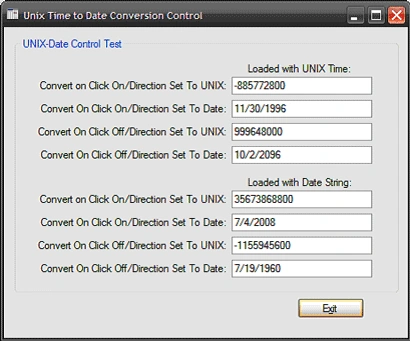
Figure 1: The test application running
The control contains two properties that may be set to control the displayed output and the usability of the control. The "Convert On Click" property will enable or disable the control's ability to convert the value back and forth between UNIX time and normal date when a user clicks on the control; this may be useful if you wish to permit the user to edit the value in one format and view it in another. The other property is "Direction". Direction is used to determine whether or not the control will display the value as UNIX time or as a standard date.
Getting Started:
In order to get started, unzip the included project and open the solution in the Visual Studio 2008 environment. In the solution explorer, you should note these files (Figure 2):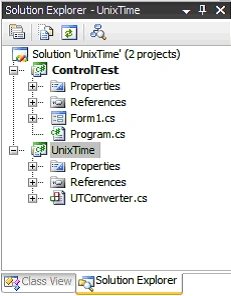
Figure 2: Solution Explorer
As you can see from Figure 2; there are two projects. UnixTime is the custom control project and it contains a single custom control (UTConverter.cs). the second project (ControlTest) is a win forms application used to test the control.
The Custom Control (UTConverter.cs).
The custom control is a class that extends the standard TextBox control.
The code is pretty simple, if you'd care to open the code view up in the IDE you will see that the code file begins with the following library imports:
using System;
using System.ComponentModel;
using System.Drawing;
using System.Text;
using System.Windows.Forms;
Following the imports, the namespace and class are defined:
namespace UnixTime
{
public partial class UTConverter : TextBox
{
Next an enumeration is defined; this enumeration is entitled "Direction". The enumeration is used to define whether or not the date displayed in the extended textbox control will display dates or UNIX time stamp values. UNIX time stamp values can be defined as the number of seconds before or after the date 1/1/1970. Following the declaration of the enumeration, two private member variables are defined; one to keep track of the selected Direction option, and one Boolean value used to determine whether or not "Convert On Click" is enabled.
#region Members
public enum Direction
{
ToUnix,
ToDate
}
private Direction mCurrentDirection;
private bool mConvertOnClick;
#endregion
Next, a constructor is defined; within the constructor, the default values for the control are set by setting the CurrentDirection property to Direction.ToDate, and setting the ConvertOnClick property to true. In this default condition, the control will normally display the date as a date and will, on click, convert the date back to the UNIX time stamp value.
#region Constructor
public UTConverter()
{
InitializeComponent();
CurrentDirection = Direction.ToDate;
ConvertOnClick = true;
}
#endregion
After the constructor, a region is setup to contain the control's added properties. The first property is CurrentDirection; it provides public access to the mCurrentDirection member variable used to determine whether or not the control will display its value as a date or as a UNIX time stamp value. The other property, ConvertOnClick, is used to enable or display the functionality that will convert between UNIX and normal date displays within the control at runtime.
#region Properties
[CategoryAttribute("UNIX Time"),
Browsable(true),
BindableAttribute(false),
DescriptionAttribute("Convert to or from UNIX time.")]
public Direction CurrentDirection
{
get
{
return mCurrentDirection;
}
set
{
mCurrentDirection = value;
}
}
[CategoryAttribute("UNIX Time"),
Browsable(true),
BindableAttribute(false),
DescriptionAttribute("Enable or disable On Click UNIX Time format
conversion.")]
public bool ConvertOnClick
{
get
{
return mConvertOnClick;
}
set
{
mConvertOnClick = value;
}
}
#endregion
#region Methods
The ConvertToDateTime function converts the unix time stamp to a short date string; this is easily accomplished by adding the number of seconds provided to the baseline data used for the UNIX time stamp.
/// <summary>
/// Convert unix time to date
/// </summary>
/// <param name="unixTime"></param>
private void ConvertToDateTime(double unixTime)
{
DateTime convertedDateTime = new DateTime(1970,1,1,0,0,0).AddSeconds(unixTime);
this.Text = convertedDateTime.ToShortDateString();
}
The next function converts a date (as a short date string) to UNIX time format:
/// <summary>
/// Convert date to unix time
/// </summary>
/// <param name="dt"></param>
private void ConvertToUnixTime(DateTime dt)
{
this.Text = (dt - new DateTime(1970,1,1,0,0,0)).TotalSeconds.ToString();
// Note: This operation will truncate the value to its
// minimum for the date time shown; for example, if "500000000"
// is entered into the textbox, this operation will
// alter the value to “499996800" which is the
// minimum value for the date 11/5/1985. If you
// need to maintain the exact unix time value,
// create a separate variable to store it in and
// set it to the unix time stamp prior to
// converting from unix time to a date.
}
The controls validated event handler is used to update the display of the date or UNIX time value based upon whether or not the control's Current Direction property has been set to display dates or UNIX time.
/// <summary>
/// Upon validation, update the control to
/// display the converted unix time
/// </summary>
/// <param name="sender"></param>
/// <param name="e"></param>
private void UTConverter_Validated(object sender, EventArgs e)
Join the conversation! Your thoughts help the community grow.