

Building a Hybrid Recommendation Engine with Collaborative Filtering, Semantic Search, LLM Reasoning, and LangGraph
Introduction
Modern recommendation systems rarely succeed with a single algorithm. Users expect recommendations that understand their interests, goals, constraints, and context. Traditional recommendation techniques often excel in one area but fail in others.
A hybrid recommendation engine combines the strengths of multiple approaches:
Collaborative Filtering (CF) for behavioral patterns.
Semantic Vector Search for content understanding.
LLM Contextual Reasoning for personalized decision-making.
LangGraph for orchestration, memory, and state management.
In this article, we'll build an enterprise-grade recommendation system that combines all four capabilities into a single intelligent platform.
1. Why Hybrid? The Limits of Any Single Signal
Different recommendation techniques capture different aspects of user intent.
| Paradigm | Captures | Blind Spot |
|---|---|---|
| Collaborative Filtering (CF) | Taste similarity, emergent communities | Cold-start users/items, lacks semantic understanding |
| Semantic Vector Search | Content meaning, conceptual similarity | Ignores social proof and popularity patterns |
| LLM Contextual Reasoning | Goals, constraints, explanations, personalization | Can hallucinate without grounding, higher latency |
A hybrid system solves these weaknesses by combining them.
CF identifies what similar users enjoyed.
Semantic Search identifies what is conceptually relevant.
LLM Reasoning ranks and explains recommendations based on user context.
LangGraph orchestrates the entire workflow with memory and state.
2. Real-World Use Case: Enterprise Learning & Career Development
Scenario
Lumina Corp, a consulting organization with 12,000 employees, operates an internal Learning & Development platform.
The platform recommends:
Training courses
Internal mentors
Stretch projects
Certification paths
Each employee has:
Current role
Skill profile
Career goals
Learning history
Project experience
Example User
A junior consultant wants to become a Cloud Architect.
Constraints:
Only 2 hours available per week.
Needs AWS and Terraform skills.
Prefers practical learning.
A recommendation engine must consider:
Similar employees who successfully became Cloud Architects.
Relevant learning content.
Time constraints.
Previous feedback.
No single algorithm can handle all these factors effectively.
3. High-Level Architecture
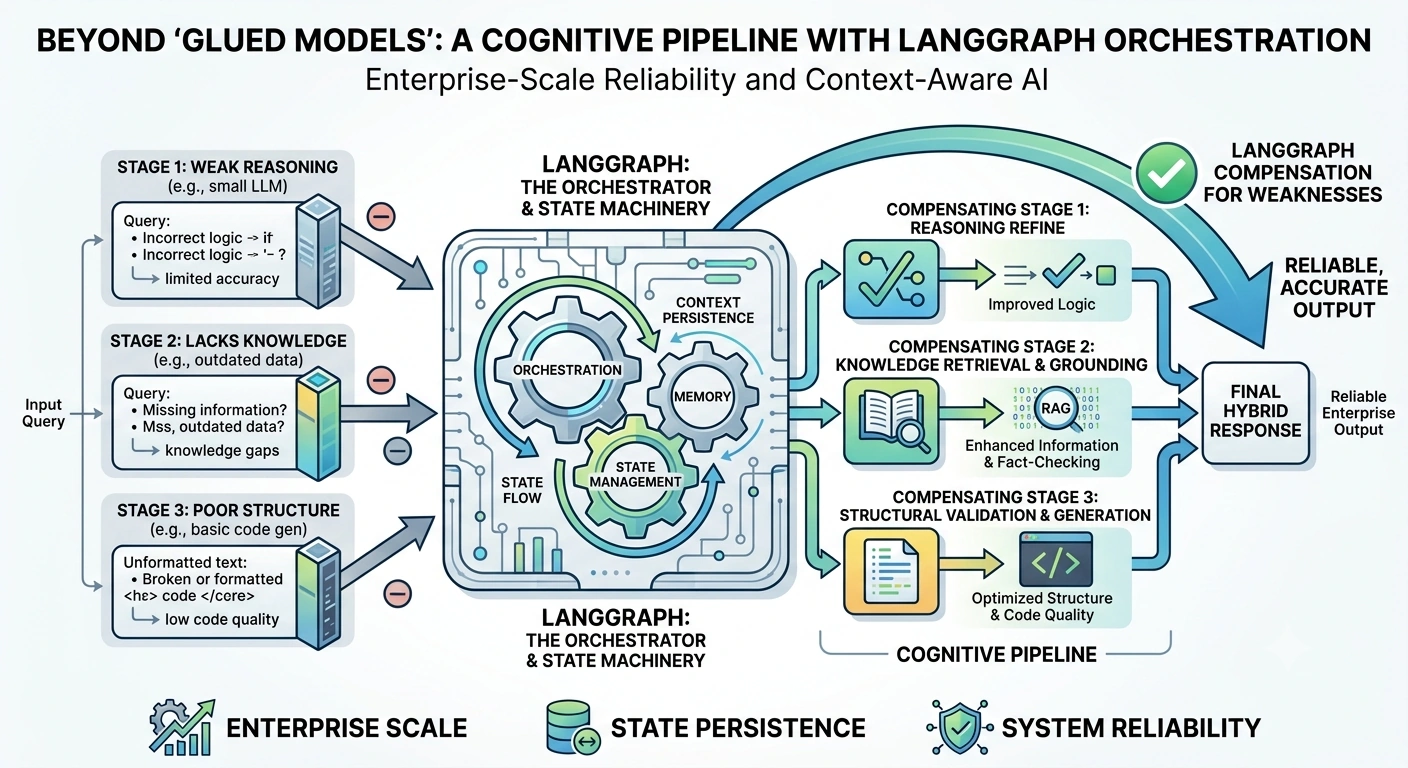
The recommendation pipeline consists of:
Collaborative Filtering Engine
Semantic Search Engine
LLM Contextual Reasoner
LangGraph Multi-Agent Orchestrator
Persistent Memory Layer
The workflow:
User Request
      ↓
Router Agent
      ↓
 ┌───────────────┬───────────────┐
 │ Collaborative │   Semantic   │
 │   Filtering   │    Search    │
 └───────────────┴───────────────┘
            ↓
      Context Agent
            ↓
      LLM Reasoner
            ↓
       Final Ranking
            ↓
        User Response
4. The Three Pillars - Implementation
4.1 Collaborative Filtering (Item-Item Cosine Similarity)
We begin with a lightweight item-based collaborative filtering model.
The model uses a user-course interaction matrix and computes similarity between courses.
import numpy as np
import pandas as pd
from sklearn.metrics.pairwise import cosine_similarity

class CollaborativeFilter:
    def __init__(self, interaction_df: pd.DataFrame):
        # interaction_df: user_id, course_id, rating
        self.pivot = interaction_df.pivot_table(
            index="user_id",
            columns="course_id",
            values="rating",
            fill_value=0
        )

        self.item_sim = cosine_similarity(self.pivot.T)
        self.course_ids = list(self.pivot.columns)

    def recommend(self, user_id: str, top_k: int = 10):
        if user_id not in self.pivot.index:
            return []

        user_vec = self.pivot.loc[user_id].values

        scores = self.item_sim.T @ user_vec

        consumed = set(np.where(user_vec > 0)[0])

        ranked = np.argsort(scores)[::-1]

        recs = []

        for idx in ranked:
            if idx not in consumed:
                recs.append({
                    "course_id": self.course_ids[idx],
                    "score": float(scores[idx]),
                    "source": "collaborative"
                })

                if len(recs) == top_k:
                    break

        return recs
Benefits
Fast inference
Easy retraining
Highly interpretable
Weakness
Cold-start users receive no recommendations.
4.2 Semantic Vector Search (RAG over Course Catalog)
Semantic retrieval solves the cold-start problem.
Instead of user behavior, recommendations are based on meaning and intent.
Each course is embedded and stored in a vector database.
from langchain_openai import OpenAIEmbeddings
from langchain_community.vectorstores import FAISS
from langchain.docstore.document import Document

class SemanticRetriever:
    def __init__(self, courses):
        self.embeddings = OpenAIEmbeddings(
            model="text-embedding-3-small"
        )

        docs = [
            Document(
                page_content=(
                    f"{c['title']}. "
                    f"{c['description']}. "
                    f"Skills: {', '.join(c['skills'])}"
                ),
                metadata={
                    "course_id": c["id"],
                    "level": c["level"],
                    "hours": c["hours"]
                }
            )
            for c in courses
        ]

        self.vectorstore = FAISS.from_documents(
            docs,
            self.embeddings
        )

    def search(self, query, k=10, filters=None):
        kwargs = {"k": k}

        if filters:
            kwargs["filter"] = filters

        results = (
            self.vectorstore
            .similarity_search_with_score(query, **kwargs)
        )

        return [
            {
                "course_id": doc.metadata["course_id"],
                "title": doc.metadata.get(
                    "title",
                    doc.page_content[:60]
                ),
                "score": float(score),
                "source": "semantic",
                "content": doc.page_content
            }
            for doc, score in results
        ]
Benefits
Handles cold-start scenarios
Understands meaning and intent
Works immediately for new content
Weakness
Does not incorporate user behavior or peer success patterns.
4.3 LLM Contextual Reasoner
The LLM acts as a decision-maker.
It evaluates:
User goals
Skill gaps
Time constraints
Collaborative signals
Semantic signals
and generates the final ranking.
Join the conversation! Your thoughts help the community grow.