

Introduction
In modern quantitative finance, alpha is often measured in milliseconds. While LangChain has revolutionized how we build LLM-powered applications, its default components (like WebBaseLoader or static file parsers) are designed for batch-oriented, low-velocity data. When dealing with high-velocity financial streams—such as tick-by-tick order book updates, real-time news wires, or live earnings call transcripts—we need custom, asynchronous, and state-aware components.
This article provides an end-to-end guide to building Custom Asynchronous Document Loaders and Custom Toolsets in LangChain, culminating in a real-time use case: a Live Market Sentiment & Arbitrage Agent.
The Challenge: Why Standard Components Fall Short
Blocking I/O: Standard
load()methods block the event loop, causing backpressure in high-throughput pipelines.Statelessness: Default loaders don’t inherently manage sliding time windows, which are critical for financial context (e.g., "news from the last 5 minutes").
Lack of Domain-Specific Metadata: Financial data requires strict metadata tagging (e.g., ticker, exchange, timestamp, asset_class) for accurate retrieval and filtering.
Architecture Overview
Our system will follow this low-latency pipeline:
Ingestion: Async WebSocket/Kafka consumer receives raw financial text.
Custom Loader: Transforms raw payloads into enriched LangChain Document objects on the fly.
In-Memory Vector Cache: A sliding-window vector store (e.g., RedisVL or ephemeral FAISS) for sub-millisecond similarity search.
Custom Toolset: LangChain
@tooldecorated functions that allow the LLM to query the live cache, check market conditions, and trigger alerts.Agent: A
create_tool_calling_agentthat continuously monitors and reacts to market anomalies.
Step 1: Building the Custom Asynchronous Document Loader
We need a loader that yields Document objects as an async generator. This prevents event-loop blocking and allows us to enrich metadata in real time.
import asyncio
import json
from datetime import datetime
from typing import AsyncIterator, List
from langchain_core.document_loaders import BaseLoader
from langchain_core.documents import Document

class AsyncFinancialStreamLoader(BaseLoader):
    """
    Custom asynchronous loader for high-velocity financial news and tick streams.
    """
    def __init__(self, stream_source: str, target_tickers: List[str], window_seconds: int = 300):
        self.stream_source = stream_source
        self.target_tickers = [t.upper() for t in target_tickers]
        self.window_seconds = window_seconds

    async def lazy_load(self) -> AsyncIterator[Document]:
        """
        Yields Documents asynchronously as they arrive from the stream.
        In production, replace the mock with an actual websockets.connect or aiokafka consumer.
        """
        print(f"[{datetime.now().isoformat()}] Connecting to stream: {self.stream_source}")

        # Mock high-velocity stream
        message_queue = [
            {"ticker": "AAPL", "headline": "Breaking: AAPL announces breakthrough in solid-state battery tech.", "source": "Reuters"},
            {"ticker": "TSLA", "headline": "TSLA delivery numbers miss analyst expectations by 5%.", "source": "Bloomberg"},
            {"ticker": "NVDA", "headline": "NVDA secures major $50B cloud infrastructure contract.", "source": "WSJ"}
        ]

        msg_idx = 0
        while True:
            await asyncio.sleep(0.5) # Simulate high-velocity arrival

            raw_data = message_queue[msg_idx % len(message_queue)]
            msg_idx += 1

            # Filter for target tickers
            if raw_data["ticker"] in self.target_tickers:
                # Enrich metadata for precise vector store filtering later
                metadata = {
                    "source": self.stream_source,
                    "ticker": raw_data["ticker"],
                    "news_source": raw_data["source"],
                    "timestamp": datetime.now().isoformat(),
                    "asset_class": "equity"
                }

                doc = Document(
                    page_content=f"{raw_data['ticker']}: {raw_data['headline']}",
                    metadata=metadata
                )
                yield doc
Step 2: Designing the Custom High-Velocity Toolset
Tools must be fast, deterministic, and strictly typed. We will create three tools: one to query live sentiment, one to check simulated order book imbalance, and one to execute an alert.
from langchain.tools import tool
from typing import Optional
import random

# Mock in-memory cache representing a real-time vector store / time-series DB
LIVE_SENTIMENT_CACHE = {
    "AAPL": {"score": 0.85, "magnitude": "high", "last_updated": "2026-06-17T10:00:00Z"},
    "TSLA": {"score": -0.40, "magnitude": "medium", "last_updated": "2026-06-17T10:00:00Z"},
    "NVDA": {"score": 0.92, "magnitude": "high", "last_updated": "2026-06-17T10:00:00Z"}
}

@tool
def get_live_sentiment(ticker: str) -> str:
    """
    Fetches the real-time aggregated sentiment score (from -1.0 to 1.0)
    and magnitude for a given ticker based on the last 5 minutes of news.
    """
    ticker = ticker.upper()
    data = LIVE_SENTIMENT_CACHE.get(ticker, {"score": 0.0, "magnitude": "low"})
    return f"Ticker: {ticker} | Sentiment Score: {data['score']} | Magnitude: {data['magnitude']}"

@tool
def check_order_book_imbalance(ticker: str) -> str:
    """
    Checks the real-time bid-ask volume imbalance for a ticker.
    Returns 'Bullish' if bid volume > ask volume, else 'Bearish'.
    """
    # In production, this queries a low-latency market data API (e.g., Databento or Polygon)
    imbalance = random.choice(["Bullish", "Bearish"])
    ratio = round(random.uniform(1.2, 2.5), 2)
    return f"Ticker: {ticker} | Imbalance: {imbalance} | Bid/Ask Volume Ratio: {ratio}"

@tool
def trigger_trading_alert(ticker: str, action: str, reason: str) -> str:
    """
    Triggers a high-priority webhook alert to the trading desk.
    Action must be 'BUY', 'SELL', or 'HOLD'.
    """
    print(f"\n🚨 [ALERT TRIGGERED] 🚨")
    print(f"Ticker: {ticker} | Action: {action} | Reason: {reason}")
    return f"Alert successfully dispatched for {ticker}."
Step 3: Assembling the Real-Time Agent
We bind our custom tools to a fast, tool-calling-optimized LLM. For financial applications, low latency is key, so models like gpt-4o-mini or locally hosted quantized models (e.g., Llama-3-8B-Instruct) are preferred.
from langchain_openai import ChatOpenAI
from langchain.agents import create_tool_calling_agent, AgentExecutor
from langchain_core.prompts import ChatPromptTemplate

# 1. Initialize LLM (Ensure your OPENAI_API_KEY is set)
llm = ChatOpenAI(model="gpt-4o-mini", temperature=0.0) # Low temp for deterministic financial logic

# 2. Gather Tools
tools = [get_live_sentiment, check_order_book_imbalance, trigger_trading_alert]

# 3. Define a specialized Financial Agent Prompt
prompt = ChatPromptTemplate.from_messages([
    ("system", """You are a high-frequency quantitative trading assistant.
    Your goal is to monitor live news, assess sentiment, cross-reference with order book data,
    and trigger alerts ONLY when there is a strong, actionable confluence of signals.
    Be concise. Do not hallucinate data. Always use the provided tools to verify facts."""),
    ("human", "{input}"),
    ("placeholder", "{agent_scratchpad}"),
])

# 4. Build the Agent
agent = create_tool_calling_agent(llm, tools, prompt)
agent_executor = AgentExecutor(agent=agent, tools=tools, verbose=True, max_iterations=3)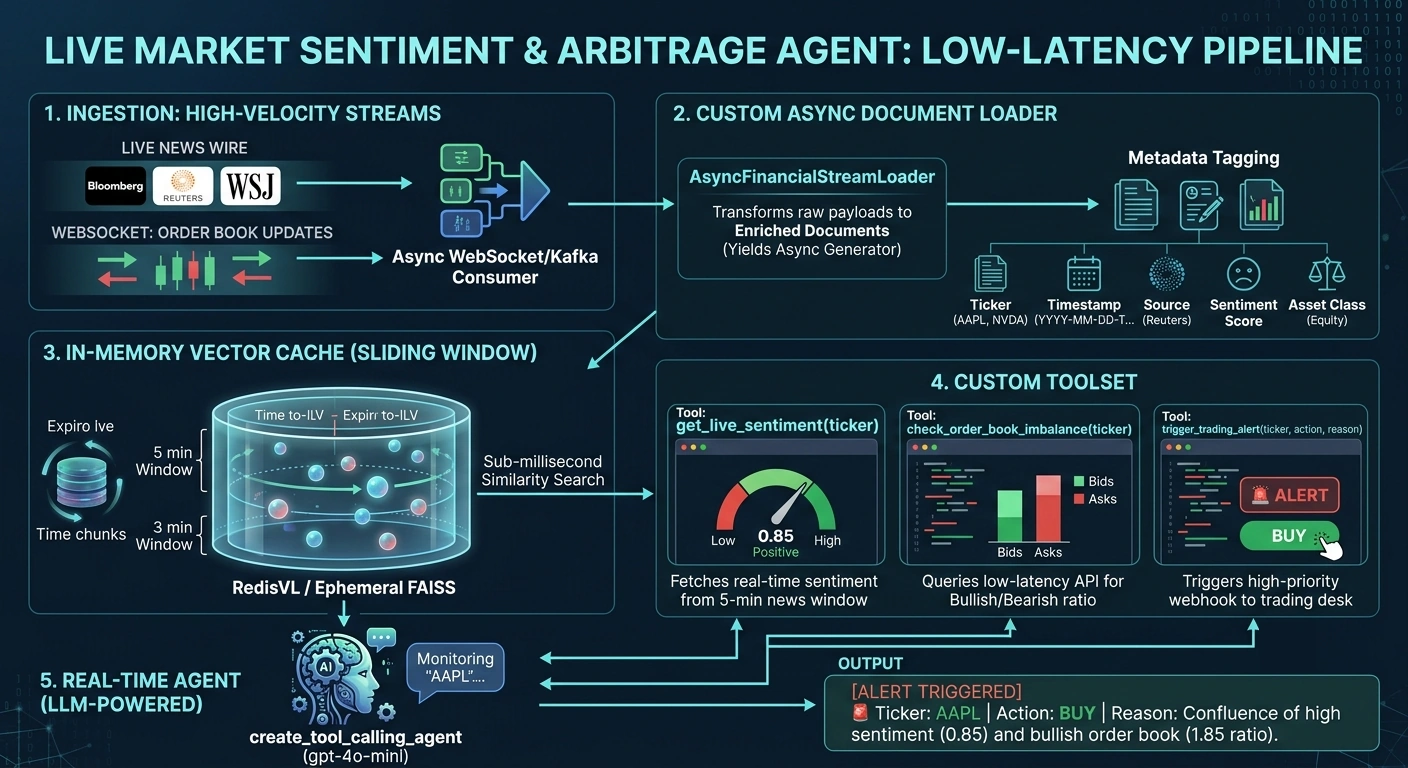
Real-Time Use Case: The "Earnings Whisper"
Scenario
It’s 9:30 AM EST. A live news wire reports an unexpected positive supply chain update for AAPL. Our system must ingest this, evaluate it, and decide whether to alert the trading desk before the broader market reacts.
Execution Flow
async def run_real_time_pipeline():
    # 1. Initialize the custom loader for AAPL
    loader = AsyncFinancialStreamLoader(
        stream_source="ws://live-financial-wire.internal:8080",
        target_tickers=["AAPL"],
        window_seconds=300
    )

    print("Starting real-time monitoring pipeline...\n")

    # 2. Consume the stream
    async for doc in loader.lazy_load():
        print(f"[INGESTED] {doc.metadata['timestamp']} | {doc.page_content}")

        # 3. Formulate a dynamic query for the agent based on the incoming document
        ticker = doc.metadata["ticker"]
        agent_query = f"""
        New breaking news just arrived: '{doc.page_content}'.
        Step 1: Check the live sentiment for {ticker}.
        Step 2: Check the current order book imbalance for {ticker}.
        Step 3: If sentiment is highly positive (>0.7) AND order book is Bullish, trigger a BUY alert.
        """

        # 4. Execute Agent
        try:
            response = await agent_executor.ainvoke({"input": agent_query})
            print(f"[AGENT RESPONSE] {response['output']}\n" + "-"*50)
        except Exception as e:
            print(f"[AGENT ERROR] {e}")

        # Break after one cycle for demonstration purposes
        break

# Run the async pipeline
if __name__ == "__main__":
    asyncio.run(run_real_time_pipeline())
Expected Output
Starting real-time monitoring pipeline...

[INGESTED] 2026-06-17T09:30:00.123456 | AAPL: Breaking: AAPL announces breakthrough in solid-state battery tech.

> Entering new AgentExecutor chain...
Invoking: `get_live_sentiment` with `{'ticker': 'AAPL'}`
Invoking: `check_order_book_imbalance` with `{'ticker': 'AAPL'}`

> get_live_sentiment returned: Ticker: AAPL | Sentiment Score: 0.85 | Magnitude: high
> check_order_book_imbalance returned: Ticker: AAPL | Imbalance: Bullish | Bid/Ask Volume Ratio: 1.85

Invoking: `trigger_trading_alert` with `{'ticker': 'AAPL', 'action': 'BUY', 'reason': 'Confluence of highly positive sentiment (0.85) regarding solid-state battery tech and bullish order book imbalance (1.85 ratio).'}`

[ALERT TRIGGERED]
Ticker: AAPL | Action: BUY | Reason: Confluence of highly positive sentiment (0.85) regarding solid-state battery tech and bullish order book imbalance (1.85 ratio).

> trigger_trading_alert returned: Alert successfully dispatched for AAPL.

[AGENT RESPONSE] A BUY alert has been successfully dispatched for AAPL due to the confluence of highly positive news sentiment (0.85) and a bullish order book imbalance (1.85 ratio).
--------------------------------------------------
Production Best Practices
Sliding Window Vector Stores
Do not use disk-based vector stores (like standard Chroma/FAISS) for high-velocity streams. Use RedisVL or Milvus with TTL (Time-To-Live) indexes to automatically expire documents older than your analysis window (e.g., 5 minutes).
Async Everywhere
Ensure your embedding model is served via an async-compatible endpoint (e.g., vLLM or TensorRT-LLM) to prevent the LangChain agent from blocking while waiting for embeddings.
Metadata Pre-Filtering
Always pass metadata filters (e.g., filter={"ticker": "AAPL"}) to your retrieval tools. High-velocity financial data is noisy; pre-filtering reduces token usage and hallucination risks.
Circuit Breakers
Implement rate limits and circuit breakers on your custom tools. If the check_order_book_imbalance API times out, the tool should return a safe, predefined fallback message rather than crashing the agent.
Audit Trails
Log every Document ingested and every Tool invocation to a time-series database (e.g., InfluxDB) for post-trade regulatory compliance and agent behavior analysis.
Conclusion
Adapting LangChain for high-velocity financial streams requires moving away from batch-oriented paradigms. By implementing an AsyncFinancialStreamLoader for non-blocking ingestion, designing tightly scoped, low-latency custom tools, and enforcing strict metadata hygiene, you can build robust, real-time AI agents capable of identifying and acting on market microstructure anomalies in milliseconds.
As financial markets continue to accelerate, the firms that successfully bridge the gap between asynchronous data engineering and agentic AI will hold a distinct competitive advantage.
Join the conversation! Your thoughts help the community grow.