

Introduction: The Idempotency Challenge in Distributed AI Systems
In enterprise-grade AI applications, particularly those involving financial transactions, healthcare records, or supply chain management, ensuring that operations execute exactly once is critical. When building multi-agent systems using LangGraph with Retrieval-Augmented Generation (RAG), the distributed nature of message processing, agent coordination, and external API calls introduces significant risks of duplicate processing. This article explores how to implement exactly-once or effectively-once semantics in a production-ready LangGraph-based RAG system, combining idempotency patterns, state management, and transactional guarantees.
Understanding Exactly-Once vs. Effectively Once Semantics
Exactly once semantics guarantee that each message or operation is processed precisely one time, regardless of failures or retries. This is theoretically ideal but practically challenging in distributed systems due to network partitions, timeouts, and agent crashes. Effectively once semantics achieve the same business outcome by making operations idempotent meaning repeated executions produce the same result as a single execution. This approach is more practical and widely adopted in enterprise systems, leveraging unique identifiers, deduplication stores, and conditional writes.
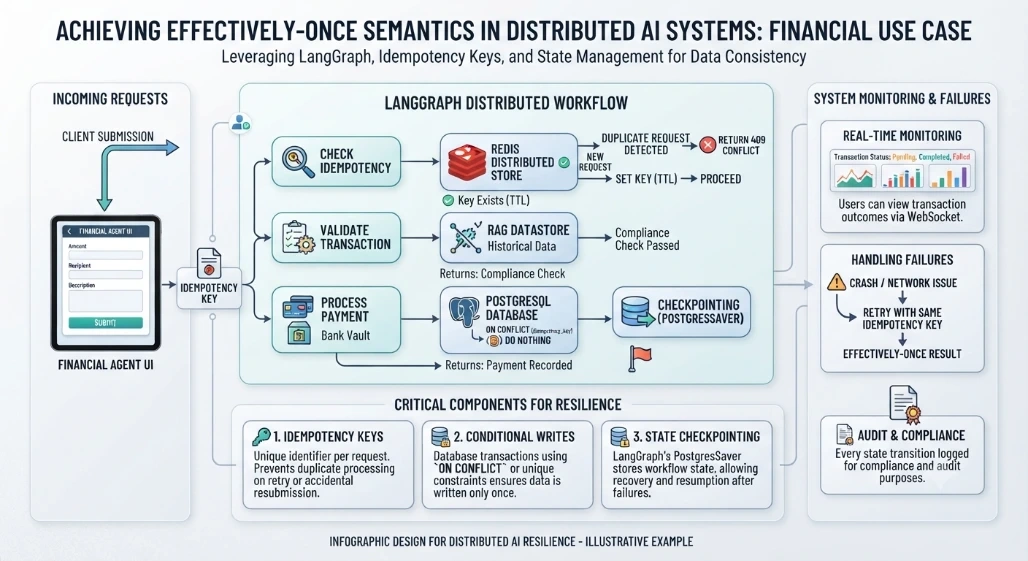
Real-Time Use Case: Financial Transaction Processing with AI Agents
Consider a banking application where customers submit transaction requests via a chat interface. An AI agent extracts transaction details, validates against compliance rules, checks fraud patterns using RAG against historical data, and processes the payment. If the agent crashes after validation but before committing, or if the user accidentally resubmits, we must ensure the transaction isn't processed twice.
Technology Stack Overview
Backend: Python, LangGraph, FastAPI, Pydantic
State Management: Redis for distributed state and idempotency keys
Database: PostgreSQL with transactional support
Message Queue: RabbitMQ or Azure Service Bus for reliable delivery
Frontend: React with TypeScript for real-time monitoring
RAG Components: Azure Cognitive Search or Pinecone for vector storage
Memory: LangChain's checkpointing with SQLite or PostgresSaver
Step-by-Step Implementation: Backend with LangGraph and State Management
Step 1: Define the Transaction Model with Idempotency Key
from pydantic import BaseModel, Field
from typing import Optional
import uuid

class TransactionRequest(BaseModel):
    idempotency_key: str = Field(default_factory=lambda: str(uuid.uuid4()))
    amount: float = Field(gt=0, description="Transaction amount")
    recipient: str = Field(min_length=1, description="Recipient account")
    description: str = Field(max_length=200)

class TransactionState(BaseModel):
    transaction_id: Optional[str] = None
    status: str = "pending"
    processed: bool = False
    idempotency_key: str
Step 2: Build the LangGraph with Checkpointing
from langgraph.graph import StateGraph, END
from langgraph.checkpoint.postgres import PostgresSaver
import redis

# Initialize Redis for idempotency tracking
redis_client = redis.Redis(host='localhost', port=6379, db=0)

def check_idempotency(state: dict) -> dict:
    key = f"idem:{state['idempotency_key']}"
    if redis_client.exists(key):
        return {"status": "duplicate", "processed": True}
    redis_client.setex(key, 86400, "processing")  # 24-hour TTL
    return {"status": "new"}

def validate_transaction(state: dict) -> dict:
    # Validation logic here
    return {"status": "validated"}

def process_payment(state: dict) -> dict:
    # Database transaction with conditional insert
    try:
        # Upsert with condition on idempotency_key
        result = db.execute(
            "INSERT INTO transactions (idempotency_key, amount, recipient) "
            "VALUES (%s, %s, %s) ON CONFLICT (idempotency_key) DO NOTHING",
            (state['idempotency_key'], state['amount'], state['recipient'])
        )
        if result.rowcount == 0:
            return {"status": "already_processed", "processed": True}
        return {"status": "completed", "processed": True}
    except Exception as e:
        redis_client.delete(f"idem:{state['idempotency_key']}")
        raise e

# Build the graph
workflow = StateGraph(dict)
workflow.add_node("check_idempotency", check_idempotency)
workflow.add_node("validate", validate_transaction)
workflow.add_node("process", process_payment)

workflow.set_entry_point("check_idempotency")
workflow.add_edge("check_idempotency", "validate")
workflow.add_edge("validate", "process")
workflow.add_edge("process", END)

# Configure checkpointing for state recovery
checkpointer = PostgresSaver.from_conn_string("postgresql://user:pass@localhost/db")
app = workflow.compile(checkpointer=checkpointer)
Step 3: FastAPI Endpoint with Error Handling
from fastapi import FastAPI, HTTPException

app_api = FastAPI()

@app_api.post("/transaction", status_code=201)
async def create_transaction(request: TransactionRequest):
    initial_state = {
        "idempotency_key": request.idempotency_key,
        "amount": request.amount,
        "recipient": request.recipient,
        "description": request.description
    }

    try:
        result = await app.ainvoke(initial_state)
        if result["status"] == "duplicate":
            raise HTTPException(status_code=409, detail="Transaction already processed")
        return {"transaction_id": result.get("transaction_id"), "status": "success"}
    except Exception as e:
        raise HTTPException(status_code=500, detail=str(e))
Frontend Integration for Monitoring and Replay
The React frontend displays transaction status in real-time using WebSocket connections. Users can view pending, completed, or failed transactions. For failed transactions, the UI provides a "Retry" button that resubmits with the same idempotency key, ensuring no duplicates.
const retryTransaction = async (idempotencyKey: string) => {
  const response = await fetch('/api/transaction', {
    method: 'POST',
    headers: { 'Content-Type': 'application/json' },
    body: JSON.stringify({ idempotency_key: idempotencyKey, ...originalData })
  });

  if (response.status === 409) {
    showToast('Transaction already processed');
  }
};
Handling Failures and Ensuring Data Consistency
The system employs several strategies:
Idempotency Keys: Unique per request, stored in Redis with TTL
Conditional Database Writes: Using
ON CONFLICTor unique constraintsCheckpointing: LangGraph's PostgresSaver enables state recovery after crashes
Dead Letter Queues: Failed messages are routed for manual review
Audit Logging: Every state transition is logged for compliance
Conclusion
Building exactly-once or effectively once semantics in multi-agent LangGraph RAG systems requires a combination of idempotency patterns, distributed state management, and transactional databases. By leveraging unique identifiers, conditional writes, and checkpointing, enterprises can ensure data consistency even in the face of failures. The key takeaway is that effectively once semantics, achieved through idempotent operations, are often more practical and equally reliable for most business scenarios. Always design your agents to be stateless where possible, externalize state to durable stores, and implement comprehensive monitoring to detect and resolve duplicates proactively.
Join the conversation! Your thoughts help the community grow.