

A router-first architecture for predictable orchestration, safer fallbacks, and evidence-driven validation.
Introduction
In Part 4, we explored orchestration patterns. In Part 5, we added quality and safety evaluation. Part 6 answers a production question:
How do we make routing deterministic, observable, and resilient when prompts, models, and environment conditions keep changing?
The answer in this part is not to make the router bigger. It is to make the router more explicit. The production workflow uses Azure AI Foundry model router instead of binding routing to one fixed small language model, so the router can keep its policy stable while Azure selects the best underlying model for the request.
That distinction matters. It is the difference between a brittle demo and a router that can survive real traffic, model changes, and audit questions.
What this part adds
One production entry point:
RouterWorkflow.Explicit classifier contract (
workflow,confidence,reason).Deterministic fallback when classifier calls fail or labels are invalid.
First-class
out_of_contexthandling.Stage-aware CI governance (PR vs main).
Why Router-First Matters
Single-agent or pattern-only demos can work for simple requests, but production systems need explicit control over routing decisions.
| Production pressure | Common failure mode | Router-first benefit |
|---|---|---|
| Deployment/model updates | Behavior shifts silently | Confidence thresholds and fallback policy make drift visible |
| Prompt changes | Wrong workflow chosen | The classifier contract keeps output shape stable |
| Unknown or unsafe requests | Overuse of retrieval workflows | out_of_context avoids unnecessary fan-out |
| Incident debugging | Hard to reconstruct decision path | Routed metadata is recorded in workflow steps |
| CI spend constraints | Expensive checks run too often | Stage-aware checks gate expensive runs on main |
The important point is that the router is not just a convenience layer. It is the policy boundary that decides when a request should be delegated, when it should fall back, and when it should stop early.
What Changed in Part 6
Part 6 introduces a production routing contract backed by Azure AI Foundry model router deployments.
| Area | Part 4/5 posture | Part 6 posture |
|---|---|---|
| Production entrypoint | Multiple workflow entry paths | RouterWorkflow is the only production entrypoint |
| Classifier runtime path | Mixed or legacy paths possible | Agent Framework OpenAI client path only |
| Underlying model strategy | Fixed router model | Azure model router selects the underlying model per request |
| Unknown labels | Inconsistent handling risk | Deterministic degrade to sequential |
| Failure policy | Ad-hoc handling | Retry transient failures, then fallback with metadata |
| Context mismatch queries | Could consume retrieval paths | Explicit out_of_context route |
| CI evaluation strategy | Broader or default runs | PR local gate, main full evaluation path |
Important additions in this part
| Layer | Component | Purpose |
|---|---|---|
| Routing config | src/agents/config.py | Foundry-first router deployment contract |
| Classifier | src/agents/router_classifier.py | Chat-completions classifier with response normalization |
| Orchestration | src/workflows/router.py | Retry/fallback/confidence routing policy |
| Runtime surface | run_devui.py | Router-first interactive execution |
| Connector surface | run_router_chatbot.py | /api/messages endpoint for channel integration |
| Governance | .github/workflows/router-*.yml | Stage-aware evaluation checks |
Why Model Router, Not a Fixed SLM
Azure AI Foundry model router is a trained language model that routes prompts in real time to the most suitable underlying model. It is deployed like any other Foundry model, but it behaves differently from a fixed router SLM because the underlying model choice can change per request.
That gives the workflow three practical advantages:
A single deployment behaves like a managed routing layer instead of a hand-wired model alias.
Balanced, Cost, and Quality routing modes let you bias the system toward cheaper or more accurate decisions.
Automatic failover reduces the chance that a single underlying model outage turns into an application outage.
There is a tradeoff. The effective context window is limited by the smallest underlying model, so the routing layer cannot exceed the limits of the models it may select. That is a good reason to keep prompts tight and to treat model subset selection as part of the design, not as an afterthought.
In practice, this is the right fit for a router workflow because the workflow is deciding among patterns, not generating long-form content.
Key operational detail
Model router does not require every supported model to be deployed separately. The main exception is Claude, which must be deployed separately before model router can invoke it. That detail matters when you explain the deployment story to readers who are new to Foundry.
For the official reference, see Microsoft Learn: Model router for Microsoft Foundry.
Router-First Architecture
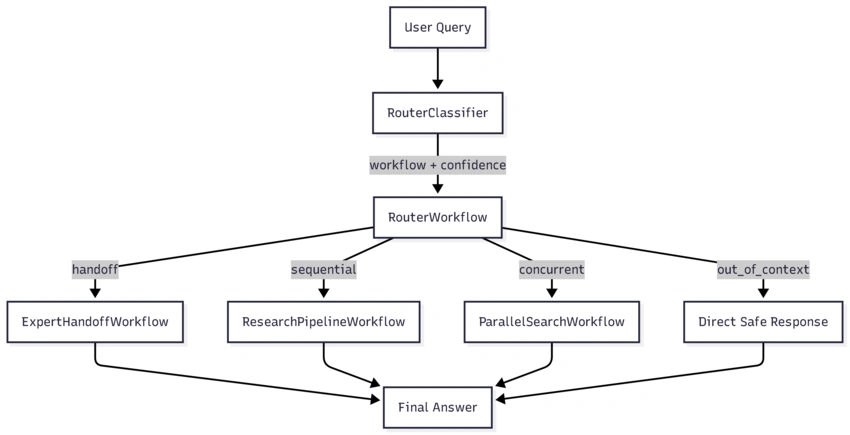
The important thing is the control boundary. The router takes a request, classifies it through model router, and then decides whether to delegate, fall back, or short-circuit the request safely.
That keeps routing policy separate from content generation.
Production Routing Contract
RouterWorkflow enforces deterministic behavior:
| Rule | Behavior |
|---|---|
| Confidence threshold | Route as classified when confidence >= 80 |
| Transient classifier error | Retry before fallback |
| Retry exhaustion | Fallback to sequential |
| Unknown workflow label | Fallback to sequential |
| out_of_context label | Return safe direct response path |
This keeps routing predictable under both model and infrastructure instability.
Metadata Contract for Observability
RouterWorkflow preserves both classification intent and executed path in workflow metadata.
| Field | Meaning |
|---|---|
| classified_workflow | Raw classifier label |
| routed_workflow | Final executed workflow after policy or fallback |
| classifier_status | Classifier outcome state |
| classifier_attempts | Retry count |
| fallback_reason | Deterministic explanation when fallback occurs |
The router uses a quantitative confidence score. Scores below 80 degrade to sequential for safer coverage while still preserving the classified route for audit.
{"route": "sequential","confidence_score": 84,"reason": "Mixed request with retrieval and summarization needs"}The exact shape is not the point. The point is that the router emits a structured decision, not a free-form guess.
Code Walkthrough: Router Policy in Python
The implementation in src/workflows/router.py keeps routing policy explicit and testable. Three constants define the operational defaults:
_CLASSIFIER_MAX_ATTEMPTS = 3
_CLASSIFIER_RETRY_DELAY_SECONDS = 0.6
_MIN_ROUTING_CONFIDENCE_SCORE = 80
That means classifier reliability and fallback are policy-controlled in code, not hidden behind prompt wording. When transient failures occur, the router retries, then degrades deterministically to sequential while preserving fallback metadata.
for attempt in range(1, _CLASSIFIER_MAX_ATTEMPTS + 1):
  try:
    classification = await self._classifier.classify(query)
    return RouterOutcome(...)
  except (...):
    if attempt < _CLASSIFIER_MAX_ATTEMPTS and self._is_retryable_classifier_error(exc):
      await asyncio.sleep(_CLASSIFIER_RETRY_DELAY_SECONDS)
      continue
    break
Confidence gating is also explicit in code, not hidden in prompts:
def _resolve_workflow_decision(self, router_outcome: RouterOutcome) -> WorkflowType:
        decision = router_outcome.classification.workflow
        score = router_outcome.classification.confidence_score

        if score is None:
            router_outcome.fallback_reason = router_outcome.fallback_reason or "missing_confidence_score"
            return _LOW_CONFIDENCE_FALLBACK
        if score < _MIN_ROUTING_CONFIDENCE_SCORE:
            router_outcome.fallback_reason = router_outcome.fallback_reason or "low_confidence_score"
            return _LOW_CONFIDENCE_FALLBACK

        if decision in self._workflow_factories:
            return decision

        router_outcome.fallback_reason = router_outcome.fallback_reason or "unknown_workflow"
        return WorkflowType.SEQUENTIAL
Code Walkthrough: Classifier Contract
In src/agents/router_classifier.py, the classifier prompt requires compact JSON with strict fields and no extra text:
{
  "workflow": "sequential" | "concurrent" | "handoff" | "out_of_context",
  "confidence_score": 0..100,
  "reason": "short explanation"
}
The parser enforces defaults safely:
unknown or invalid workflow values degrade to
sequentialmalformed JSON is tolerated and does not crash routing
confidence is normalized to an integer score
That combination keeps the classifier useful even when output format varies.
Tracing and Span Correlation
Two spans are central for troubleshooting a routing decision end-to-end:
router.classifier.classifyinrouter_classifier.py(classifier call path)router.workflow.selectinrouter.py(final routing policy selection)
The workflow-selection span captures the decision context needed for RCA:
router.classified_workflowrouter.routed_workflowrouter.confidence_scorerouter.classifier_statusrouter.classifier_attemptsrouter.fallback_reason
This is why the OTel capture is important. It is not cosmetic telemetry. It is the policy evidence trail.
Quick Start
This sequence keeps startup intent explicit: first tool surface, then router runtime, then connector validation.
1. Start the MCP server (tool surface)
uv run python run_mcp_server.pyWhy: this exposes GraphRAG tools over MCP so routed workflows can call retrieval operations.
2. Start DevUI with router-first execution (workflow surface)
uv run python run_devui.pyWhy: this is the fastest way to inspect routing decisions, workflow events, and execution flow in one place.
3. Optional: start connector endpoint (chat surface)
uv run python run_router_chatbot.pyWhy: this exposes /api/messages for Teams or Agents Playground integration backed by RouterWorkflow.
4. Optional: validate from Microsoft 365 Agents Playground
Install CLI:
winget install agentsplaygroundor
npm install -g @microsoft/m365agentsplaygroundRun against local connector endpoint:
agentsplayground -e http://localhost:3978/api/messages -c msteamsWhy: this validates the connector path independently from DevUI, which is useful for channel integration checks.
Workflow Surface Alignment
uv run python run_devui.py is the interactive runtime surface. Router remains the production default workflow, while sequential and concurrent patterns are retained for debugging and targeted validation.
For Teams or Agents Playground compatibility, run_router_chatbot.py exposes a connector-oriented endpoint at /api/messages backed by RouterWorkflow.
These two surfaces are independent.
Use DevUI when you want to inspect the workflow graph, the events panel, and the live trace for a request. Use Agents Playground when you want to validate the connector surface over the chat endpoint. You do not need both for the same story, and the article should say that clearly.
Testing Workflows and Observability
We can see how the system make decisions.
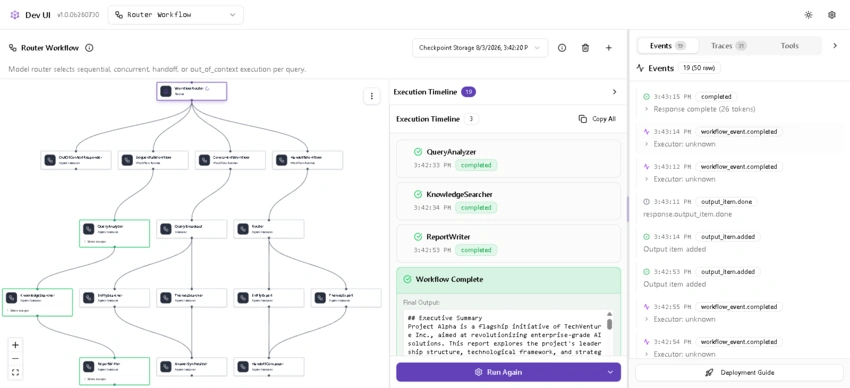
Figure. DevUI router execution view with workflow graph and timeline events.
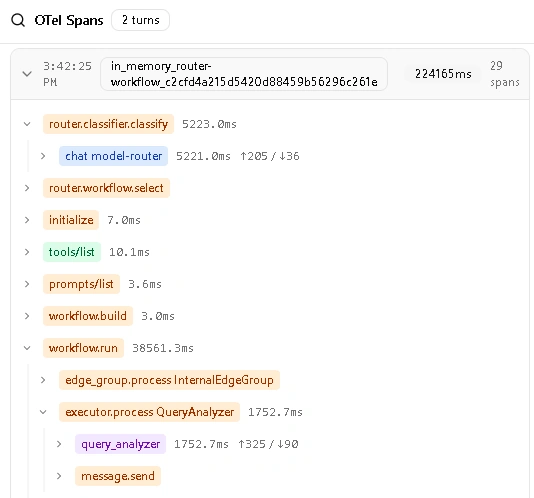
Figure. OTel spans view for the same DevUI turn, showing classifier, workflow selection, and tool activity.
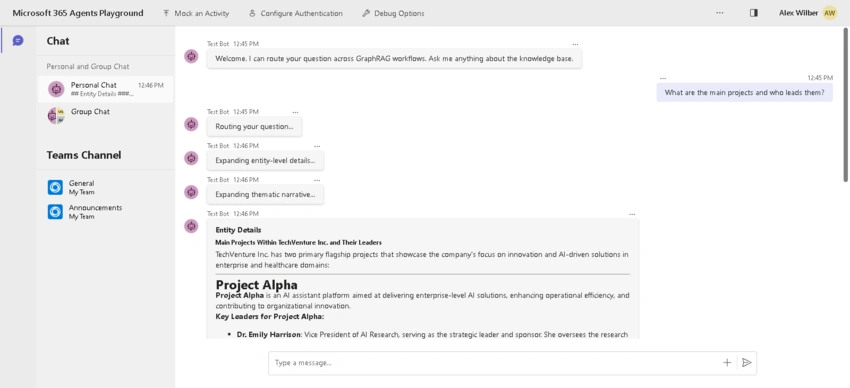
Figure. Microsoft 365 Agents Playground conversation routed through the Part 6 backend.
The DevUI view is the most useful single capture because it shows the workflow graph, the events panel, and the execution timeline together. A second capture of the OTel spans view from the same run makes the evidence stronger because it shows how the classifier call, workflow selection, and tool activity line up across the same turn.
If you include a log excerpt, keep it short and purposeful. The goal is not to dump logs. The goal is to prove that the UI and the backend agree about what happened.
Router classifier invoking chat completions on deployment '<deployment>'
Router classifier received response in 5.22s
Router selected 'sequential' workflow
Retry and fallback behavior is also directly visible when transient errors happen:
Router classifier attempt 1/3 failed (TimeoutError). Retrying in 0.6s.
Router classifier failed after 3 attempt(s). Falling back to sequential workflow.
That combination gives readers a full chain of evidence: the visible flow, the traced execution, and the lower-level log record.
CI Governance and Evaluation Spend
Router evaluation follows a staged policy:
PR path: local-only router checks for merge gating.
Main path: full router batch plus Foundry publish and red-team checks when relevant files changed.
Workflow split:
.github/workflows/ci.yml: core lint/type/test pipeline for push and PR validation..github/workflows/router-evaluation.yml: reusable evaluator workflow for local, Foundry, and optional red-team toggles..github/workflows/router-main-evaluation.yml:main-only workflow that runs full router evaluation with Foundry publish and red-team when relevant files changed..github/workflows/router-pr-merge-gate.yml: required PR gate workflow triggered on PR lifecycle updates and review submissions; expensive router evaluation remains conditional.
This preserves deterministic merge enforcement while reducing unnecessary evaluation spend.
Testing Strategy
tests/agents/test_router_classifier.py validates:
Request payload structure, including the JSON-only response contract and temperature control.
Credential handling for API key versus Azure CLI token provider path.
Workflow parsing, confidence normalization, and reason extraction.
Metadata overrides when the Foundry response includes router annotations.
Error handling when the router deployment rejects or fails the request.
tests/workflows/test_router.py validates router orchestration behavior:
Unknown classifier labels degrade to
sequentialwhile preserving classified versus routed workflow metadata.Transient classifier failures retry and recover without manual intervention.
Non-retryable classifier failures degrade to
sequentialwith explicit fallback metadata.
The tests do not just verify that the system responds. They verify that the router still tells the truth about how it responded.
Common Operational Pitfalls
| Pitfall | Typical symptom | Practical mitigation |
|---|---|---|
| Router deployment mismatch | Classifier errors or low-confidence bursts | Validate deployment names, endpoint, and parser contract |
| Unknown workflow labels | Inconsistent behavior across requests | Enforce deterministic sequential fallback |
| Over-routing unsupported queries | Unnecessary retrieval calls | Keep out_of_context as a first-class route |
| Missing decision metadata | Difficult RCA after regressions | Persist classified and routed workflow fields |
| Unscoped expensive CI checks | Avoidable credit burn | Keep PR local gate and main full-eval split |
Practical Release Guidance
Treat router promotion as a policy rollout, not only a model rollout.
Use this release lens:
Routing correctness: classified versus routed workflow consistency.
Fallback stability: retries and deterministic degradation behavior.
Operational traceability: metadata and logs sufficient for RCA.
Cost discipline: staged CI checks aligned with branch lifecycle.
Key Takeaways
Part 6 makes
RouterWorkflowthe production control plane for orchestration.Reliability comes from explicit policy, not implicit model behavior.
out_of_contextrouting is essential for safe and efficient traffic handling.Step-level metadata is non-negotiable for debugging and auditability.
Stage-aware CI governance balances quality evidence with evaluation spend.
What Comes Next
Part 7 can build on this foundation by adding conversational session readiness:
session-aware routing context
memory-safe turn handling
session-level diagnostics tied to router decisions
Part 8 can then add human-in-the-loop approval checkpoints on top of the same router policy surface.
Reference Material
Microsoft Learn: Model router for Microsoft Foundry
Project repository: cristofima/maf-graphrag-series
Part 6 implementation notes: part6-implementation-notes.md
Join the conversation! Your thoughts help the community grow.