

In the enterprise, Large Language Model (LLM) applications are no longer just experimental chatbots; they are mission-critical systems integrated into daily workflows. However, relying on a single, massive LLM endpoint (like GPT-4o or Claude 3 Opus) introduces significant risks: rate limits, unexpected downtime, latency spikes, and spiraling costs.
When your primary LLM degrades, your enterprise RAG (Retrieval-Augmented Generation) application shouldn't crash. It should gracefully degrade.
In this end-to-end guide, we will explore how to implement robust fallback mechanisms—specifically model cascading (falling back to smaller models) and rule-based logic (bypassing the LLM entirely)—using LangGraph to build a highly resilient Enterprise RAG application.
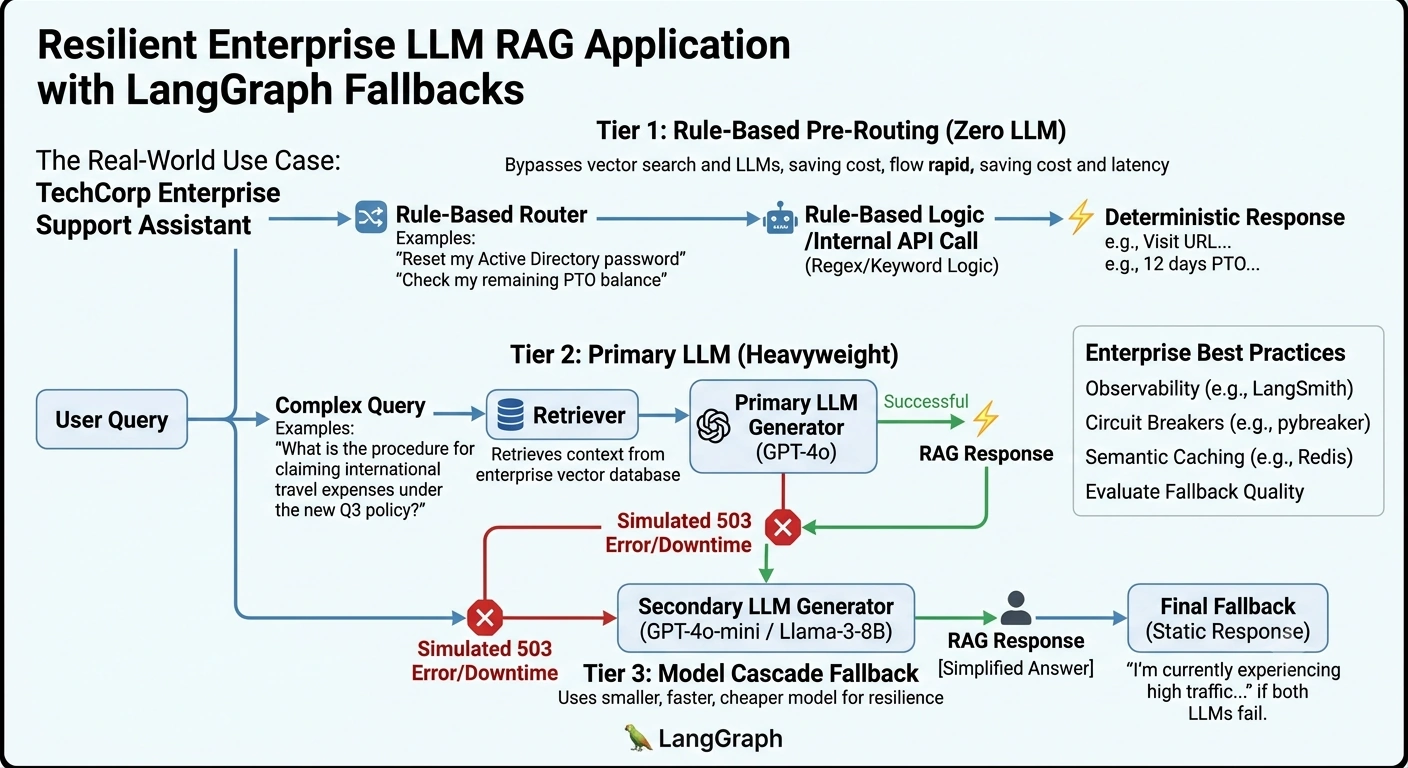
The Real-World Use Case: TechCorp Enterprise Support Assistant
Imagine you are building an internal AI assistant for TechCorp, a company with 10,000 employees. The assistant handles:
Complex Queries: "What is the procedure for claiming international travel expenses under the new Q3 policy?" (Requires deep RAG and complex reasoning).
Deterministic Tasks: "Reset my Active Directory password" or "Check my remaining PTO balance." (Requires zero LLM reasoning; just API calls and rule-based routing).
The Fallback Strategy
To ensure 99.9% availability and optimize costs, we will implement a three-tier resilience strategy:
Tier 1: Rule-Based Pre-Routing (Zero LLM): If the user asks for a password reset or PTO balance, regex/keyword logic intercepts the query, triggers the respective internal API, and returns the result. No LLM or vector search is used.
Tier 2: Primary LLM (Heavyweight): For complex RAG queries, we use a high-capability model (e.g., GPT-4o) to synthesize retrieved documents.
Tier 3: Secondary LLM (Lightweight Fallback): If the primary LLM times out, hits a rate limit, or throws an error, LangGraph automatically routes the exact same retrieved context to a smaller, faster, and cheaper model (e.g., GPT-4o-mini or Llama-3-8B).
Architecting the Solution with LangGraph
LangGraph is the perfect framework for this because it allows us to model our application as a stateful, multi-actor graph with conditional edges. We can explicitly define the "failure" states and route the flow dynamically.
Step 1: Define the Graph State
First, we define the state that will be passed between our nodes. It needs to track the user query, retrieved context, the final response, and the status of our LLM calls.
from typing import TypedDict, List, Optional
from langgraph.graph import StateGraph, END
import re
import random

class AgentState(TypedDict):
    query: str
    context: List[str]
    response: str
    llm_status: str  # "success", "primary_failed", "secondary_failed"
    is_deterministic: bool
    deterministic_result: Optional[str]
Step 2: Build the Nodes
Now, we create the individual functions (nodes) that will perform the work.
Node 1: Intent Router (Rule-Based Fallback)
This node checks if the query matches deterministic patterns. If it does, we bypass the LLM entirely.
def rule_based_router(state: AgentState) -> AgentState:
    query = state["query"].lower()

    # Rule-based logic for deterministic tasks
    if "reset password" in query or "ad password" in query:
        return {
            "is_deterministic": True,
            "deterministic_result": "Please visit https://techcorp.internal/reset-password to reset your AD password.",
            "response": ""
        }
    elif "pto" in query or "vacation balance" in query:
        # In a real app, this would call an HR API
        return {
            "is_deterministic": True,
            "deterministic_result": "You have 12 days of PTO remaining for this year.",
            "response": ""
        }

    return {"is_deterministic": False, "deterministic_result": None}
Node 2: Retriever
If the query isn't deterministic, we retrieve context from our enterprise vector database.
def retrieve_context(state: AgentState) -> AgentState:
    # Mocking vector database retrieval
    print("  Retrieving context from Vector DB...")
    mock_docs = [
        "TechCorp Q3 Travel Policy: International flights must be booked 14 days in advance.",
        "Expenses over $500 require pre-approval from the Department Head."
    ]
    return {"context": mock_docs}
Node 3: Primary LLM Generator
This node attempts to generate an answer using the primary, high-capability model. We wrap it in a try-except block to simulate endpoint degradation.
def generate_primary(state: AgentState) -> AgentState:
    print("Attempting generation with Primary LLM (GPT-4o)...")

    # SIMULATION: Randomly fail the primary LLM to demonstrate fallback
    if random.choice([True, False]):
        print("Primary LLM endpoint degraded (Simulated 503 Error).")
        return {"llm_status": "primary_failed", "response": ""}

    # Mock successful generation
    context_str = "\n".join(state["context"])
    response = f"Based on the Q3 policy: {context_str}"
    return {"llm_status": "success", "response": response}
Node 4: Secondary LLM Generator (Model Cascade Fallback)
If the primary model fails, this node uses a smaller, more resilient model.
def generate_secondary(state: AgentState) -> AgentState:
    print("Falling back to Secondary LLM (GPT-4o-mini / Llama-3-8B)...")

    # Smaller models are less likely to hit strict rate limits and have lower latency
    context_str = "\n".join(state["context"])
    response = f"[Simplified Answer] Policy summary: {context_str}"

    return {"llm_status": "success", "response": response}
Node 5: Final Fallback (Static Response)
If both LLMs fail, we return a polite, hardcoded message rather than crashing.
def static_fallback(state: AgentState) -> AgentState:
    print("All LLMs failed. Triggering static fallback.")
    return {
        "llm_status": "secondary_failed",
        "response": "I'm currently experiencing high traffic. Please contact IT support at [email protected] or try again later."
    }
Step 3: Define Routing Logic (Conditional Edges)
This is where LangGraph shines. We define the logic that dictates how the graph flows based on the state.
def route_after_router(state: AgentState) -> str:
    if state.get("is_deterministic"):
        return "end_deterministic"
    return "retrieve"

def route_after_primary(state: AgentState) -> str:
    if state["llm_status"] == "primary_failed":
        return "try_secondary"
    return "end"

def route_after_secondary(state: AgentState) -> str:
    # Assuming secondary always succeeds in this mock, but in reality,
    # you could check for failure here and route to static_fallback.
    return "end"
Step 4: Compile the LangGraph
Now, we wire the nodes and edges together into a compiled graph.
def build_rag_graph():
    workflow = StateGraph(AgentState)

    # Add Nodes
    workflow.add_node("router", rule_based_router)
    workflow.add_node("retriever", retrieve_context)
    workflow.add_node("primary_llm", generate_primary)
    workflow.add_node("secondary_llm", generate_secondary)
    workflow.add_node("static_fallback", static_fallback)

    # Set Entry Point
    workflow.set_entry_point("router")

    # Add Edges
    workflow.add_conditional_edges(
        "router",
        route_after_router,
        {
            "retrieve": "retriever",
            "end_deterministic": END
        }
    )

    workflow.add_edge("retriever", "primary_llm")

    workflow.add_conditional_edges(
        "primary_llm",
        route_after_primary,
        {
            "try_secondary": "secondary_llm",
            "end": END
        }
    )

    workflow.add_edge("secondary_llm", END)

    return workflow.compile()

# Initialize the graph
app = build_rag_graph()
Running the Application
Let's test our resilient RAG application with two different types of queries.
Test 1: The Deterministic Query (Rule-Based Fallback)
query1 = "I forgot my password, how do I reset it?"
result1 = app.invoke({"query": query1, "context": [], "response": "", "llm_status": "", "is_deterministic": False, "deterministic_result": None})

print(f"\nUser: {query1}")
print(f"Bot: {result1['deterministic_result']}")
Notice that the retriever and LLMs were completely bypassed, saving latency and compute costs.
Test 2: The Complex RAG Query (Model Cascade Fallback)
query2 = "What is the rule for booking international flights?"
result2 = app.invoke({"query": query2, "context": [], "response": "", "llm_status": "", "is_deterministic": False, "deterministic_result": None})

print(f"\nUser: {query2}")
print(f"Bot: {result2['response']}")
Enterprise Best Practices for LLM Fallbacks
Implementing this graph is only the first step. To run this in a true enterprise environment, consider the following:
Observability is Mandatory: Integrate LangSmith or Arize Phoenix. When a fallback occurs, you need to trace why the primary model failed (e.g., was it a timeout, a content filter block, or a rate limit?).
Circuit Breakers: Don't just rely on try/except blocks. Implement a circuit breaker pattern (using libraries like
pybreaker). If the primary LLM fails 5 times in 10 seconds, automatically route all traffic to the secondary model for 60 seconds without even attempting the primary call.Semantic Caching: Before hitting the LLM at all, check a Redis semantic cache. If an identical or highly similar question was answered 5 minutes ago, return the cached response. This acts as a "Tier 0" fallback.
Evaluate Fallback Quality: Smaller models (like Llama-3-8B or GPT-4o-mini) might hallucinate more on complex RAG tasks. Regularly evaluate the secondary model's output using RAGAS or TruLens to ensure the degraded experience is still acceptable for the user.
Conclusion
Building enterprise-grade AI isn't just about achieving the highest accuracy on a benchmark; it's about building systems that are resilient, observable, and cost-effective. By leveraging LangGraph, we can elegantly orchestrate complex fallback mechanisms. We bypass the LLM entirely for deterministic tasks using rule-based logic, and we protect our users from downtime by cascading to smaller, faster models when our primary endpoints degrade. This ensures that your Enterprise RAG application remains a reliable partner to your employees, regardless of what happens in the cloud.
Join the conversation! Your thoughts help the community grow.