

Multi-tenant SaaS architecture allows a single software platform to serve multiple customers while keeping their data, configuration, users, and resources appropriately isolated.
For development teams, however, multi-tenancy introduces architectural challenges that don't exist in the same way in a traditional single-tenant application.
How should tenant data be isolated? Which database model should be used? How should authentication identify the tenant? How can the application scale as tenant workloads increase? And how can engineering teams monitor and deploy the platform reliably?
When building a multi-tenant SaaS application with .NET and Angular, these decisions need to be considered as part of the architecture rather than added later.
1. Understanding Multi-Tenancy
In a multi-tenant application, multiple customers—known as tenants—use the same SaaS platform while their data, configuration, and resources remain logically or physically separated.
The tenancy model determines how that separation is implemented.
Three common approaches are:
Shared Database, Shared Schema
All tenants share the same database and schema. Tenant-specific records are typically distinguished using a TenantID or similar tenant identifier.
This approach can be economical when supporting a large number of smaller tenants, but the application must enforce tenant filtering consistently across queries and operations.
Shared Database, Separate Schema
Each tenant receives a separate schema within a shared database.
This provides stronger data separation while still allowing infrastructure and database resources to be shared.
Separate Database per Tenant
Each tenant receives its own database.
This provides the highest level of database isolation and can be useful for larger enterprise customers or workloads with strict compliance requirements, although it increases provisioning and operational complexity.
There is no universal tenancy model. The decision should consider tenant size, security, compliance, performance, scalability, and operating cost.
2. Tenant Isolation in .NET and Angular
Tenant isolation is one of the most important security considerations in a multi-tenant SaaS platform.
At the .NET application layer, tenant-aware middleware and authorization controls can establish the tenant context for incoming requests. That context can then be used by services and database operations to ensure that data access remains tenant-specific.
For example, the application flow can conceptually look like:
Request → Identify Tenant → Validate User → Authorize → Execute Tenant-Scoped Operation
The tenant context should be consistently available throughout the request lifecycle.
At the data layer, stronger physical separation can be implemented through separate schemas or databases. Entity Framework can support dynamic connection selection based on the tenant context where the architecture requires it.
Angular also has an important role.
Route guards and tenant-aware state management can help ensure that users only see the navigation options and data associated with their tenant.
The objective is to prevent both accidental and malicious cross-tenant data exposure.
3. Designing the Database Layer
Database architecture directly affects the performance, security, scalability, and operational cost of a SaaS platform.
When using .NET, the application can work with database technologies such as SQL Server, Azure SQL, PostgreSQL, and other relational platforms.
A multi-tenant database strategy should address several areas:
Performance
High-volume tenants can create "noisy neighbor" problems in shared environments. Indexing, caching, partitioning, or moving high-volume tenants to dedicated resources can help maintain predictable performance.
Automated Provisioning
If tenants are provisioned manually, operational effort increases as the customer base grows.
Infrastructure and database automation can help create schemas, databases, and required resources consistently during tenant onboarding.
Security
Encryption at rest and in transit should be treated as baseline requirements. Managed database services can also reduce operational overhead around backups, patching, and failover.
Scalability
The database architecture should anticipate future tenant growth. Partitioning and sharding strategies may become important as tenant data volumes increase.
4. Tenant-Aware Authentication and Authorization
Authentication becomes more complex when a single SaaS application supports multiple organizations.
The application needs to establish not only who the user is, but also which tenant the user belongs to and what that user is allowed to access.
A secure implementation can combine:
Identity providers
Multi-factor authentication
JWT tokens
OAuth 2.0
OpenID Connect
Role-Based Access Control
Angular route guards
Tenant and user information can be propagated through claims so that backend services can make authorization decisions for each request.
A simplified request flow could be:
User → Identity Provider → Token → Tenant Context → Authorization → Tenant Resource
This approach helps reduce the risk of privilege escalation and unauthorized access.
5. Scaling a Multi-Tenant SaaS Application
Scalability becomes increasingly important as the number of tenants and their workloads grow.
A few architectural patterns can help.
Stateless Services
Stateless APIs make it easier to distribute requests across multiple application instances.
Distributed caching technologies such as Redis can be used where appropriate to reduce repeated database operations and improve response times.
Containerization and Microservices
Docker and Kubernetes can allow individual workloads to scale independently.
This can be particularly useful when different parts of the SaaS platform experience different workload patterns.
Auto-Scaling
Cloud services such as Azure App Services and AWS ECS can dynamically increase or decrease resources based on demand.
The objective is not simply to add infrastructure, but to make sure the application architecture can use additional capacity efficiently.
6. Monitoring and Observability
A multi-tenant environment requires visibility at both the platform level and tenant level.
Centralized logging can be implemented using tools such as Serilog and ELK, while Application Insights and Azure Monitor can provide application and infrastructure telemetry.
Useful metrics can include:
Tenant usage
API response times
Application errors
Resource consumption
Database performance
SLA-related metrics
User experience issues
Proactive alerts can then identify abnormal behavior before it becomes a larger operational problem.
Angular applications can also incorporate client-side monitoring to identify UI errors, navigation failures, and performance bottlenecks.
For a multi-tenant platform, observability should answer an important question:
Which tenant is experiencing the problem, and what part of the platform is causing it?
7. DevOps and Automation
As tenant numbers increase, manual operations become increasingly difficult to maintain.
Infrastructure as Code can make environment provisioning repeatable and auditable.
CI/CD pipelines can automate the build, test, and deployment process across both the .NET backend and Angular frontend.
Automated testing should also cover tenant-specific scenarios, including:
Integration testing
Security testing
Load testing
Tenant isolation testing
Regression testing
These practices help reduce manual errors and allow development teams to release changes more consistently.
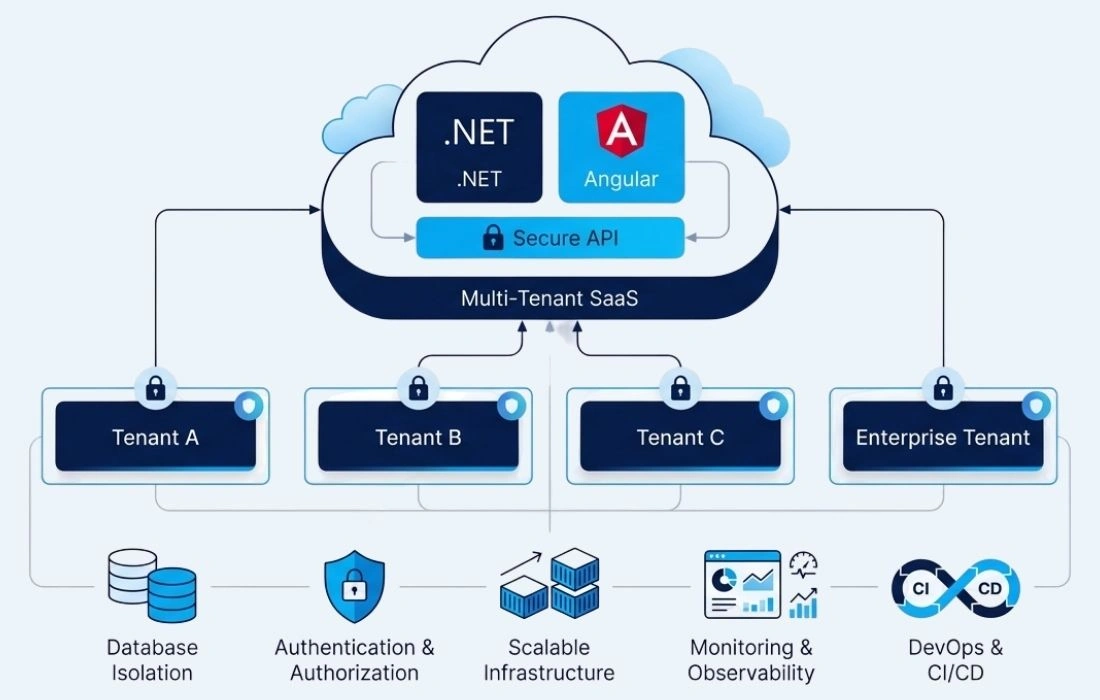
Putting the Architecture Together
A production-ready multi-tenant SaaS platform requires these components to work together:
Tenant Context
↓
Authentication & Authorization
↓
Tenant-Aware Application Services
↓
Database Isolation Strategy
↓
Scalable Infrastructure
↓
Monitoring & Observability
↓
Automated DevOps
The important point is that multi-tenancy is not a single feature.
It is an architectural strategy that affects the application, database, security, infrastructure, monitoring, and deployment layers.
Conclusion
Building a multi-tenant SaaS application with .NET and Angular requires careful planning around tenant isolation, database architecture, authentication, scalability, observability, and automation.
The right architecture depends on the specific requirements of the SaaS product and its customers. A solution designed for thousands of lightweight tenants may require a different strategy from a platform serving a smaller number of enterprise customers with strict compliance requirements.
The goal should be to create an architecture that can scale securely, remain maintainable, and adapt as tenant requirements evolve.
💬 For your next multi-tenant SaaS project, which area would you design first: tenant isolation, database architecture, or authentication?
Join the conversation! Your thoughts help the community grow.