

When building a program structure, sometimes several classes need to exchange information with each other without knowing each other directly. With this, it becomes possible to accompany those classes independently of each other, to expand them easily.
PS: you can download the source code from the repository. Don't forget to star if you like it. :)
public class Subscriber {
    private string _name;
    public Subscriber(string name) {
        this._name = name;
    }
    public void NotifyMe(string filename, string folder) {
        Console.WriteLine($ "{_name}, `{filename}` removed from {folder}");
    }
}
The Observer Design pattern is for implementing the notification, subscription, and process that we encounter in real life. If you can subscribe to any person, or channel on social networks, various sites, and portals, it means that the system uses the Observer design pattern directly or indirectly.
Delegates are one of the most interesting topics encountered while learning .NET/C#, which many people do not fully understand, will be used in this article when establishing a 1-to-1 relationship between classes. So, our program will inform the subscribed object about the changes that occur in it.
The program we will write will monitor any folder in the operating system and if any file in that folder is deleted, it will inform the subscriber about it.
Let's first prepare for the Subscriber class in the program. What this class will do is simply get the name of the deleted file and the folder where the file is deleted via the NotifyMe method and display it on the screen.
Our DirectoryMonitor class starts monitoring the selected directory through the StartMonitoring() method. If one or more files in the folder are deleted, our GetDeletedFiles() method gives us information about it.
public class DirectoryMonitor {
    private readonly List < string > _filesInFolder;
    public string MonitoredDirectory {
        get;
        private set;
    }
    public DirectoryMonitor(string foldernameToMonitor) {
        MonitoredDirectory = foldernameToMonitor;
        _filesInFolder = new List < string > ();
    }
    ///
    /// Check if we can monitor given folder from ctor..
    ///
    ///
    public bool StartMonitoring() {
        if (!Directory.Exists(MonitoredDirectory)) {
            return false;
        }
        var directoryInfo = new DirectoryInfo(MonitoredDirectory);
        foreach(var fileInfo in directoryInfo.GetFiles()) {
            _filesInFolder.Add(fileInfo.FullName);
        }
        return true;
    }
    public List < string > GetDeletedFiles() {
        var result = new List < string > ();
        foreach(var file in _filesInFolder.ToArray()) {
            if (!File.Exists(file)) {
                _filesInFolder.Remove(file);
                result.Add(file);
            }
        }
        return result;
    }
}
Now let's come to the most interesting part. As we can see, neither the Subscriber class nor the DirectoryMonitor class knows about each other. But it will be possible to exchange information between them. For this, we have the FolderMonitorDelegate class. This class contains the DirectoryMonitor class and receives a very interesting parameter from the constructor. This parameter is an Action delegate.
private readonly DirectoryMonitor _directoryMonitor;
private readonly Action < string, string > _subscriber;
public FolderMonitorDelegate(string folderToMonitor, Action < string, string > subscriber) {
    _directoryMonitor = new DirectoryMonitor(folderToMonitor);
    _subscriber = subscriber;................................
}
The template of that delegate matches the template of the NotifyMe() method of the Subscriber class. It is through this delegate that the DirectoryMonitor class will communicate with the Subscriber.
The FolderMonitorDelegate class calls a method to retrieve a list of files in a folder at a specified time interval using the Timer class.
public class FolderMonitorDelegate: IDisposable {
    private readonly Timer _timer;
    private readonly DirectoryMonitor _directoryMonitor;
    private readonly Action < string, string > _subscriber;
    public FolderMonitorDelegate(string folderToMonitor, Action < string, string > subscriber) {
        _directoryMonitor = new DirectoryMonitor(folderToMonitor);
        _subscriber = subscriber;
        if (_directoryMonitor.StartMonitoring()) {
            _timer = new Timer(1000);
            _timer.Elapsed += CheckIfRemoved;
            _timer.Start();
        } else {
            Console.WriteLine("Directory doesn't exists");
            this.Dispose();
        }
    }
    private void CheckIfRemoved(object sender, ElapsedEventArgs e) {
        //get lists of removed files
        foreach(var fileName in _directoryMonitor.GetDeletedFiles()) {
            //notify user about changing in folder..
            _subscriber(fileName, _directoryMonitor.MonitoredDirectory);
        }
    }
    public void Dispose() {
        _timer.Dispose();
    }
}
Now when we use our program, we just need to write something like this.
static void Main(string[] args) {
    //create subscriber
    Subscriber subscriber = new Subscriber("Simon");
    FolderMonitorDelegate folderMonitorDelegate = new FolderMonitorDelegate("C:/mycode", subscriber.NotifyMe);
    Console.ReadLine();
    folderMonitorDelegate.Dispose();
}
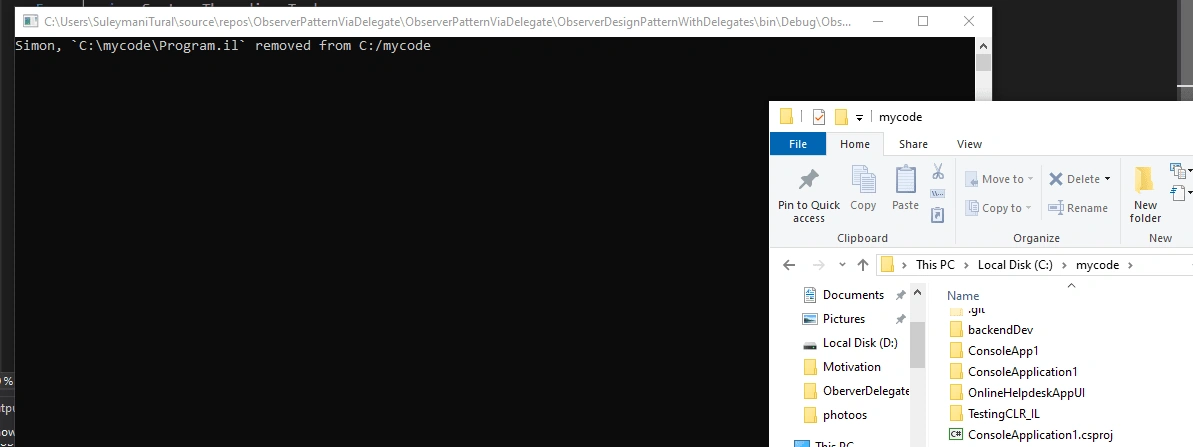
After starting the program, when any file is deleted in the specified folder, the Subscriber is automatically informed in our program and a text about it appears on the screen.
Join the conversation! Your thoughts help the community grow.