
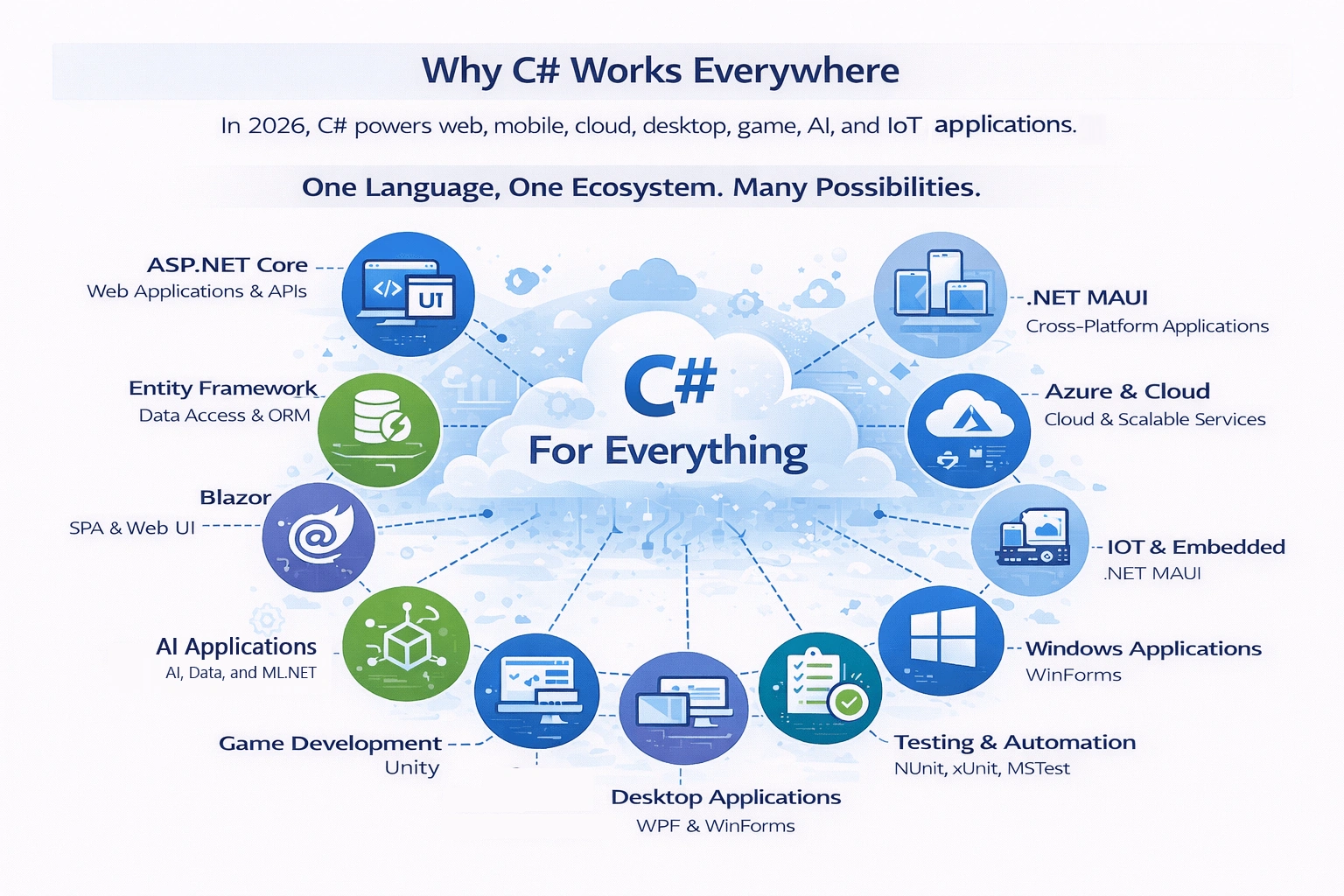
Introduction
C# is no longer "just a backend language."
In 2026, C# sits at the heart of modern application development, powering everything from cloud-native web APIs to mobile apps, desktop software, real-time systems, games, and even machine learning.
The idea of "C# for Everything" isn't marketing hype — it's the reality of a mature, evolving ecosystem built around performance, productivity, and long-term stability.
This article explores how one language, one runtime, and one ecosystem can support almost every type of application developers build today.
Why C# Works Everywhere
C# succeeds across domains because it combines:
Strong typing with modern language features
Excellent performance via the .NET runtime
Cross-platform support
First-class tooling and ecosystem maturity
Backing from Microsoft and a global community
Instead of constantly switching languages, teams can standardize on C# and reuse skills, libraries, and architecture patterns across projects.
C# + ASP.NET Core — Web Applications & APIs
ASP.NET Core is one of the fastest web frameworks available today and the backbone of modern web development with C#.
It enables:
High-performance web applications
RESTful APIs and minimal APIs
Microservices and backend-for-frontend (BFF) architectures
Secure, scalable, cloud-ready systems
Many large-scale systems run millions of requests per second on ASP.NET Core.
With features like dependency injection, middleware pipelines, and OpenTelemetry support, ASP.NET Core makes C# a top choice for production-grade web systems.
C# + Entity Framework — Data Access & ORM
Data remains central to every application.
Entity Framework (EF Core) allows developers to:
Work with relational databases using strongly typed models
Apply LINQ for expressive queries
Handle migrations and schema evolution
Reduce boilerplate data-access code
For many teams, EF Core strikes the right balance between developer productivity and performance.
C# + Blazor — SPA & Web UI Development
Blazor changes how developers think about frontend development.
With Blazor, teams can:
Build SPA and interactive web apps using C#
Share validation, models, and logic between client and server
Avoid context switching between JavaScript-heavy stacks
For C# developers, Blazor enables full-stack development using a single language.
C# + .NET MAUI — Cross-Platform Applications
.NET MAUI allows developers to build:
Android apps
iOS apps
Windows apps
macOS apps
All from one shared C# codebase.
This dramatically reduces development and maintenance cost while enabling consistent UI and business logic across platforms.
C# + Unity — Game Development
C# is one of the most widely used languages in game development thanks to Unity.
With Unity and C#, developers build:
2D and 3D games
AR and VR experiences
Mobile, console, and PC games
The accessibility of C# combined with Unity's tooling makes it a strong choice for both indie developers and large studios.
C# + WPF — Desktop Applications
Despite the rise of web apps, desktop software remains critical in many industries. C# remains one of the best desktop development languages in the world.
WPF enables:
Rich Windows desktop applications
Complex UI workflows
Data binding and MVVM patterns
High-performance enterprise tools
Many mission-critical enterprise applications still rely on WPF — and continue to evolve with .NET.
C# + WinForms — Windows Applications
WinForms remains relevant for:
Legacy modernization
Internal enterprise tools
Rapid UI development
Join the conversation! Your thoughts help the community grow.